Is Georges Seurat's art public domain? A collector's guide
Seurat died in 1891 at thirty-one after only six or seven large canvases. Learn why his work is public domain and why his most famous painting never leaves Chicago.
From the guide to the collection
Explore the Seurat collection → · Shop all art → · Free Seurat wallpapers — the complete paintings at 4K ↓
From the studioSeurat prints — 130+ restored works, curated and annotated →
The smallest catalogue, the biggest picture
Georges Seurat was born in Paris on 2 December 1859 and died there on 29 March 1891, at thirty-one. Between those two dates he completed — depending on which catalogue you trust — six or seven large canvases. That is the entire monumental output of the man who invented a new way of painting. Van Gogh, who outlived his own start by only a decade, left nine hundred paintings; Seurat’s whole career fits in a single room.
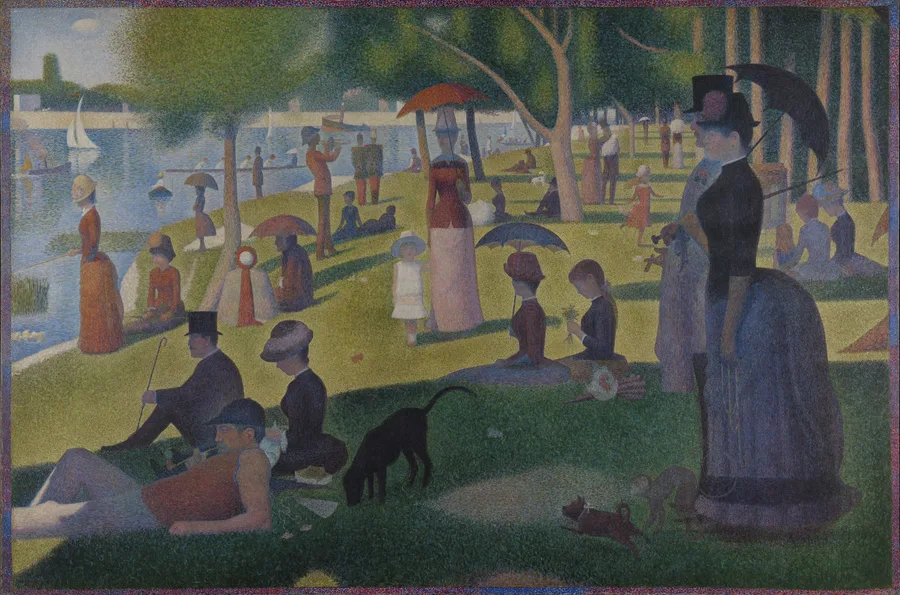
He worked slowly because he worked deliberately. Trained in the academic tradition at the École des Beaux-Arts, he came to believe that colour could be built the way a draughtsman builds tone: small touches of pure pigment set side by side, left for the viewer’s eye to mix at a distance. The method demanded patience that borders on the unreasonable. A Sunday on La Grande Jatte took him about two years, and the preparatory drawings and oil panels for it number in the dozens — the counts in the literature run from around thirty to more than seventy, and either end of that range would be extraordinary for one picture.
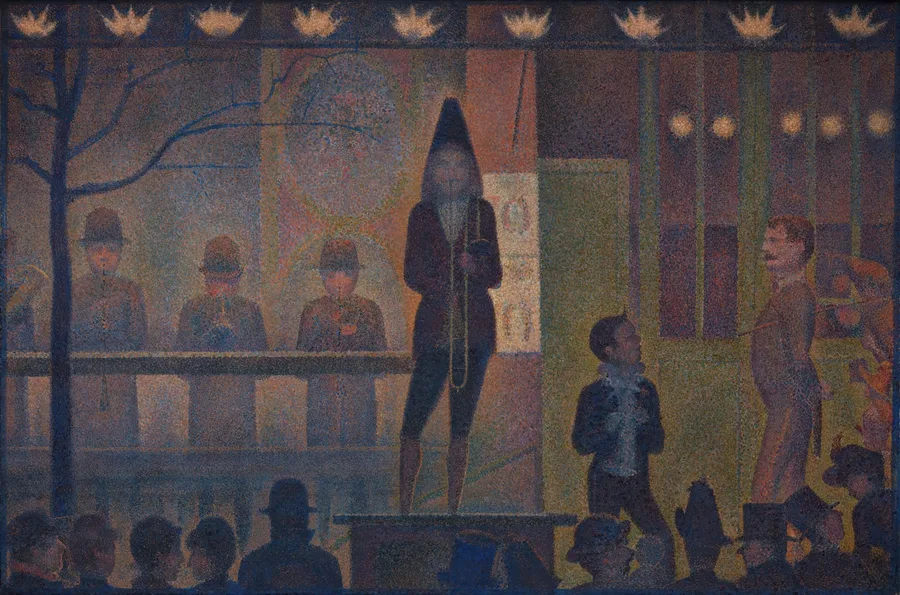
His career began with a door closing. In 1884 the Salon jury rejected Bathers at Asnières, his first large canvas. Rather than resubmit, Seurat joined a group of fellow refusés to found the Société des Artistes Indépendants, an exhibiting society with no jury and no prizes, and showed the Bathers at its first exhibition that summer. Nearly everything he made afterward was seen there first — including the last thing he made. The Circus was still unfinished when he hung it at the Indépendants in March 1891; he died before the exhibition closed.
The death was sudden: a short illness with fever, over in days. No cause was ever established with certainty — meningitis, diphtheria, and infectious angina have all been proposed, and honest biographers leave it open. His infant son died of a similar illness about two weeks later. The painter of the most patient pictures of the nineteenth century was gone almost without warning, nine years before the twentieth began.
The painting that does not travel
What happened to La Grande Jatte afterward is a story collectors should know, because it bears directly on how you can and cannot see the picture.
In 1924 the Chicago collector Frederic Clay Bartlett bought the canvas for $20,000 and placed it with the Art Institute of Chicago, where it has hung ever since. It has left the building once. In 1958 it was lent to the Museum of Modern Art in New York — and while it was there, on 15 April, a fire broke out at MoMA. The painting was carried out unharmed and sheltered at the Whitney, then returned to Chicago under guard, and the Art Institute resolved that it would never travel again. It has not.
So the most famous pointillist painting in the world does not tour. There is no waiting for it to come to a museum near you. Short of a trip to Chicago, a reproduction is the only way this picture comes to your wall — which makes the quality and the provenance of that reproduction worth caring about.
Is Seurat’s art public domain?
Yes — and with Van Gogh, his is about the clearest case that exists.
Most of the world, including the European Union, protects an artwork for the life of the artist plus seventy years. Seurat died in 1891, so under that rule every copyright he held expired by 1961 at the very latest, and in many countries earlier still under the shorter terms that applied historically. The United States runs on a different clock for old works, counting roughly ninety-five years from publication rather than from the artist’s death. Seurat’s entire output predates March 1891, which clears the American bar by several decades, not by a technicality.
There is no estate asserting rights, no late or posthumously published work to argue over, no jurisdiction where a term is still running. Anyone may reproduce, adapt, print, and sell his paintings. The one honest caveat: copyright terms vary by country and change over time, and this page is general information, not legal advice. For an artist dead since 1891 the answer does not move, but if a commercial decision hangs on it, ask a lawyer where you live.
A free painting is not the same as a free file
One distinction matters more than collectors usually realise. The painting — the thing Seurat made — is public domain. A particular digital image of that painting is a separate object with its own history. Museums and image libraries sometimes claim rights or impose contract terms on their photographs of public-domain works, and whatever the legal force of those claims in any given country, the practical lesson holds: you cannot assume that every file circulating online carries the freedom the artwork itself does.
That is why the provenance of the file matters as much as the status of the painting, and why we can say plainly: the restorations we sell are our own work, and we verify the rights status of every individual piece before it is listed.
Seurat in our collection
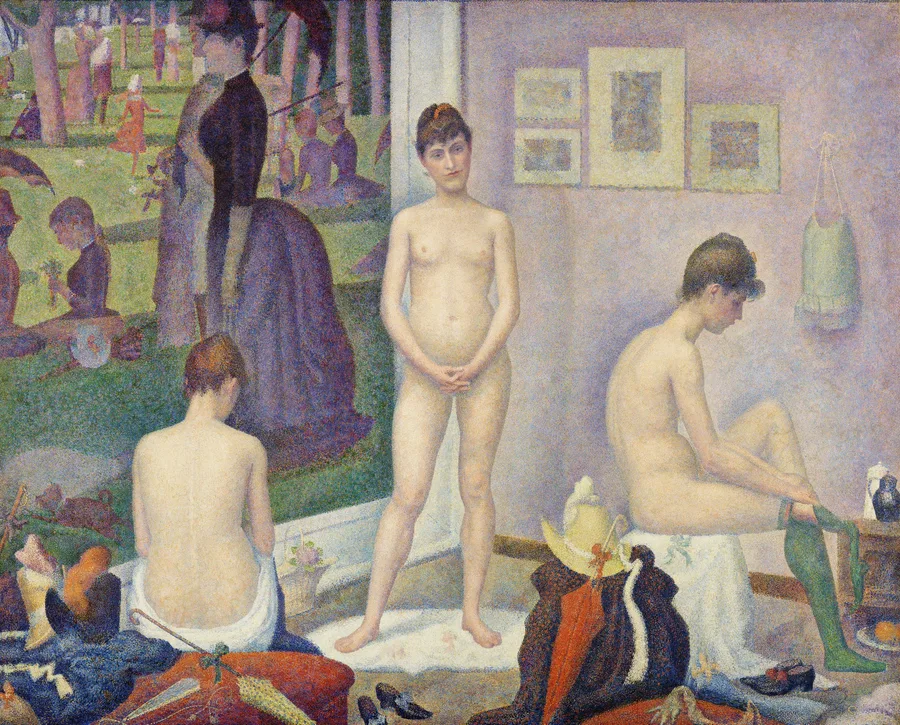
Our Seurat collection is the smallest of the major artists in the shop — over 130 works, which for Seurat is not small at all; it reaches from the dense early woods of The Forest at Pontaubert to the bleached last summer at Gravelines. The seven monuments are here: La Grande Jatte with its border of painted dots intact, Models with its quiet flesh tones, the gaslit murk of Circus Sideshow, the rising lines of Le Chahut, and The Circus, unfinished exactly as he left it. So is Young Woman Powdering Herself — the portrait of Madeleine Knobloch, the companion he kept secret, in which he painted his own reflection into the little mirror and then covered it with a vase of flowers.
Every piece comes in the same four formats: rolled poster, stretched canvas, framed canvas, and framed paper print. The rolled poster suits collectors with a framer they trust; the framed options arrive ready to hang.
A painter who finished six or seven big pictures and died at thirty-one left no room for a casual purchase — every work in this catalogue was, for him, a major commitment. Browse the Seurat collection and take your time choosing; he certainly did.
Editorial record
About this article
- Publisher
- GeMarkt
- Published
Found a claim that needs checking? Report a factual error.