GeMarkt Blog · Practical guide
Ramadan and Eid Art: Islamic Patterns and Calligraphy
Choose meaningful Ramadan and Eid art by understanding calligraphy, distinguishing sacred text from ornament, and matching historical images to the recipient’s home.

For Ramadan or Eid, choose an image whose meaning is welcome in the particular home—not merely one labelled “Islamic”. Calligraphy may contain scripture, a blessing, poetry or other words. Floral and geometric ornament can carry very different histories. Knowing what you are looking at is part of choosing the gift well.
The three historical objects below offer starting points for reproductions, not a prescribed festival style. A manuscript page, an inscribed bowl and an İznik dish are not interchangeable religious symbols, and none is presented here as an item currently stocked in our shop. Their images help you consider wording, pattern, scale and the recipient’s preferences before buying anything.
Begin with the household, not a theme
Ramadan and Eid al-Fitr are related but not the same occasion: Eid al-Fitr marks the end of Ramadan. If you are choosing a gift for a particular celebration, confirm the occasion and preferred greeting rather than assuming a generic seasonal label is sufficient.
Ask one straightforward question: would the recipient enjoy a calligraphic work, a patterned image without text, or something unrelated to the festival that they can keep up all year? A gift can mark an occasion without depicting it. Someone who loves ceramics may prefer a photograph of an old dish to an unfamiliar religious inscription.
There is no single colour scheme or wall arrangement for all Muslim homes. Family practice, language, region and personal taste matter. If sacred text or images of living creatures raise questions for the recipient, let them decide what belongs in their space. This guide offers art-selection advice, not a religious ruling about appropriate display.
Understand a sacred page before choosing it
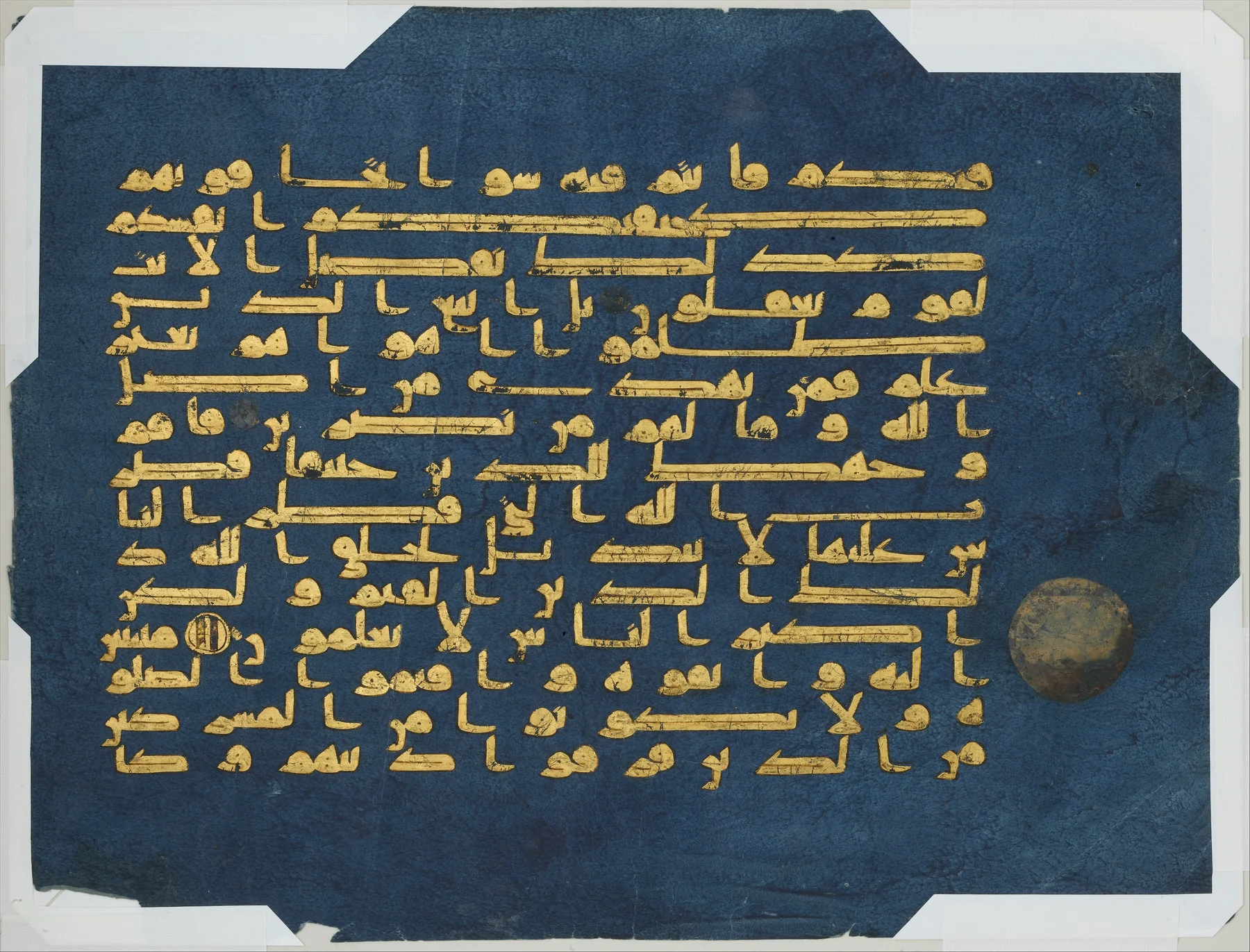
This folio from the Blue Qur’an is a page of scripture, not simply gold lettering on a fashionable blue ground. The Met dates it to the second half of the ninth through the mid-tenth century and places its making in Tunisia, possibly Qairawan. The original is parchment, not blue-painted paper.
The broad horizontal lines are striking, but this is not a sensible choice for someone who wants an easily readable contemporary inscription. The museum explains that the historic lettering lacks marks needed to distinguish certain letters and has been shaped to fill equal-length lines. A fluent reader’s help and a reliable identification are preferable to guessing what a decorative script says.
If considering a reproduction, first establish the passage and whether the recipient wants that passage displayed. Do not crop words to fit a frame, reverse the image to balance another picture, or add an unverified translation. The Met’s calligraphy overview makes the essential distinction: ornamented writing still transmits text. Its appearance does not make its verbal content optional.
A written blessing is a different choice
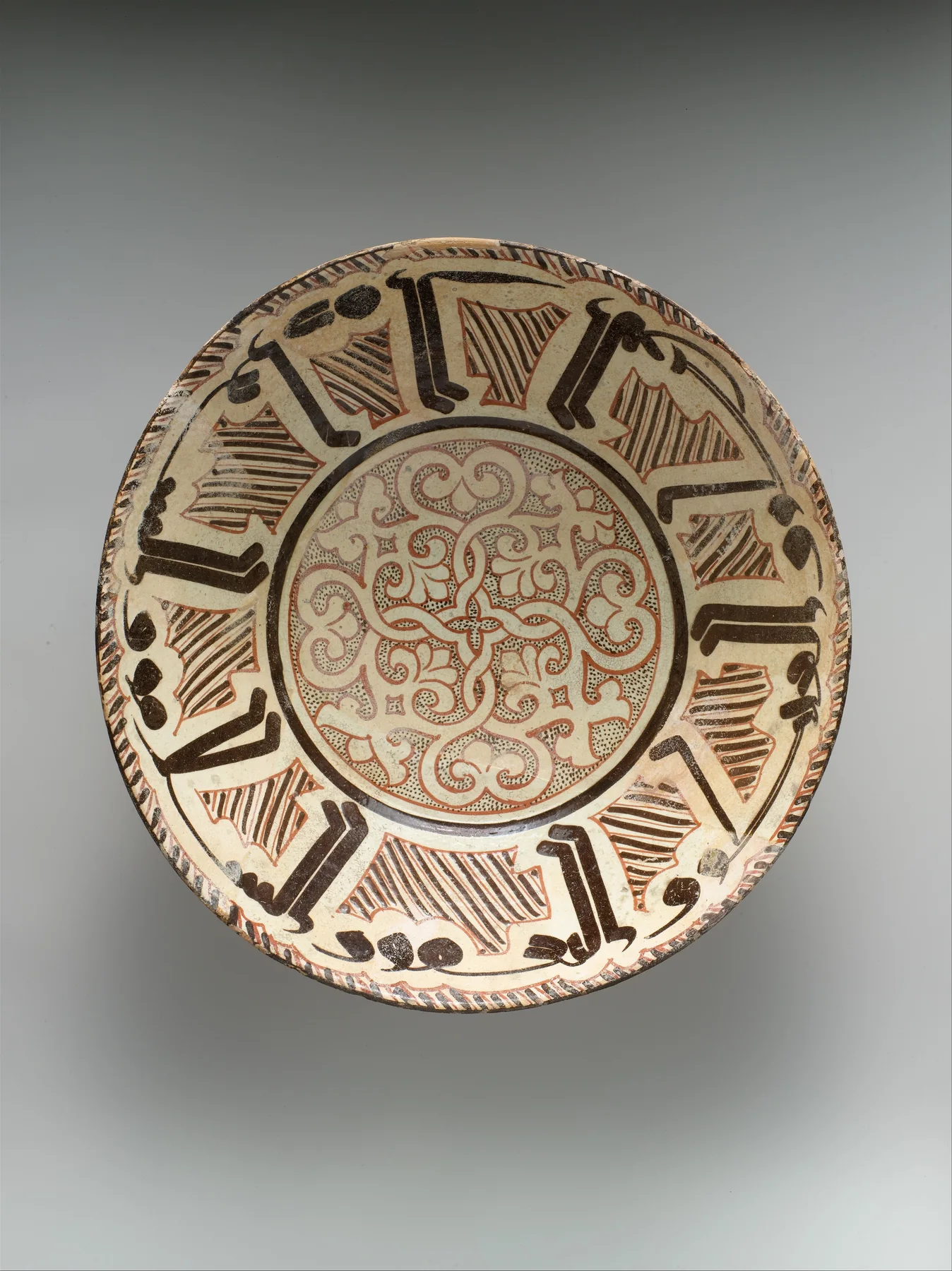
The inscription on this bowl conveys good wishes to its owner. The museum’s account identifies blessings, prosperity and well-being rather than presenting it as a Qur’anic passage. It also notes an incomplete additional word in the design. That detail is a reason to preserve the object’s history, not silently “correct” the lettering in an image editor.
Made probably in Samarqand, in present-day Uzbekistan, and excavated at Nishapur in Iran, the bowl has a more specific identity than a generic “Arabic pattern”. Its dark lettering, pale ground and interlaced centre could appeal to someone who enjoys both ceramics and graphic forms.
A photograph retains the bowl’s curved surface, shadows and worn edges. It is not a flat calligraphic print, and the surrounding photographic background will be part of the reproduction unless explicitly changed. Try a small paper outline near a sideboard rather than assuming that a large enlargement is needed. The circular object can remain visually complete inside a rectangular sheet.
Flowers and pattern with a specific history
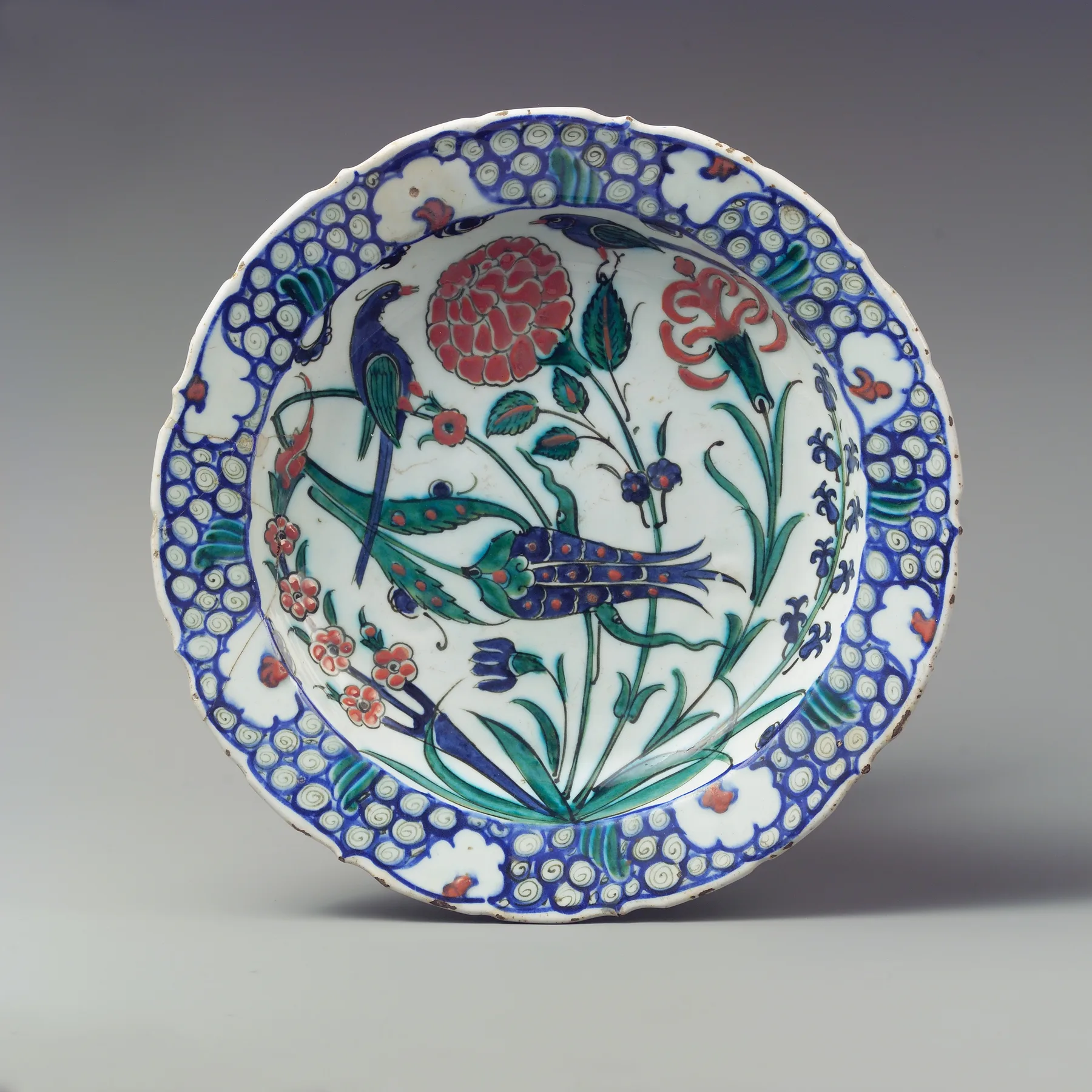
This İznik dish offers colour and plant forms rather than a central inscription. The Met identifies carnation, tulip and hyacinth stems among the birds and dates the object to about 1575–90. It is an Ottoman ceramic, not a documented Ramadan decoration.
Look at the irregular relationship between the flowers and the border. The stems bend through the centre while the rim repeats smaller motifs. On a wall, that combination can work with a simple frame and one colour already present in the room. A blue cushion or green chair is enough of a connection; a full matching set is unnecessary.
The two birds are clearly part of this design. It should not be described as non-figurative ornament or proposed as universally suitable religious décor. If the recipient prefers pattern without living creatures, select a different, properly identified image rather than removing the birds from this object’s photograph. Our Ottoman and Turkish art guide offers a broader domestic starting point without treating one motif as a whole culture.
Make space for the picture and the occasion
Decide whether the art will remain after the gathering. A permanent picture should work with the everyday furniture, not only with temporary table decorations. If it is a seasonal display, think about where the framed item will be stored afterwards before choosing an awkwardly large format.
Measure the complete frame, including its outer moulding. For example, two frames each 35 cm wide with an 8 cm gap occupy 78 cm together. Centred over a 120 cm cabinet, that leaves 21 cm at each side. These are planning numbers, not a rule, a mounting specification or a product listing. Check what will actually sit on the cabinet before deciding the pictures’ positions.
Keep the reading of text in mind too. A distant wall may reduce an inscription to marks. If the words matter to the recipient, a closer viewing position may be better than enlarging the file beyond its useful detail. A room mockup alone cannot establish whether the lettering will remain clear in a particular print.
Give the recipient a real choice
For an art gift, a short conversation can be more thoughtful than a complete surprise. Show two or three candidate images and ask which, if any, they would want to live with. Include the object’s title and meaning, not just a screenshot stripped of its source.
If they prefer calligraphy, confirm both the wording and the language. Do not treat every Arabic-script inscription as Arabic, or assume that a friend can read a historic script because of their religion or family background. For a new commission, request a readable transcription and translation and have any sacred wording checked by someone qualified to do so.
Leave the frame decision open when you do not know the room. An unframed print or a contribution towards a chosen work can be more useful than a large frame that creates storage and installation work. Check the actual seller’s delivery and return conditions; the occasion does not turn an estimated arrival date into a guarantee.
Keep the source with the gift
The three photographs reproduced here are supplied as public-domain images through The Met’s Open Access programme, which uses CC0. That is evidence for these particular files, not a licence for a modern artist’s lettering, a new photograph on another website or a commercial designer’s rearrangement of the motifs.
Keep the museum object link, the accession number and any supplier’s licence with a digital purchase. If giving a download, check whether the recipient may receive the file and arrange their own printing. A personal-use licence is not automatically transferable simply because the gift is free.
Include a short note explaining why you chose the image: its flowers, its careful lettering, its connection to a place, or the recipient’s interest in ceramics. You do not need to assign a religious meaning to every colour. An accurate, welcome picture with a personal reason behind it can mark the occasion and still belong comfortably in the home afterwards.
Editorial record
About this article
- Author
- Publisher
- GeMarkt
- Published
- Reviewed
- Internal source & rights check. Conducted by GeMarkt Research Review. This is an internal editorial check—not independent peer review.
- Source standard
- Buying guide source standardSeparates measured or first-hand evidence from general guidance and keeps practical limits visible.
Found a claim that needs checking? Report a factual error.