GeMarkt Blog · Essay
Impressionism vs Post-Impressionism
Compare Monet, Van Gogh, Caillebotte and Cézanne through four actual paintings. See what changed—and why the two labels overlap.

A bright landscape with visible brushstrokes might be Impressionist—or it might be by Van Gogh, usually called Post-Impressionist. Colour and loose handling alone will not settle the question. Nor will the appealing formula that Impressionists painted what they saw while Post-Impressionists painted what they felt. All these artists selected, arranged and transformed what they saw.
Impressionism names a historical exhibition network as well as tendencies in painting. Post-Impressionism is a later umbrella for several different developments connected to it. Four pictures make that distinction easier to see than a list of dates alone.
The short difference
The Met’s introduction to Impressionism begins with artists exhibiting independently in Paris. Eight group exhibitions took place between 1874 and 1886. Modern life, outdoor light and visible brushwork mattered, but the participants did not all paint alike.
Post-Impressionism was not their replacement club. As the National Galleries of Scotland explains, Roger Fry introduced the term through a London exhibition in 1910. It gathered varied late-nineteenth-century approaches retrospectively. Cézanne’s landscape structure and Van Gogh’s directional brushwork can both sit under that broad name without becoming one method.
Two outdoor scenes, two kinds of movement
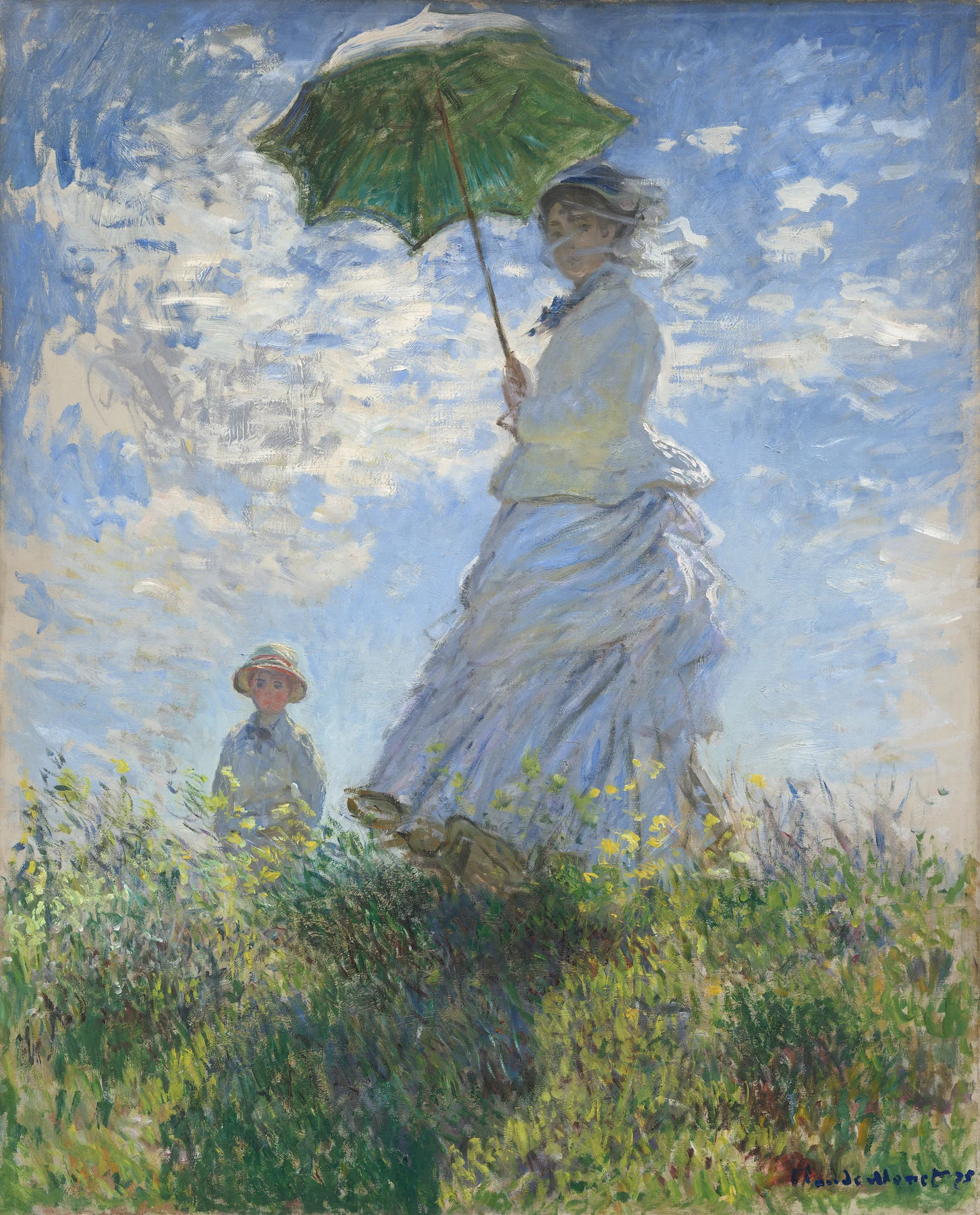
Begin with Monet’s white dress. It is not painted as one uniformly white surface: different patches describe folds, shade and reflected light. The veil, parasol and grass establish different directions. Taken together, they give a still image the feeling of a moment that could change.
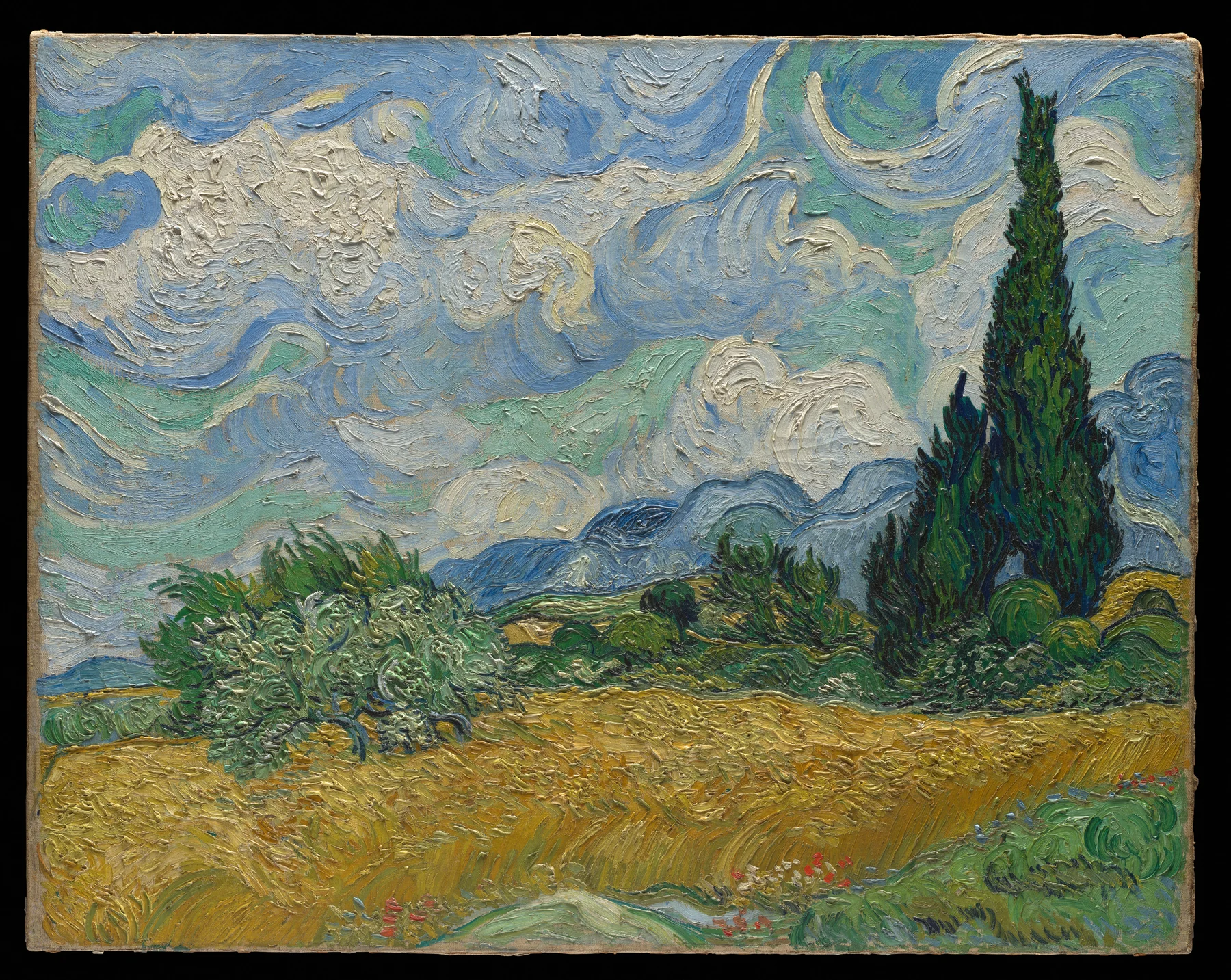
In Van Gogh’s landscape, the marks insist more strongly on their own routes. The wheat bends in repeated strokes; clouds curl across the sky; the cypresses gather dark upward movements. You can read the scene as a landscape and, at the same time, follow it as a network of painted directions.
Follow the brushwork, not a personality story
The difference does not mean that Monet simply recorded nature while Van Gogh invented everything. The Met identifies this wheat field as an on-the-spot study, followed by studio versions. Observation and deliberate organisation coexist in the very example often used to represent personal expression.
Monet’s painting also requires selection. A low viewpoint places the figures against the sky; the parasol makes a broad dark shape near the top. Nothing about visible brushwork removes the need to compose a picture.
Try comparing one small area at a time. In the dress, changing colour helps explain a shifting surface. In the wheat, repeated marks establish a rhythm across a larger band of the canvas. This is a difference you can point to, without guessing either painter’s state of mind.
A city and a mountain complicate the rule
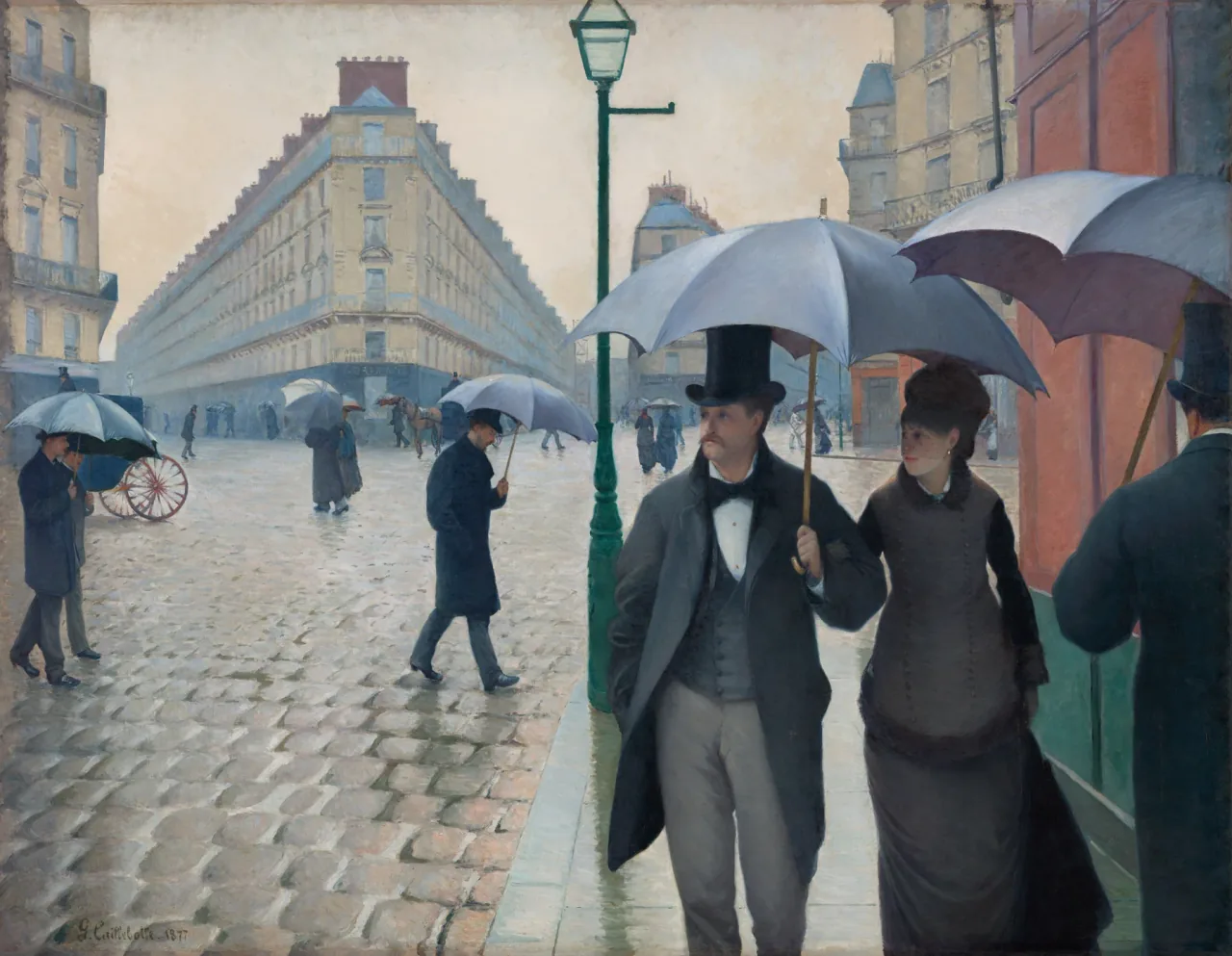
Caillebotte’s street resists the idea that every Impressionist work must look rapidly brushed. The nearest faces and clothes are carefully defined. Paving, façades and the central lamppost organise a convincing depth. Figures cut by the edges suggest that life continues beyond the frame, but the arrangement is anything but shapeless.
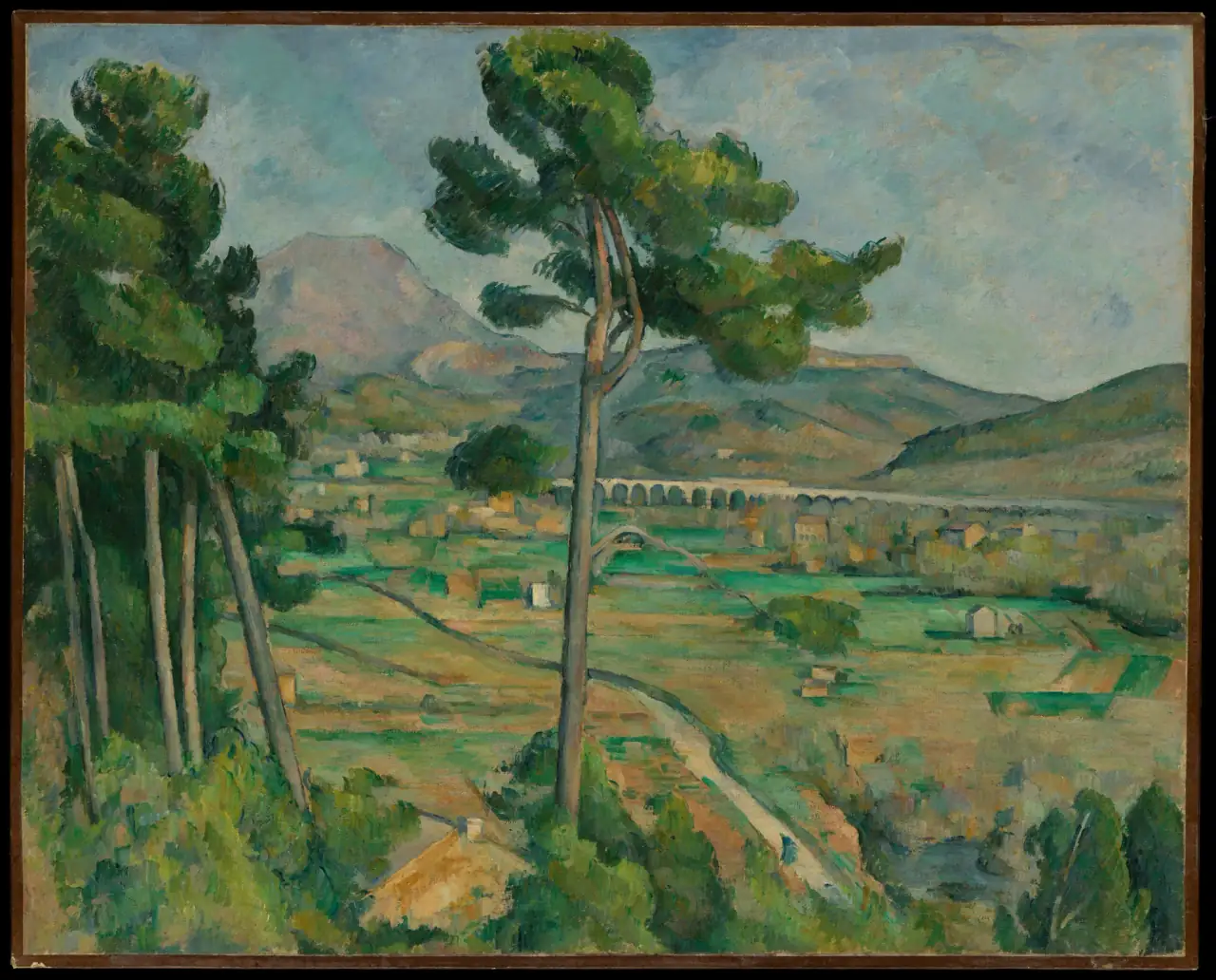
Cézanne offers a different kind of structure. The central tree interrupts the view, while repeated greens and ochres connect near and far. The viaduct supplies a band of arches; the mountain’s slopes answer other angled forms below. The picture asks you to move between a distant place and the coloured patches through which it is built.
Structure was not invented after Impressionism
Here the usual contrast—fleeting Impressionism versus solid Post-Impressionism—needs care. Caillebotte already gives strong architectural order to a contemporary encounter. Cézanne does not erase weather or observation when he concentrates on relationships among forms.
The Met’s account of this particular Cézanne places it near his sister’s property outside Aix and identifies the railway viaduct. It is not a generic mountain assembled merely to demonstrate geometry. A known landscape remains the basis for the experiment.
When you see a simple rule fail, do not discard the whole comparison. Make the rule more precise. Ask what holds this particular picture together: perspective lines, recurring colours, directional strokes, silhouettes, or some combination. That gets you closer to the work than deciding which label is meant to be more advanced.
The dates overlap
Cézanne’s mountain was painted in 1882–85, before the last Impressionist group exhibition. Van Gogh’s wheat field came later, but Monet continued painting after it. The word “post” does not mean that Impressionism stopped one day and its successor began the next.
There were also shared exhibitions and relationships. The Met’s Impressionism overview includes Cézanne among the exhibitors and Seurat in the final exhibition of 1886. Historical categories can describe diverging practices among artists who still occupied connected worlds.
For a wider account of the original exhibitions and their variety, see Impressionism: the painters who chased light.
Not one Post-Impressionist method
The Met’s Post-Impressionism overview brings together artists whose differences are essential to the category: Cézanne, Van Gogh, Gauguin and Seurat, among others. You would not expect their paintings to share one brushstroke simply because a later exhibition history groups them together.
Seurat’s small divided marks are not Van Gogh’s sweeping contours. Gauguin’s broad colour areas are not Cézanne’s interlocking patches. The umbrella is useful for tracing alternatives to, and developments from, Impressionism. It becomes misleading when treated as a uniform visual recipe.
A useful way to compare the labels
First establish the artist, date and exhibition context. Then look at what happens on the surface. Finally, ask how the marks organise the subject rather than assuming bright colour or an outdoor setting supplies the answer.
Monet’s dress, Van Gogh’s clouds, Caillebotte’s paving and Cézanne’s valley each reward a different route through the image. Remember those visible decisions and the labels become helpful directions—not boxes that make the paintings smaller.
Editorial record
About this article
- Author
- Publisher
- GeMarkt
- Published
- Reviewed
- Internal source & rights check. Conducted by GeMarkt Research Review. This is an internal editorial check—not independent peer review.
- Source standard
- Art history source standardPrioritises object records and research sources, distinguishes evidence from interpretation, and states material uncertainty.
Found a claim that needs checking? Report a factual error.