GeMarkt Blog · Essay
Pointillism vs Impressionism
Compare Monet's Bridge at Argenteuil with Seurat's Grande Jatte and a preparatory study. Understand dots, divided colour and the history they share.


Stand close to a Seurat painting and the coloured marks become conspicuous. Step back and they help form people, grass and light. Monet also leaves separate strokes visible, yet we do not usually call him a Pointillist. What makes the difference?
Pointillism describes a way of applying paint in small dot-like touches. Impressionism describes a wider historical movement whose artists used many kinds of marks. The two are connected, but they are not equivalent categories. Comparing a Monet river scene with Seurat’s famous park makes the relationship much clearer.
A technique is not quite the same as a movement
Impressionism was more than a surface effect. Artists including Monet organised independent exhibitions in Paris; the first took place in 1874 and the last in 1886. The Met’s movement overview explains the variety within this circle. Painting modern surroundings and changing outdoor light did not oblige every participant to use the same brushstroke.
Pointillism is closely associated with Neo-Impressionism, the movement linked to Georges Seurat and Paul Signac. But even there, the names have different jobs: one identifies an application of paint, the other a historical grouping and artistic programme. A painting covered in dots is not automatically a nineteenth-century Neo-Impressionist work.
Compare two places beside the Seine
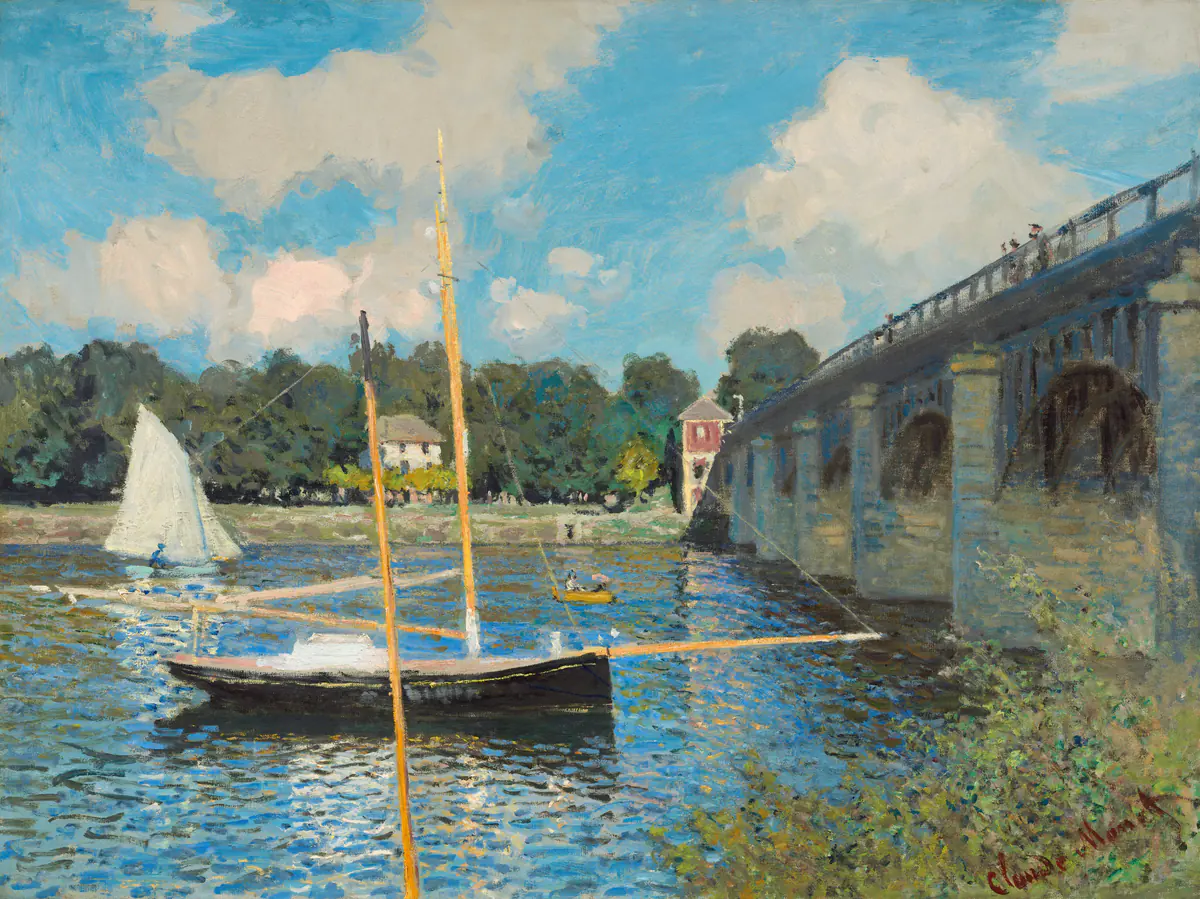
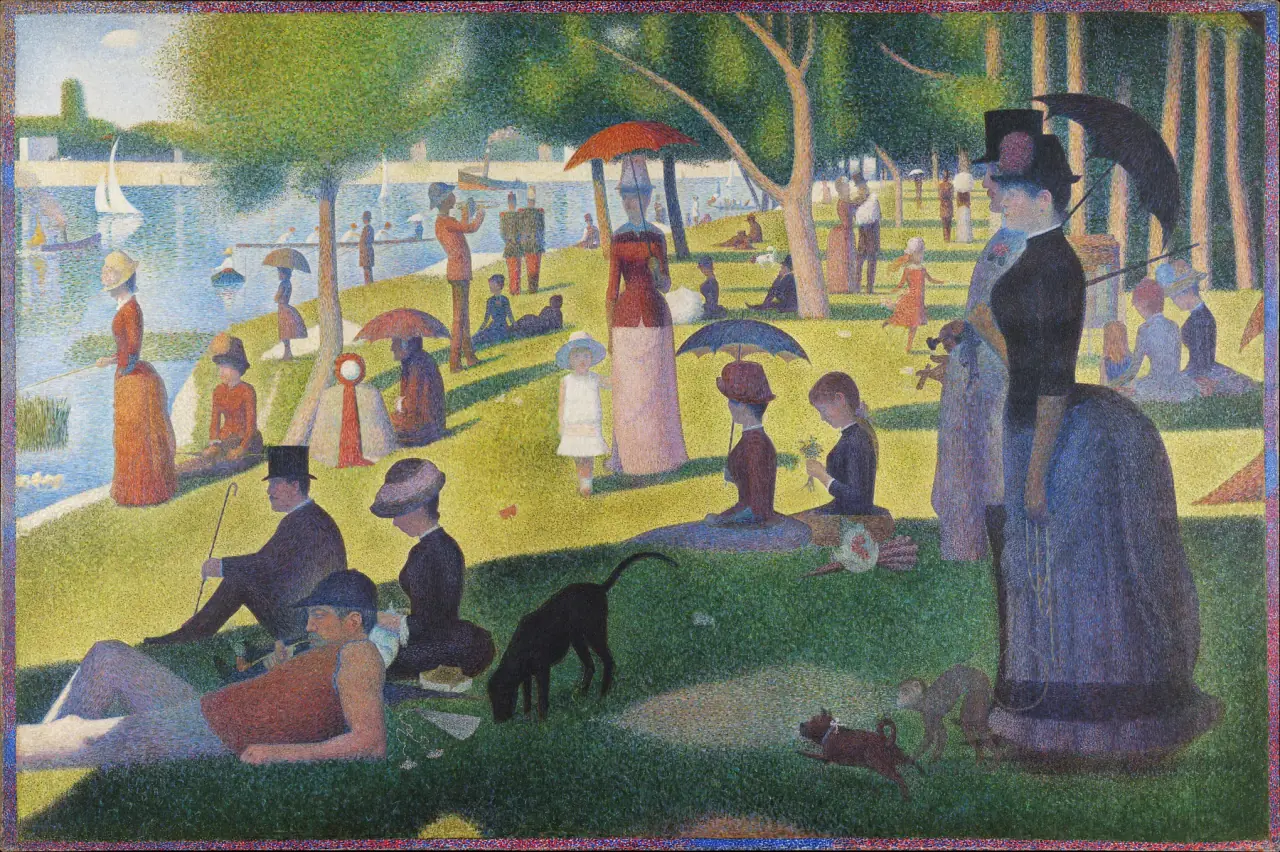
Both subjects belong to leisure beside the river rather than an ancient legend or royal ceremony. Yet they organise that familiar world differently. Monet gives substantial space to moving water. Seurat stretches figures across a bank, where standing, seated and reclining bodies create repeated changes of scale and direction.
These are different places and compositions, not a controlled demonstration with the same view painted twice. That matters: differences in mood cannot all be assigned to the brushwork.
What happens in the water and grass
In Monet, follow a mast down to its reflection. The straight line above the water becomes broken below it. Short horizontal marks make the surface seem interrupted by ripples. A reflection does not need a hard boundary to remain recognisable.
Now look at Seurat’s foreground grass. Its larger areas of shadow remain readable while smaller touches animate their surface. On the figures, the dark curves of skirts and parasols do not disappear into a shapeless accumulation of dots. Small marks work inside a strong arrangement of silhouettes.
The distinction is therefore not marks versus no marks. Monet varies the direction and length of strokes to describe particular effects; Seurat uses a more consistently divided surface in this finished painting. Both still need large relationships that can be read from a distance.
Dots and divided colour are different ideas
The Met’s Neo-Impressionism essay separates two useful terms. Divisionism concerns keeping colours in distinct neighbouring touches. Pointillism concerns the dot-like form those touches can take. A separated colour mark does not have to be a perfect round dot.
Artists in this circle drew on contemporary colour theories and believed that separate touches could produce greater vibrancy in the viewer’s perception than colours mixed beforehand. That is a historical ambition, not a guarantee that every red and blue mark will become one particular purple at a fixed distance.
In practice, you can often still notice the marks while seeing the larger image. The pleasure is in moving between those readings. A small screen reproduction cannot reproduce the precise experience of approaching the physical canvas, where scale, paint texture and lighting also matter.
Seurat’s study breaks the stereotype
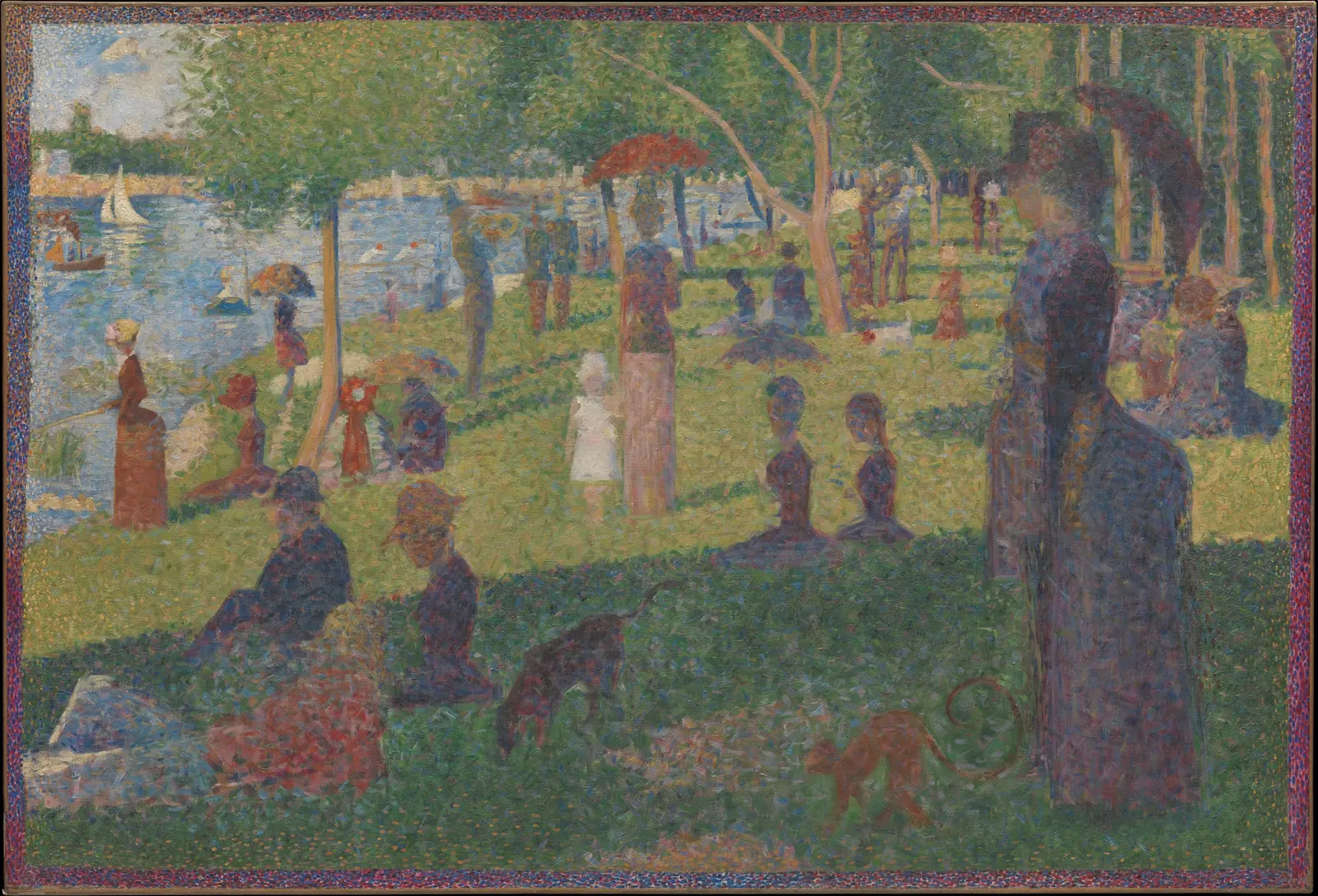
This is a separate painting, not an unfinished photograph of the Chicago canvas. The Met identifies its broader, patchier handling in contrast to the tighter touches of the large final work. It records a stage in developing the composition.
Compare the central people and the large foreground figures with the finished version above. Their positions are already broadly established, but edges and intervals feel different. In the study, marks can cross or blur a boundary that becomes much firmer in the final painting.
This is why “Seurat painted everything in dots” is such a poor rule. A technique can be chosen and refined during a project. It does not erase studies, revisions or other ways of working. Our sketch, study and finished painting guide follows that distinction in more detail.
Composition matters as much as brushwork
Look away from the tiny marks and compare the biggest shapes. Monet’s water occupies much of the lower picture; the bridge draws a strong line across the upper right. Vertical masts interrupt the horizontal flow. The scene balances stability and movement before you examine a single reflection.
Seurat repeats upright figures, rounded parasols and tree trunks. The foreground pair is much larger than the people near the river. Open spaces separate several figures rather than crowding everyone into one encounter. These decisions contribute to the picture’s composed stillness; dot-like paint alone would not create it.
An easy test is to imagine both paintings blurred until the small marks vanish. Their larger structures would remain quite different. Technique and composition cooperate, but they are not the same thing.
The two histories meet in 1886
The Art Institute’s exhibition research records that La Grande Jatte appeared at the final Impressionist exhibition in 1886 after an extended process involving painted and drawn studies. It was a challenge presented within a connected artistic world, not an invention arriving from nowhere.
The Met’s Neo-Impressionism account also places Camille Pissarro in the new circle. These overlapping relationships matter more than a diagram in which one movement simply ends and another starts. Artists could reconsider their methods without losing all connection to earlier work.
How to tell the difference without counting dots
First identify the artwork and its history. Then inspect a manageable passage: water, grass, a sleeve or a patch of sky. Ask how separate marks relate to larger shapes, and whether their size and direction change with the subject.
For this pair, remember Monet’s broken reflections and Seurat’s divided surfaces within firm silhouettes. Those visible relationships explain more than the shorthand “loose strokes versus dots”—and leave room for the many paintings that refuse to fit it neatly.
Editorial record
About this article
- Author
- Publisher
- GeMarkt
- Published
- Reviewed
- Internal source & rights check. Conducted by GeMarkt Research Review. This is an internal editorial check—not independent peer review.
- Source standard
- Art history source standardPrioritises object records and research sources, distinguishes evidence from interpretation, and states material uncertainty.
Found a claim that needs checking? Report a factual error.