GeMarkt Blog · Essay
Painting vs Print: Why Some Famous Works Exist in Many Copies
Three painted Bedrooms and two states of Rembrandt's Three Crosses explain versions, impressions and editions—and why the same title can hide changes.

A famous image can exist more than once because the artist painted it again, because a printing surface produced several impressions, or because somebody reproduced an existing artwork. Those are three different histories, even when the pictures share a title.
There is a fourth possibility worth looking at closely: an artist can change a printing plate and print it again. Rembrandt’s Three Crosses offers a dramatic example. The two sheets below are not simply light and dark photographs of one unchanged image. They record different stages of the plate itself.
Many copies can mean different things
“Copy” is a useful everyday word but an imprecise catalogue description. Before asking which copy is best, ask what kind of repetition has taken place.
| Term | What is repeated or changed? |
|---|---|
| Painted version | The artist paints the composition again on another support |
| Impression | A block, plate or other printing surface transfers an image to a sheet |
| State | The printing surface has been altered, changing the image it can produce |
| Edition | A group of impressions is issued together |
| Reproduction | An existing artwork is represented again, often through photography and printing |
These terms answer different questions. A sheet can be an impression of a particular state within an edition. A modern poster can reproduce that exact sheet. Its source therefore has a history more specific than “Rembrandt, Three Crosses.”
Our original versus reproduction guide explains why a print can be an original artwork. Here, the question is what changes when recognisably similar images exist in several physical objects.
Three Bedrooms are three painted objects
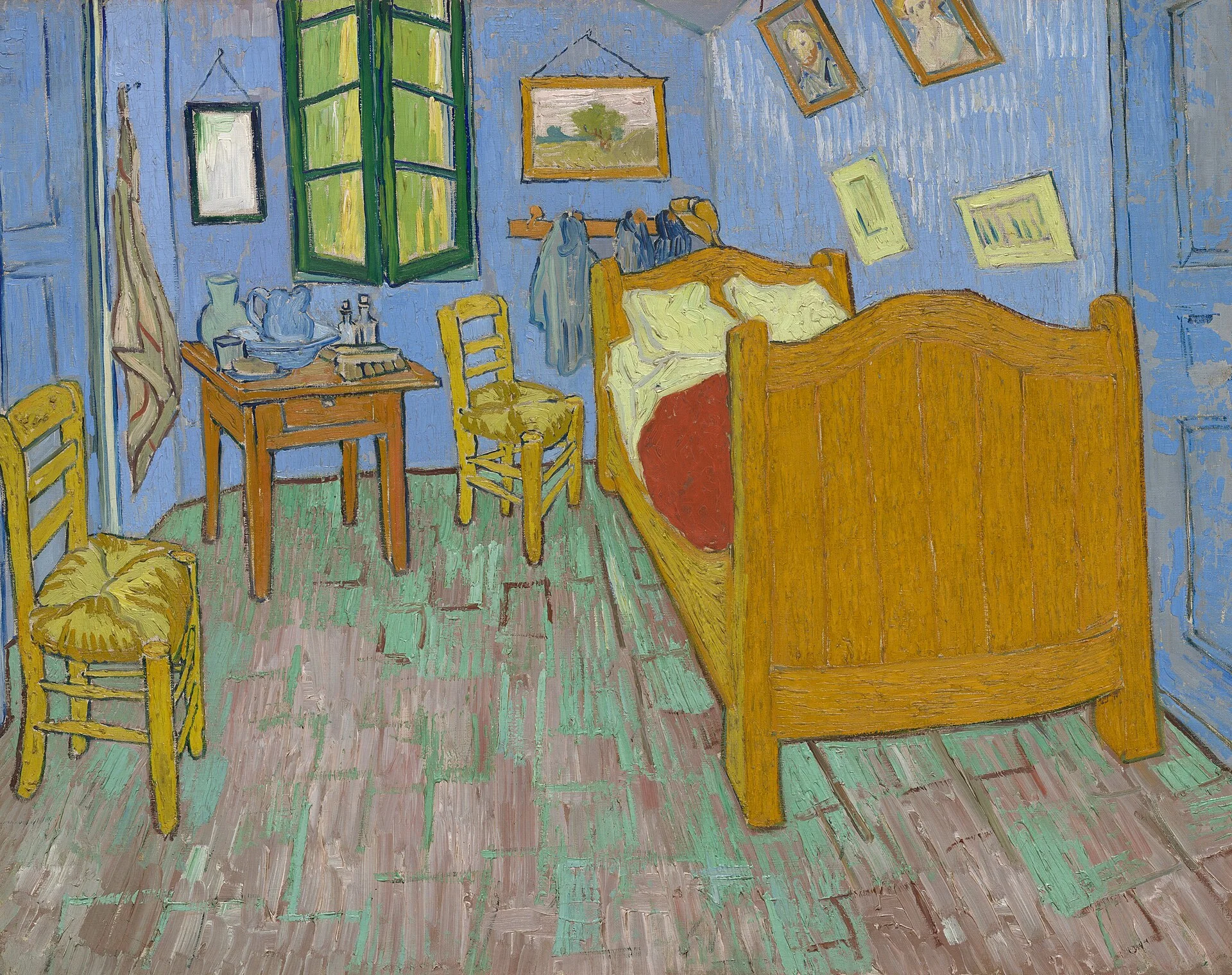
Van Gogh painted his bedroom in Arles in 1888, then made two further painted versions in 1889. The Art Institute’s exhibition on the three Bedrooms explains that the repetitions followed damage to the first version and his wish to give a version to his mother and sister.
The Chicago work shown here is oil on canvas, not a printed sheet. The yellow bed, furniture and small wall pictures were made again in paint. The recurrence of the subject does not turn the three paintings into impressions of a single printing surface.
Look at the strokes describing the floor and the bed’s upright end. They belong to this painted object. A photograph of another version might look familiar at first glance but is not a colour variation of this photograph. When identifying the work, the date and collection belong beside the title. Our Bedroom rights guide keeps the Chicago version distinct from the others.
One plate can produce many impressions
Printmaking introduces another kind of repetition. A prepared matrix—the block, plate, stone or screen carrying an image—allows the design to be transferred more than once. Each resulting printed object is an impression. MoMA’s printmaking introduction describes this indirect transfer and the possibility of multiple examples.
Multiple does not mean physically identical. Each impression involves a receiving surface and a printing event. More importantly, the matrix itself can be reworked between groups of impressions. The word state identifies a stage of that changed matrix, not how clean or valuable an individual sheet is.
This is not limited to tiny corrections. An artist might alter figures, shadows or the balance of an entire scene. In such a case, comparing the images is part of understanding the artwork, not merely checking which museum has a better photograph.
Rembrandt changed the plate, not just the ink
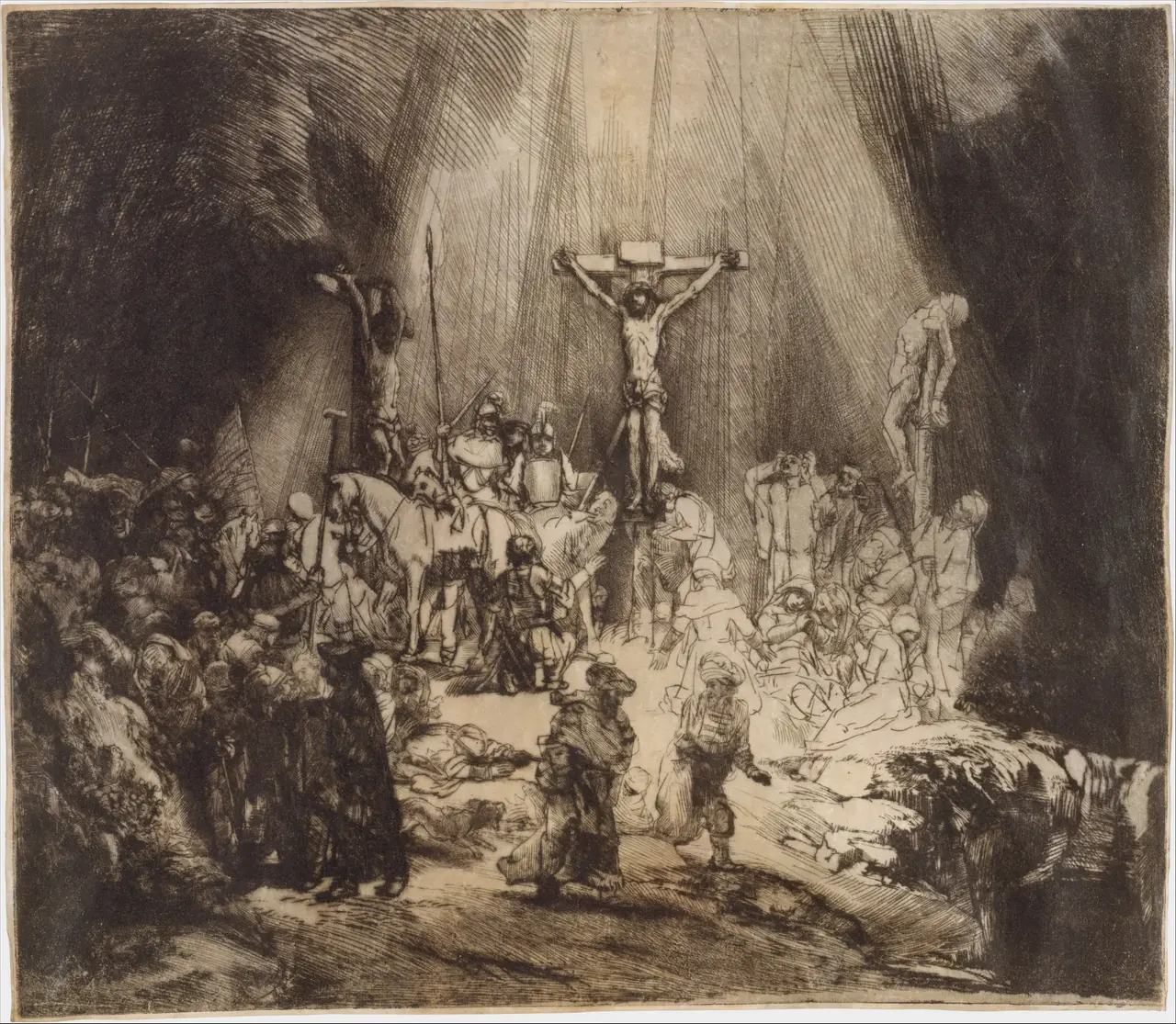
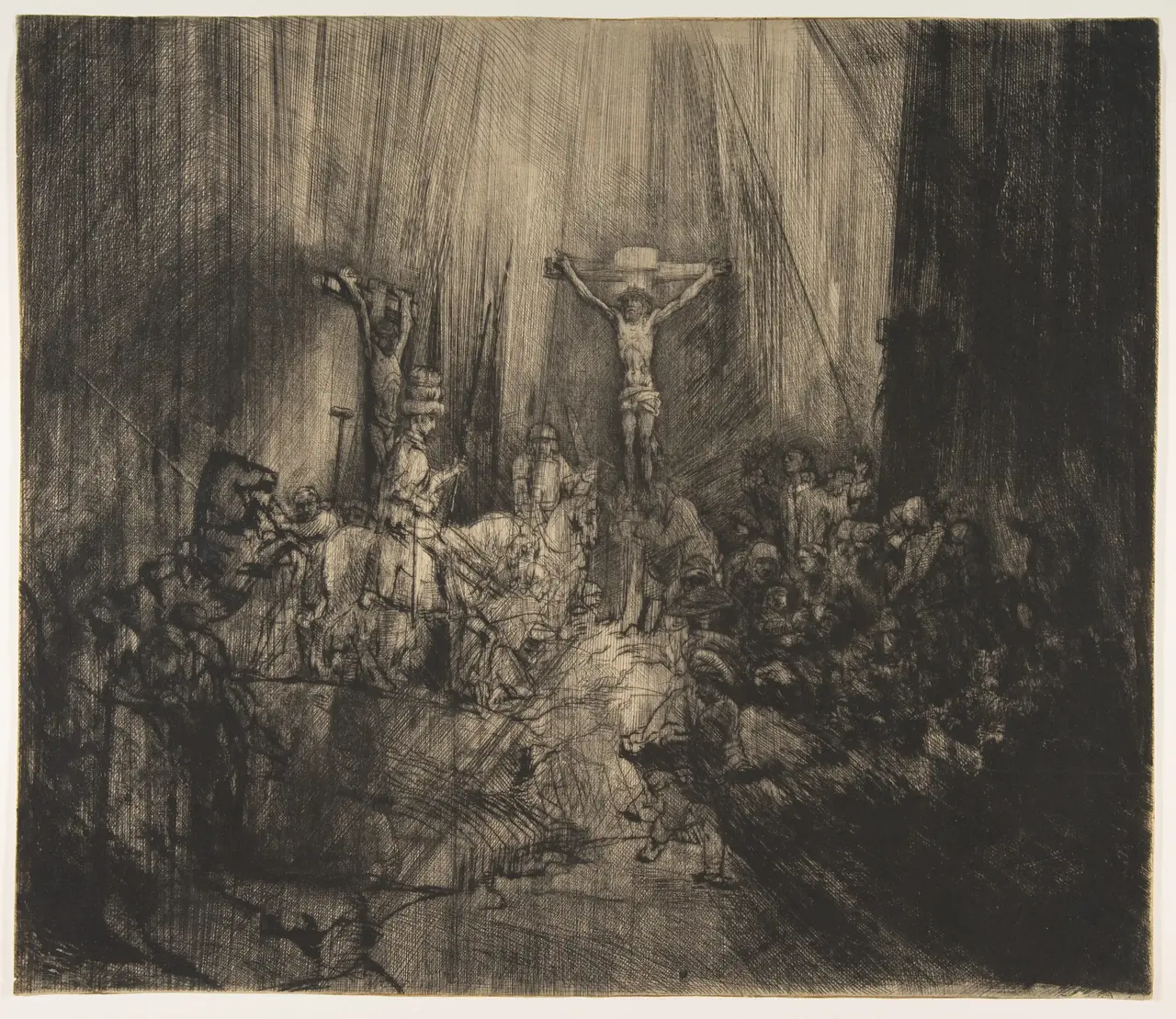
In the second state, the central light spreads over a large group beneath the crosses. At the right, kneeling and seated figures remain comparatively easy to separate. In the fourth, long, dense lines cut across the scene. Much of that open space has become darkness, and the arrangement of figures has changed.
The Met’s fourth-state commentary confirms a substantial reworking: Rembrandt scraped away large areas, introduced strong parallel hatching and redrew Christ. These are changes to the plate, not effects caused only by a different camera exposure.
Try comparing a fixed location in each image: the area immediately below the left-hand cross, then the lower-right group. Looking for particular lines and figures makes the distinction clearer than saying only that one print is darker. “Fourth state” locates this transformation in the print’s development; it does not mean fourth sheet off the press.
The same state can still look different
Variation also happens without a new state. In its account of the second-state impression, the Met discusses Rembrandt’s use of vellum and selective wiping of ink. Ink left on the plate’s surface could create a veil over parts of the image, alongside the ink held by its lines.
Drypoint adds another variable. A sharp point scratches metal and can raise a delicate ridge, or burr, beside the line. That ridge holds ink and can give a soft, rich effect, but wears with printing. The Met’s history of drypoint explains the importance of this fragile feature.
Different supports, ink handling, wear, condition and photography should not all be folded into “different state.” Conversely, the visible new hatching in the fourth state should not be dismissed as a darker scan. Object records and close comparison work together.
An edition is not a state
An edition concerns a group of issued impressions; a state concerns a changed printing surface. A number written on a modern print does not identify which state of a historical plate its image depicts. Nor should you expect every old master impression to carry the modern numbered-edition format.
A proof is another term that needs context. MoMA’s proof definition distinguishes working and trial proofs from impressions set aside for an artist or printer. A proof may document an experiment, but the label alone does not mean the composition differs from the regular edition.
For a historical object, its catalogue description matters more than a generic promise of rarity. Who printed it, when, from which matrix and in which state? Those are research questions, not answers supplied by the image’s fame.
Identify the version before comparing
Keep four details together: artist, title, date or state, and collection reference. For the Rembrandt pair, the references 41.1.31 and 41.1.33 identify two actual museum objects. For the Bedroom, Chicago’s 1926.417 identifies one particular painted version.
If you are choosing a reproduction, ask which object supplied its image. You might prefer the more open second-state Three Crosses or the denser drama of the fourth. That is a meaningful choice between images, not simply a search for the brightest file.
Familiarity can hide these differences. A repeated title sometimes means another sheet, sometimes a newly painted version, and sometimes a changed composition. Once we name the kind of repetition, we can see what the artist actually kept—and what they decided to remake.
Editorial record
About this article
- Author
- Publisher
- GeMarkt
- Published
- Reviewed
- Internal source & rights check. Conducted by GeMarkt Research Review. This is an internal editorial check—not independent peer review.
- Source standard
- Art history source standardPrioritises object records and research sources, distinguishes evidence from interpretation, and states material uncertainty.
Found a claim that needs checking? Report a factual error.