GeMarkt Blog · Essay
Old Master vs Modern Master: Where's the Line?
Old Master and modern master are useful but flexible labels, not quality grades. Compare Rembrandt and Van Gogh and learn why no single cutoff fits every museum.

“Old Master” usually refers to established European artists working before about 1800. “Modern master” is a looser term for a major artist associated with modern art. Neither is a universal rank, and there is no single date on which one group officially turned into the other.
Rembrandt is comfortably described as an Old Master; Van Gogh belongs to the history of modern art. The interesting part lies between and around these familiar examples. Different museums draw their collections’ boundaries differently, while artists rarely change direction to fit a later catalogue heading.
The useful short answer
The National Galleries of Scotland’s glossary places Old Masters broadly between 1300 and 1800. Treat that as a useful convention for European painting, not a law governing all art everywhere.
For modern art, MoMA’s glossary gives a broad span from the 1880s to the 1970s, while recognising variation across cultures. Other collections organise the story differently. “Modern master” adds a judgement of importance to that already flexible period label; it does not supply a more exact calendar.
| Label | Useful starting point | Misleading shortcut |
|---|---|---|
| Old Master | An established artist within the earlier European painting tradition | Any old picture, regardless of maker or context |
| Modern master | An important artist associated with modern art | Any living artist, or any abstract picture |
| Masterpiece | A judgement about a particular work’s achievement | Proof that the object is authentic or original |
Dates help orient us. They do not replace the name of the artist, the work’s actual date or a description of what we are looking at.
Two self-portraits across the boundary
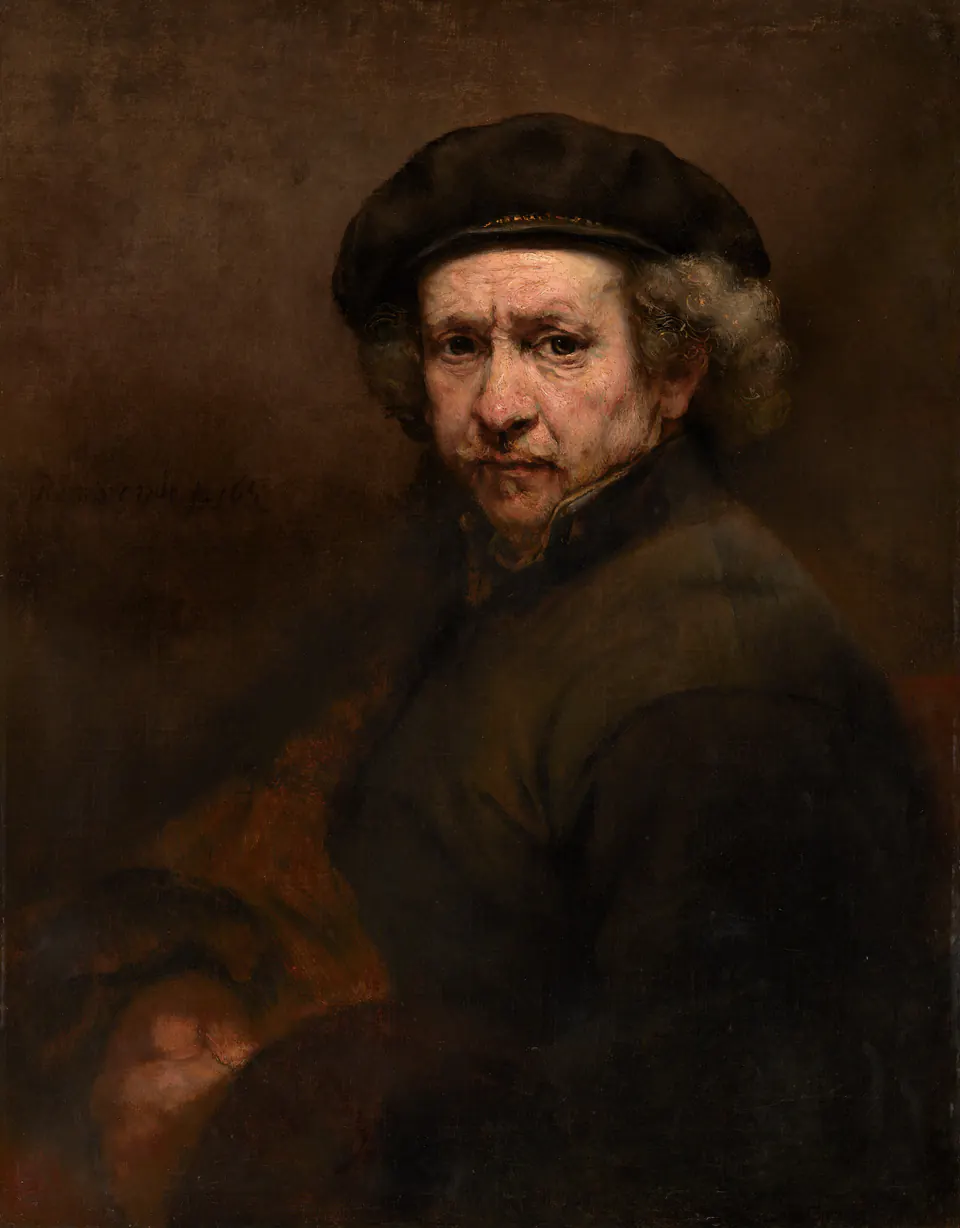
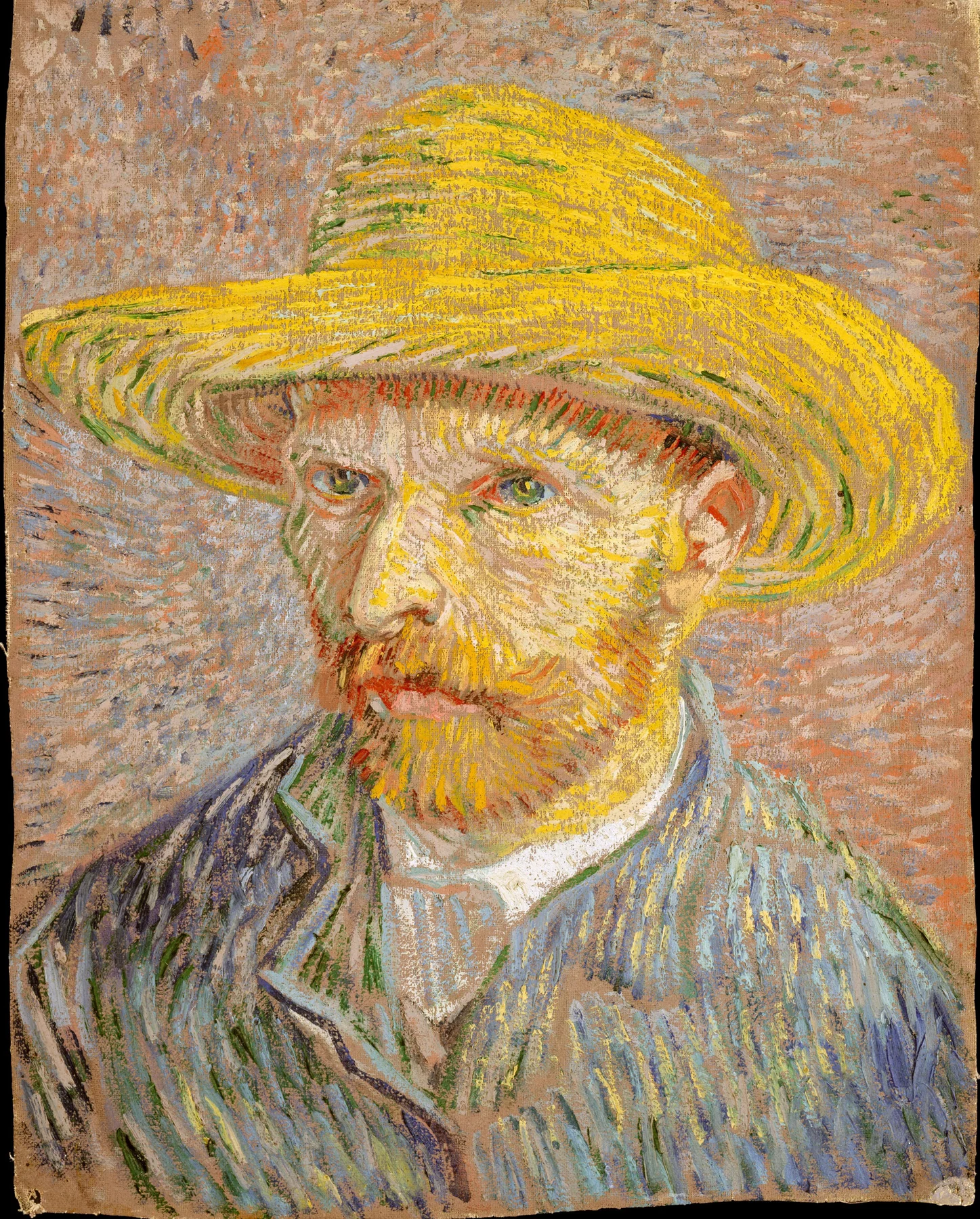
Both artists use oil on canvas, both paint themselves, and both bring our attention towards the face. The distinction is not “an old technique versus a new technique”. The dates and the artists’ places in art history do more work than the material label alone.
In Rembrandt’s 1659 picture, the dark clothing and background let the illuminated face come forward. Look around the nose, eyes and forehead: the surface is not a perfectly smoothed photograph. The National Gallery of Art’s record identifies the painting and places it among his late self-portraits.
Van Gogh’s face is also built with visible paint, but the marks are distributed differently. Short contrasting strokes continue into the jacket and background. The Met dates this portrait to 1887, during his Paris years. The contrast can be seen without deciding that one artist knew how to paint and the other deliberately forgot.
Old Master is not a style
Duccio, Leonardo, Rembrandt and Fragonard do not paint alike. Grouping them within an earlier European tradition does not turn gold-ground devotion, Renaissance figure painting, Dutch portraiture and Rococo scenes into one visual recipe.
The Met’s European Paintings galleries use the span 1300–1800. That is a practical way to organise a collection containing many periods, places and purposes. It is not a claim that all the pictures in those rooms share a single style or identical working methods.
This is why “make it look Old Master” is an imprecise request. Do you mean a dark background, careful light on a face, a gold ground, a crowded biblical scene or a delicate pastel-coloured garden? Name the feature, artist or period and the comparison immediately becomes more useful.
Modern does not mean made this year
In ordinary conversation, “modern” often means recent. In an art-history label, it can identify a historical development that began long before any living viewer was born. Van Gogh’s portrait is more than a century old and still belongs in discussions of modern painting.
The label also does not require abstraction. A recognisable face, street or still life can participate in a modern artistic experiment. In this portrait, we can examine the decision to keep coloured strokes distinct while still building a readable head.
Conversely, visible brushwork by itself does not prove that an image is modern. Rembrandt’s face makes that clear. One visible feature can appear in different periods for different reasons. Date, context and the whole work matter more than a single diagnostic-looking stroke.
Why the nineteenth century resists a neat line
If you take “before about 1800” and “from the 1880s” as rigid boxes, most of the nineteenth century seems to fall into a gap. That is a warning about the boxes, not an absence of important art.
Consider Turner’s The Fighting Temeraire, painted and exhibited in 1839. The National Gallery’s account describes an old sailing warship being towed by a steam tug. The picture belongs to a nineteenth-century world thinking about older and newer technologies; its painter does not become easy to understand by forcing him into a pre-1800 category or skipping straight to Impressionism.
For such cases, more specific terms do better work: the artist’s name, the painting’s date, Romanticism, Realism, or the precise movement relevant to the question. Museum departments and sale catalogues may use different boundaries because their practical purposes differ.
Master is not an object certificate
Calling someone a master expresses esteem. It does not tell you whether the object in front of you was painted by that artist, made by a workshop, copied later or printed yesterday. Those are separate questions about authorship and the individual object.
An “Old Master print” can also be an original historical print rather than a photographic reproduction of a painting. The word print needs its own explanation. Our guide to originals, reproductions and prints separates the types of object without using prestige as a substitute for description.
Nor does an art-period label settle copyright. A reproduction’s source, the particular work and applicable rules still need checking. “Master” is not a legal permission, and “modern” is not a complete rights verdict.
What the label leaves out
“Old Master” developed around a European canon. It is not a sensible name for every accomplished artist working anywhere in the world before 1800. Applying it that way flattens distinct histories into the timetable of one collecting tradition.
The word can also sound exclusively male, although women artists belong in the history it describes. The National Galleries of Scotland’s glossary explicitly includes women such as Artemisia Gentileschi and Rachel Ruysch. The useful response is to name artists and their work clearly, rather than imagining that an inherited label is a complete list of who mattered.
A better way to use the terms
Use these labels to find a shelf, gallery or broad discussion. Once you reach a particular picture, become more specific. Ask who made it, when, with what materials, and what you can actually see.
For the two portraits here, “Old Master and modern master” provides a starting contrast. “Two artists using visible oil paint to construct very different encounters with a face” gives you something to look at. The second description is where the comparison becomes rewarding.
Editorial record
About this article
- Author
- Publisher
- GeMarkt
- Published
- Reviewed
- Internal source & rights check. Conducted by GeMarkt Research Review. This is an internal editorial check—not independent peer review.
- Source standard
- Art history source standardPrioritises object records and research sources, distinguishes evidence from interpretation, and states material uncertainty.
Found a claim that needs checking? Report a factual error.