GeMarkt Blog · Practical guide
Moving House with Art: A Packing Guide
Plan a house move for paper prints, glazed frames and stretched canvas, with condition records, suitable protection and clear points for professional help.

Sort art by what can be damaged, not simply by which pieces fit in the same box. Unframed paper needs support, a glazed frame needs protection from movement and impact, and exposed canvas needs space between its image surface and the packaging. Valuable, fragile or oversized works are a reason to involve an art handler before moving day.
A short journey does not remove the awkward moments: lifting a frame off the wall, turning through a doorway, loading it beside furniture and finding somewhere to put it in the new house. Plan those moments as well as the distance in the van.
Make an art list before moving day
Assign a simple reference to each piece and photograph the front, back and existing marks. Record the overall dimensions, whether it contains glass or acrylic, and any loose or fragile parts you already know about. Keep the record somewhere accessible when the boxes are closed.
Add its intended destination room and who will pack it. A note such as “hallway print, glazed, frame corner already scratched” is useful to the people handling it. A valuable original should have a separate discussion about transport, condition and cover, not a vague instruction to be careful.
Ask the mover or insurer what their actual terms require, including any professional-packing requirement and exclusions. Do not assume a general moving policy covers the object or its full replacement value. Keep receipts and any valuation documents with your records, not inside the only copy of the package.
Inspect before you lift
Prepare a clear route and a safe padded resting place first. Open doors and remove obstacles. If you cannot comfortably control the object while seeing where you are going, arrange assistance or suitable equipment before touching it.
The Canadian Conservation Institute’s handling guidance emphasises condition checks, enough handlers and a planned route. A loose frame corner or unstable surface needs attention before moving, not a tighter wrap afterwards.
Lift a sound framed piece with support under its lower structure and control at the sides, not by the hanging wire or decorative top edge. Do not press on canvas from the front or back. If you find flaking paint, failing joints or broken glazing, stop; do not carry it across the room just to get a better look.
Choose protection for the object
Keep original packaging if it is sound, correctly sized and intended for that exact product. Check it rather than assuming a previously used carton remains protective. A crushed corner or missing insert can change how the object sits inside it.
The CCI’s shipment guidance starts with the object’s structure, condition and journey. It distinguishes close protection from cushioning and the outer container. A layer that prevents rubbing does not necessarily prevent bending or absorb an impact.
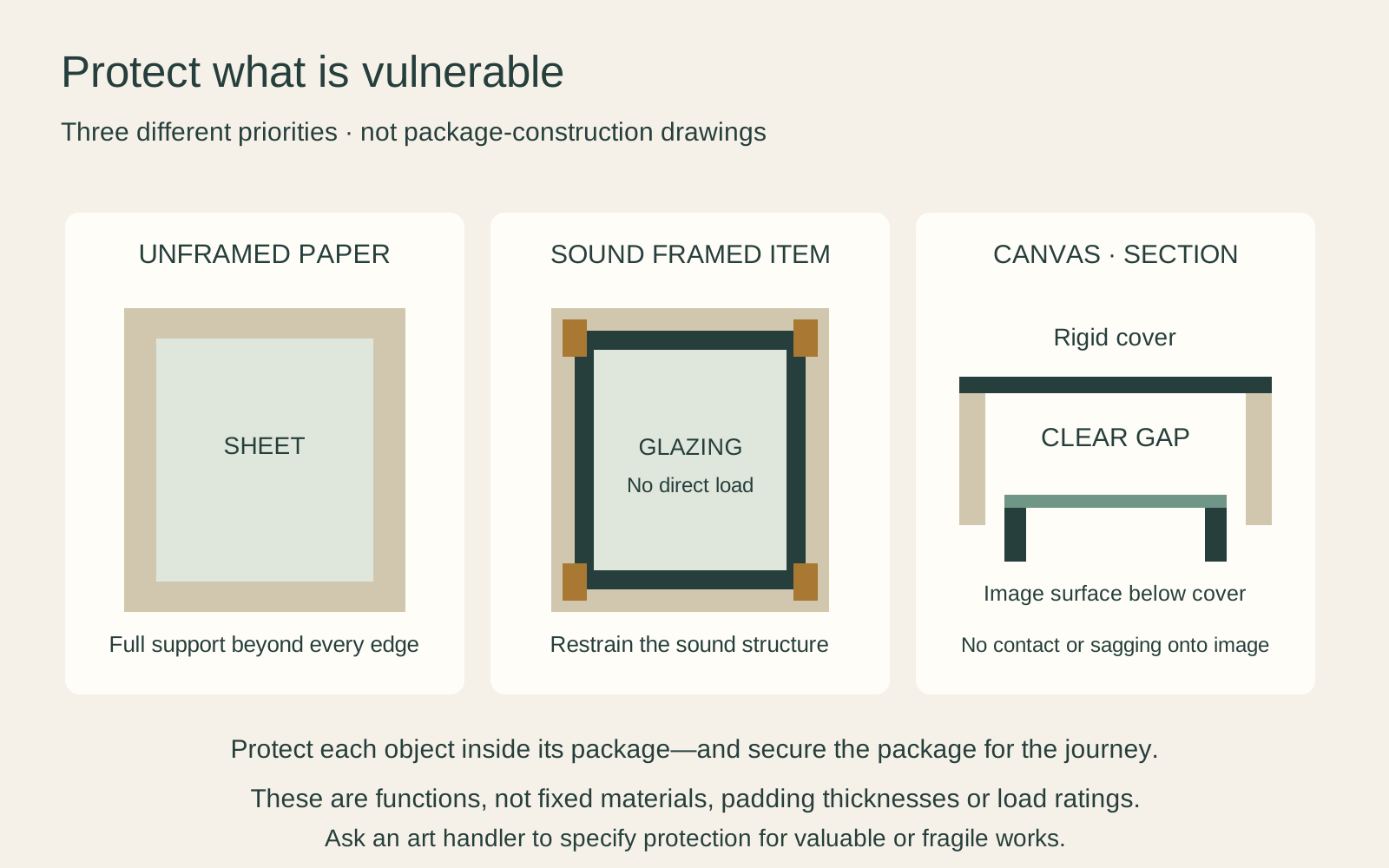
Separate objects so their frames, hooks or corners cannot collide. Plan how the closed package will be held in the vehicle as well as how the artwork is held inside it. A well-wrapped picture still needs a secure place to travel.
Pack flat paper with full support
For an already flat, ordinary paper print, use a suitable protective folder or enclosure and rigid support larger than the sheet. Keep the corners inside the support. Do not fold an edge to fit a smaller box or improvise a tube simply because it is easier to carry.
The Library of Congress’s paper-care guidance recommends supportive protective enclosures and warns that some transparent plastic sleeves can attract loose media through static. An original charcoal drawing and a stable machine-printed poster therefore need different material choices.
Keep tape on the outer packing, away from the print. Label the package rather than writing on the artwork or leaving a loose note to rub against its image. If you have several sheets, record their order and use suitable individual separation instead of making a bare stack.
A print already stored rolled needs its own assessment. Do not force it flat on moving morning. Leave brittle, valuable or unfamiliar paper to a paper conservator; transport preparation is not the moment to begin a flattening experiment.
Protect the frame without loading the image
For a sound glazed frame, protect the frame’s corners and prevent movement inside a properly fitted outer package. Supports should act on suitable structural areas rather than transferring a load to the glazing. Avoid placing other belongings on top of the packed picture.
Do not automatically apply tape to the glass. The CCI’s wrapping guidance treats glass protection as a conditional decision and refers to the glazing manufacturer’s directions; coatings and removal risks matter. Ask the framer or art handler rather than copying a generic crossed-tape trick.
Measure the finished package, not only the frame. For a purely illustrative fit check, a 70 × 90 cm frame with 5 cm of packaging allowance on every side becomes 80 × 100 cm before any additional outer-wall thickness. That calculation helps identify a doorway problem; 5 cm is not a recommended cushioning thickness for your object.
Give canvas a clear front
Do not put bubble wrap directly against an exposed image surface or assume a thin sheet makes contact harmless. Packing should prevent abrasion and pressure without relying on the canvas itself to hold the wrapping away.
CCI describes using a sufficiently deep frame or a separate travel frame so that a rigid cover stays clear of a painting. The important principle is clearance, not the decorative appearance of the frame. A floating frame around a canvas does not necessarily project far enough forward to perform that job.
For a new printed canvas, ask the supplier for packing instructions appropriate to its coating and construction. For an original or vulnerable surface, have an art handler specify the support. Do not remove the canvas from its stretcher or roll it for convenience; that changes the task from packing to intervention in the object.
Plan the journey and the first night
Tell the movers which packages contain art, which way they should travel and where they should be set down. Arrange a dry, protected destination space before the van arrives. Keep it separate from the route for furniture and boxes.
For example, “bedroom” is not enough if that room is still being painted and every wall has boxes leaning against it. A designated clear area with a responsible person receiving the artwork is more useful than deciding its final hanging position in the doorway.
Discuss temperature changes, rain exposure and any overnight storage with the carrier in advance. Valuable works may need specialist transport and a planned acclimatisation period. No generic instruction to leave every package sealed for a fixed number of hours suits every climate or condition.
Unpack with the same care
Unpack one piece at a time in the prepared space. Read any handling notes before cutting; keep blades away from the object. Retain the packaging until you have checked the condition and compared it with the earlier photographs.
If a package is wet or glazing is broken, stop ordinary unpacking and obtain appropriate help. Photograph the condition safely and notify the responsible mover or supplier according to their process. Do not clean, repair or discard evidence before the problem has been assessed.
Finally, inspect the hanging arrangement for the new wall. The old fixing does not automatically suit a different surface. Leave the work in protected storage until the location and installation are ready. A careful move ends with a safely received object, not with a rushed decision to hang everything that evening.
Editorial record
About this article
- Author
- Publisher
- GeMarkt
- Published
- Reviewed
- Internal source & rights check. Conducted by GeMarkt Research Review. This is an internal editorial check—not independent peer review.
- Source standard
- Buying guide source standardSeparates measured or first-hand evidence from general guidance and keeps practical limits visible.
Found a claim that needs checking? Report a factual error.