Is Amedeo Modigliani's art public domain? A collector's guide
Modigliani died in 1920, so his art is public domain worldwide. Explore his short life, the exhibition police closed, the forgery problem, and what collectors may print.
From the guide to the collection
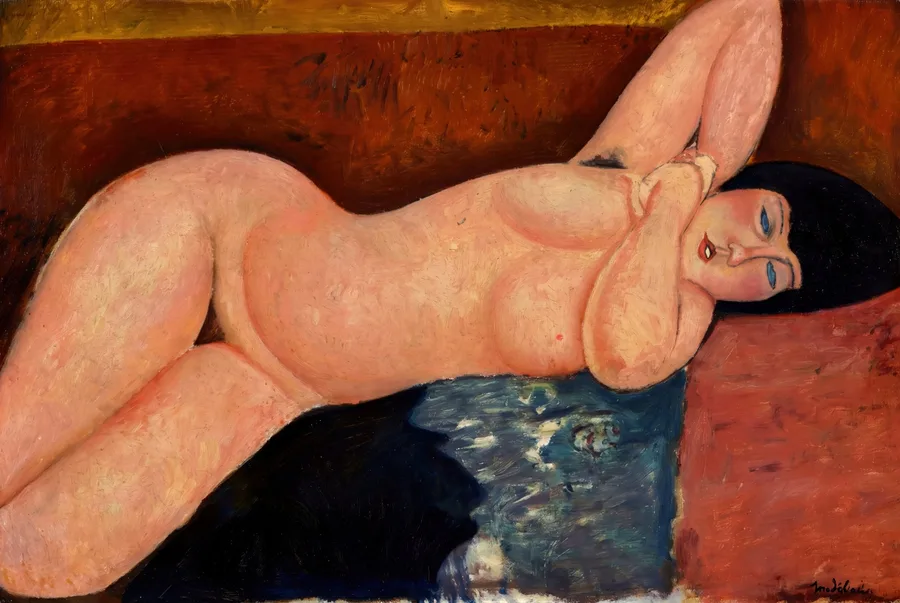
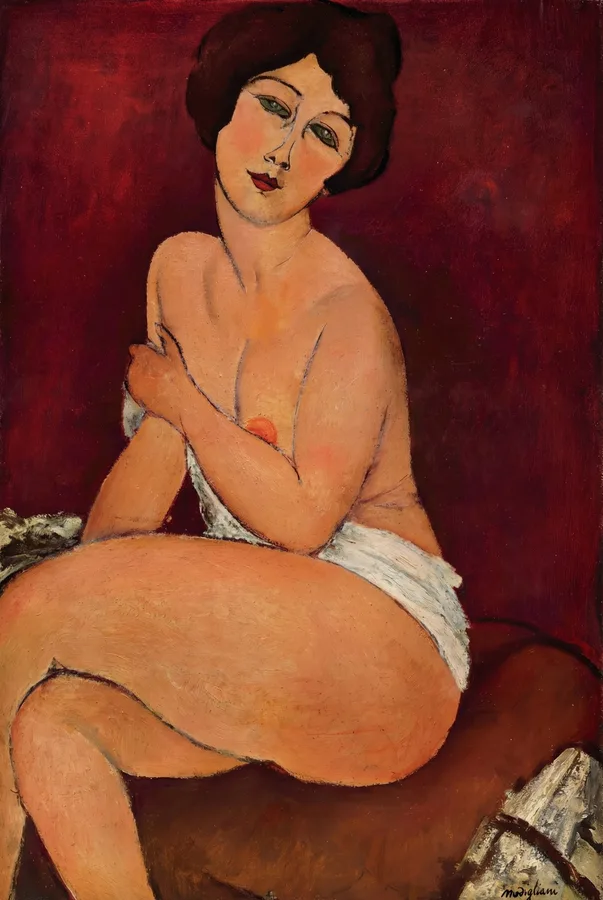
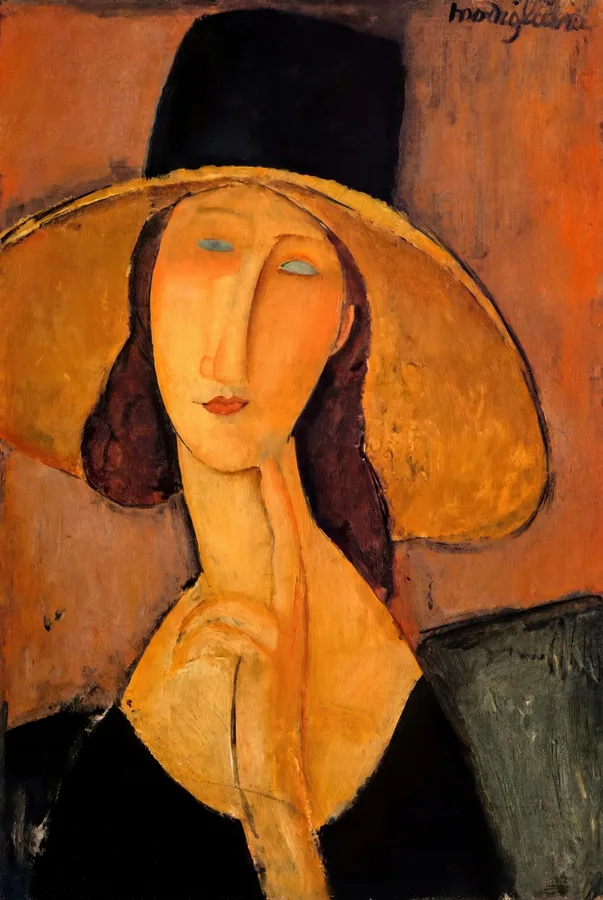
Explore the Modigliani collection → · Shop all art → · Free Modigliani wallpapers — the complete paintings at 4K ↓
From the studioModigliani prints — 120+ restored works, curated and annotated →
A short life, mostly in Montparnasse
Amedeo Modigliani was born in Livorno, Italy, in 1884, into a Sephardic Jewish family, and did the work that made him famous in Paris. For several years he insisted he was a sculptor, not a painter, filling sheet after sheet with caryatids — drawn columns for a temple he never got to build. When ill health and the cost of stone pushed him back to canvas, he brought the sculptor’s economy with him: the long necks, the almond eyes, the faces pared down to a curve and a tilt.
What followed was one of the most concentrated runs in modern portraiture. He painted the poets and painters around him — Jean Cocteau in 1916, upright in a high red chair; his closest friend Chaim Soutine in 1917, hands folded at a table. Under the patronage of his dealer Léopold Zborowski he painted the great series of nudes in 1917, and then, again and again, Jeanne Hébuterne, the young art student who became his companion. Near the end came the pale, quiet portraits of the south of France, and in 1919 the only painted self-portrait he left: palette in hand, eyes almost closed.
He died in Paris on 24 January 1920, of tubercular meningitis, at thirty-five. Jeanne, eight months pregnant with their second child, threw herself from a fifth-floor window two days later. He had sold little and exhibited less; the fame, as so often, arrived when he could no longer collect it.
One solo exhibition — closed on opening day
Modigliani had exactly one solo exhibition in his lifetime. It opened at Berthe Weill’s small gallery on the rue Taitbout in Paris on 3 December 1917, with nudes hung in the window to draw a crowd. They drew the police instead. The commissioner across the street judged the paintings an outrage to public decency and ordered them taken down on the very first day — first from the window, then from the walls. The show produced notoriety and almost no sales.
The postscript took ninety-eight years to write. On 9 November 2015, one of the reclining nudes from that 1917 series — Nu couché — sold at Christie’s in New York for 170.4 million dollars, at the time one of the highest prices ever paid for a painting at auction. The pictures a Paris police commissioner ordered off the wall now anchor the walls of museums built around them.
The most faked painter — and why that is not a copyright problem
Modigliani is also, by broad agreement, one of the most forged artists in history. He worked fast, kept no proper records, and paid bar tabs with drawings, which left the door to his catalogue permanently ajar. In 1984, students in his hometown of Livorno carved fake Modigliani heads with a power drill and dropped them in a canal; experts authenticated them enthusiastically until the students produced the video of themselves making them. In 2017 it stopped being funny: an exhibition at the Palazzo Ducale in Genoa was shut down three days early after police seized twenty-one works and experts declared twenty of them forgeries.
For a collector, it is worth being precise about what those stories are and are not. Forgery is an authenticity problem, and it attaches to objects — a canvas claimed to be by his hand that is not. Copyright is a separate question, and it attaches to images — who may reproduce a genuine work. The first question keeps Modigliani scholars and courtrooms busy. The second, for Modigliani, is settled, and settled in your favor.
Is Modigliani’s art public domain?
Yes — everywhere, under both major systems.
Most of the world protects artworks for the life of the artist plus seventy years. Modigliani died in January 1920, so that term ran out at the end of 1990; since 1991 his work has been public domain across Europe and every other life-plus-seventy country. The United States runs on a different clock for older art, counting roughly ninety-five years from publication rather than from the artist’s death — and since everything Modigliani made predates January 1920, his entire output cleared the American bar decades ago as well. There is no late work to argue over, no posthumous edition, no country where the term is still running. Anyone may reproduce, adapt, print, and sell his paintings and drawings.
The honest caveat: copyright terms vary by country and get revised over time, and this page is general information, not legal advice. For an artist who died in 1920 the answer does not change from one jurisdiction to the next — but if a commercial decision hangs on it, ask a lawyer where you live.
The painting is free — a given file of it may not be
One distinction matters more in practice than any of the above. That Reclining Nude is public domain does not automatically make every digital file of it free to use. Museums and image libraries sometimes assert rights or contractual terms over their own photographs of public-domain paintings, and whatever the legal strength of those claims in a given country, a careful print seller does not build on ground it has not checked. The provenance of the file matters as much as the status of the painting. This is why we can say plainly: the restorations we sell are our own work, and we verify the rights status of every individual piece before it is listed.
Modigliani in our collection
Our Modigliani collection holds over 120 restored works, from the early Paris years to the last months. The 1917 nudes are here — Reclining Nude and Nude Sitting on a Divan, from the very series the police objected to, restored so the warm flesh tones hold against those deep red grounds instead of sliding toward brick. So are Jeanne Hébuterne with Large Hat of 1918, the 1919 Self-Portrait, and Woman with a Fan — a painting stolen from a Paris museum in 2010 and never recovered, which means prints are now the way this picture is seen at all.
Every piece comes in the same four formats: rolled poster, stretched canvas, framed canvas, and framed paper print. The rolled poster suits collectors with a framer they trust; the framed options arrive ready to hang. Browse the Modigliani collection — a selection chosen and annotated by the studio, and a door to the rest of the 120+ behind it.
Editorial record
About this article
- Publisher
- GeMarkt
- Published
Found a claim that needs checking? Report a factual error.