GeMarkt Blog · Essay
Leonardo vs Michelangelo
Compare Leonardo's study of the Virgin with Michelangelo's Libyan Sibyl studies: soft transitions, turning bodies and two approaches to drawing.

Leonardo da Vinci’s drawn face seems to emerge slowly from shadow. Michelangelo’s seated figure turns so decisively that you can almost feel the movement between the shoulders and hips. Put these two sheets together and the familiar question—who was the greater artist?—becomes less useful than another: how does each make a body feel present on flat paper?
Neither drawing is a complete summary of its maker. But they offer a better beginning than Leonardo the thinker versus Michelangelo the man of muscle. Both are thinking through marks. Both are studying what a figure can do.
A rivalry is not a complete explanation
Their careers did overlap competitively. The Royal Academy’s Florence c. 1504 exhibition release (PDF) places them in a city where major public commissions offered exceptional visibility. Leonardo received the commission for the Battle of Anghiari in 1503; Michelangelo was asked to design the accompanying Battle of Cascina the following year.
That rivalry helps explain an occasion, not every later drawing. The two sheets below belong to different projects and solve different problems. Looking at their purpose prevents us from treating every soft passage or firm contour as a clue to an artist’s personality.
Put these two drawings together
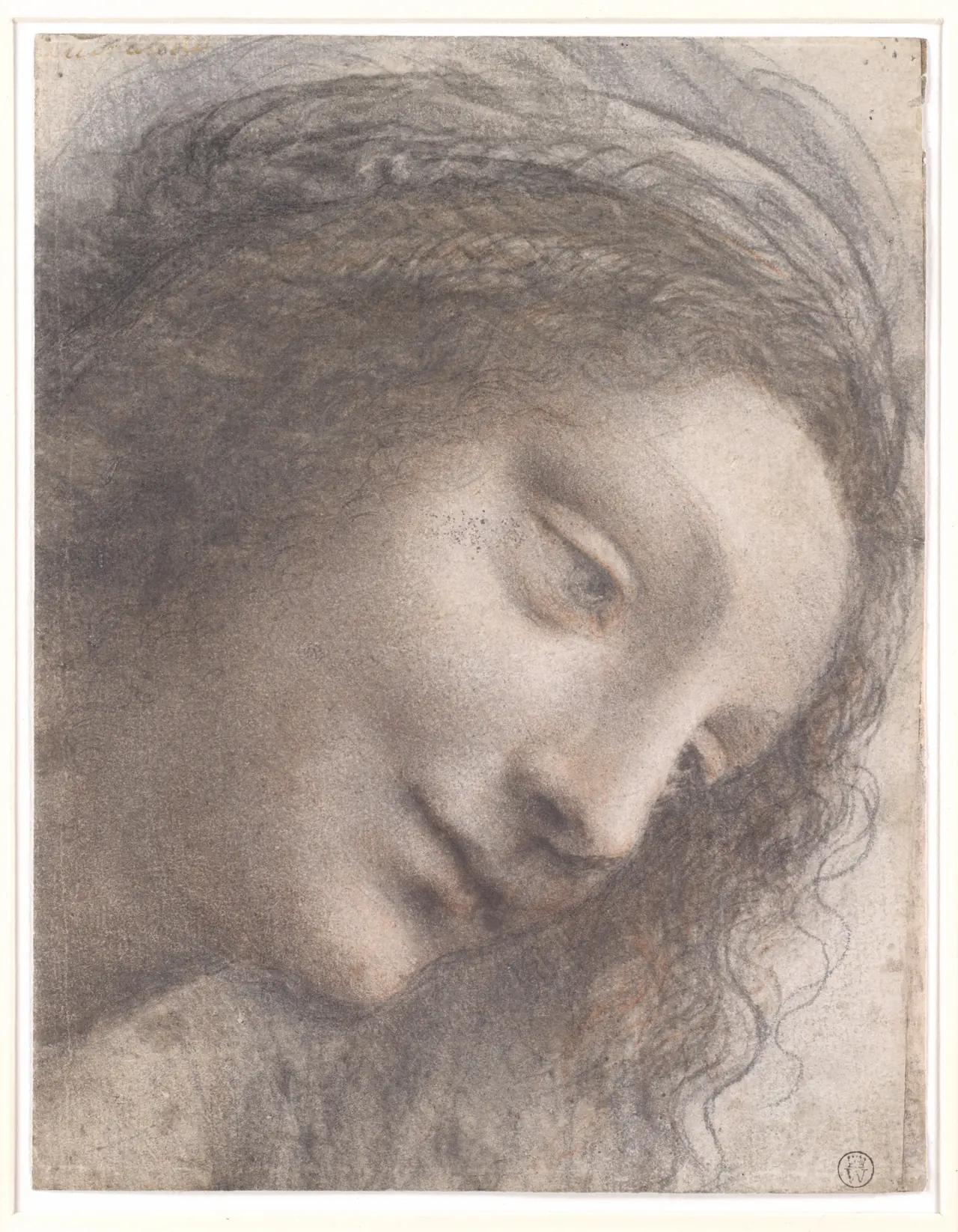
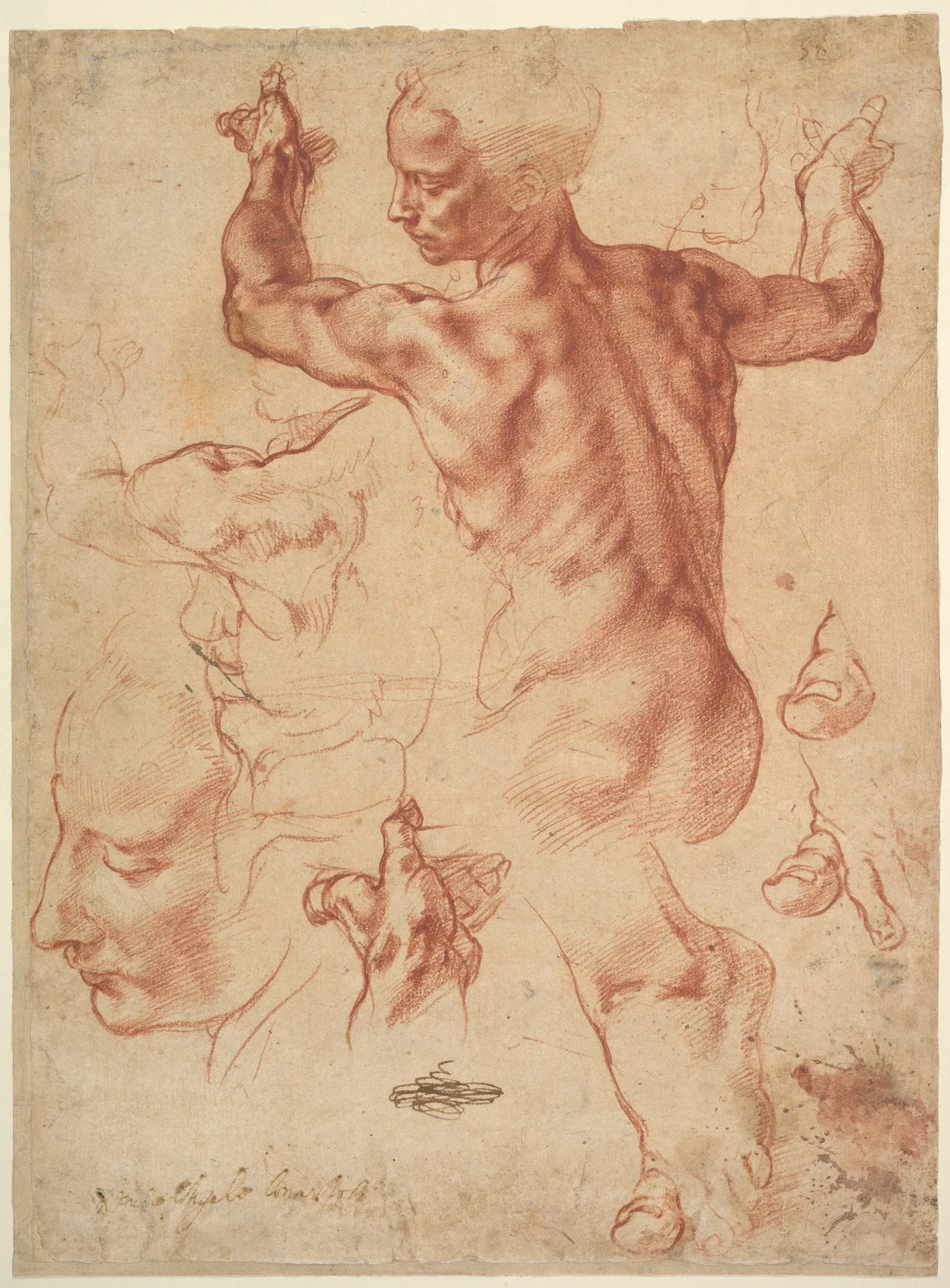
These are small works on paper, not competing wall paintings. Leonardo concentrates on a head; Michelangelo investigates a larger bodily action and particular extremities. The difference in what they select is already part of the comparison.
Leonardo makes an edge disappear
Start below the near eye in Leonardo’s drawing. There is no heavy line enclosing the cheek. Its roundness comes from a slow change between pale paper and darker shading. Under the nose, the shadow deepens; near the mouth it becomes gentler again. The face remains legible without every feature being fenced in.
Now move towards the hair. Here you can find more explicit curls and quicker-looking marks. Leonardo has not made the whole sheet equally soft. Sharper and looser passages give the carefully shaded face something to stand against.
The National Gallery’s definition of sfumato describes gradual tonal transitions that soften outlines. In plain language, an edge can be suggested by changing light rather than drawn as a boundary. It is not the same as putting an indiscriminate blur over a picture: the eye and mouth still need just enough definition to hold your attention.
Try following the far side of the face. At some points you can name a contour; at others you infer it. That alternation contributes to the sense of a head occupying air rather than a shape cut out of paper.
Michelangelo turns a body through space
In Michelangelo’s sheet, look first at the shoulder nearest you, then follow the back down towards the seated hips. The upper and lower parts do not face the same way. The raised arms extend the turn, while the head rotates away from the back presented to us.
The pose would be difficult to understand from an outline alone. Shaded passages describe the shoulder blade, side and waist, helping one part overlap another. A light area running across the upper back makes the surrounding darker marks feel like changes of plane rather than decoration.
The Met’s study record explains that Michelangelo used a young male model while preparing the female Libyan Sibyl for the Sistine ceiling. A study records a step in making a figure, not necessarily the finished character’s identity. The model and the painted prophet are not interchangeable people.
That distinction makes the sheet more interesting. Michelangelo could examine weight and rotation in front of him, then adapt what he learned for a figure on a ceiling.
The paper shows different kinds of work
Look below Michelangelo’s main figure. A hand and several studies of feet sit apart from the torso. Their separation lets a practical question become visible: how does this particular part work? They are not extra characters inhabiting the same scene.
Leonardo’s sheet has a more concentrated visual centre. The head takes up most of the page, and the shading around it does not turn into a fully described setting. Where Michelangelo distributes attention across several investigations, Leonardo gathers it into the transitions of one face.
Neither arrangement proves that one artist improvised while the other planned. Both sheets are evidence of preparation. A beautiful drawing can be a working object, and a working object can be brought to a very high degree of refinement. Our guide to sketches, studies and finished paintings explains why those categories overlap.
Both artists model with light
It is tempting to reduce the pair to Leonardo’s shading against Michelangelo’s line. Look again: Michelangelo shades extensively, and Leonardo uses identifiable lines in the hair and features. The useful distinction concerns emphasis and degree, not the presence or absence of either tool.
In Leonardo, the small distances between cheek, nose and mouth carry much of the effect. In Michelangelo, the larger relationships between head, shoulders, arms and hips demand attention. One passage encourages you to linger over a transition; the other sends you around a turn.
You can test this without knowing any specialist vocabulary. Cover the hair in Leonardo and the face still holds together. Cover Michelangelo’s head and the torso still suggests twisting. Each figure is built through several mutually supporting decisions, not one signature trick.
Keep the finished work in mind
The Met connects Leonardo’s head to the Virgin in his Virgin and Child with Saint Anne in the Louvre. The lowered gaze therefore belongs to a developing relationship among figures, not an isolated portrait commissioned to identify a sitter.
Michelangelo’s study likewise points beyond itself: its bodily turn had to work within the larger painted setting of the Sistine ceiling. Seeing these drawings online removes the scale, colour and surrounding figures of their eventual destinations. That is useful for examining marks, but it is not the whole experience of either project.
How to look without picking a winner
For a quick comparison, ask three questions: where does the edge become firm or soft; how does light turn a flat mark into volume; and what action does the figure seem capable of making?
These sheets give different answers. Leonardo’s face gathers its presence through fine changes of tone and a downward inclination. Michelangelo’s figure gains its force through rotation and the relationship between connected parts. The pleasure is not in declaring sensitivity superior to structure, or structure superior to sensitivity. It is in noticing how thoroughly both drawings contain both.
Editorial record
About this article
- Author
- Publisher
- GeMarkt
- Published
- Reviewed
- Internal source & rights check. Conducted by GeMarkt Research Review. This is an internal editorial check—not independent peer review.
- Source standard
- Art history source standardPrioritises object records and research sources, distinguishes evidence from interpretation, and states material uncertainty.
Found a claim that needs checking? Report a factual error.