GeMarkt Blog · Essay
Landscape vs Seascape vs Cityscape
Compare Cole's Oxbow, Homer's Herring Net and Caillebotte's Paris Street to understand three kinds of view—and the places where they overlap.

A landscape centres on land and its surroundings; a seascape on the sea or coast; a cityscape on an urban setting. These names describe the main subject, not the paint, the style or the shape of the frame. A harbour can belong to more than one category.
The easiest way to understand the difference is to compare actual pictures. Thomas Cole’s river valley, Winslow Homer’s fishing boat and Gustave Caillebotte’s rainy Paris street all contain people, weather and distance. What changes is the kind of place that holds the picture together.
The short difference
| Term | What usually organises the view | What can still appear in it |
|---|---|---|
| Landscape | Fields, hills, woodland, mountains or a wider land setting | Rivers, farms, buildings, roads and people |
| Seascape | Open water, coast, waves or maritime activity | Boats, shore buildings and working figures |
| Cityscape | Streets, buildings and the spaces of a town or city | Trees, rivers, sky, weather and crowds |
These are flexible descriptions, not a contest over which object occupies the most pixels. A huge sky does not stop a picture being a landscape. A person in the foreground does not automatically turn it into a portrait.
A useful first question is: what would be lost if the setting changed? Move Homer’s boat to a sheltered pond and the danger of the scene changes. Put Caillebotte’s pedestrians in an open field and their relationship to streets, pavements and buildings disappears.
Cole’s landscape has water and people
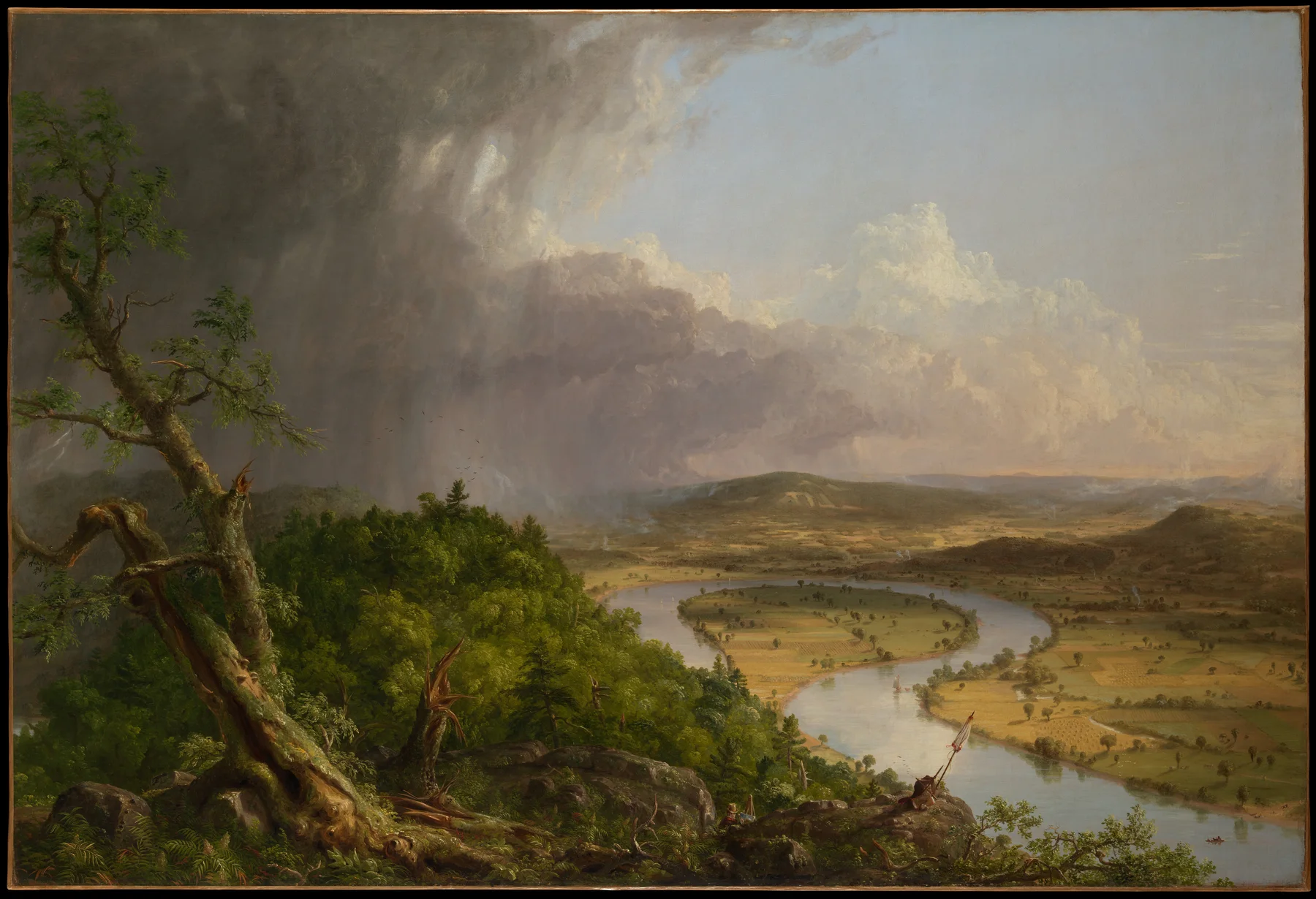
The river is the most memorable shape in Cole’s Oxbow, but this is not a seascape. It is a view across a Connecticut River valley in Massachusetts. The Met’s record dates the painting to 1836 and identifies the small artist at work in the foreground.
Start with the split in the weather. On the left, dark clouds press against tangled trees. On the right, light opens over fields and a broad river bend. Those are not two separate pictures: the curve of the water draws the eye across the division.
The fields also matter. This is not simply “nature with no people in it”. Cultivation is visible even where individual workers are too small to pick out. A landscape can show human activity through roads, cleared ground and planted fields, not only through a crowd of figures.
That helps explain why “beautiful scenery” is too narrow a definition. The Met’s history of Netherlandish landscape painting discusses invented as well as observed views, and pictures with meanings connected to land, work and ownership. A landscape can invite reflection on a place without acting as a neutral map of it.
Sea and city side by side
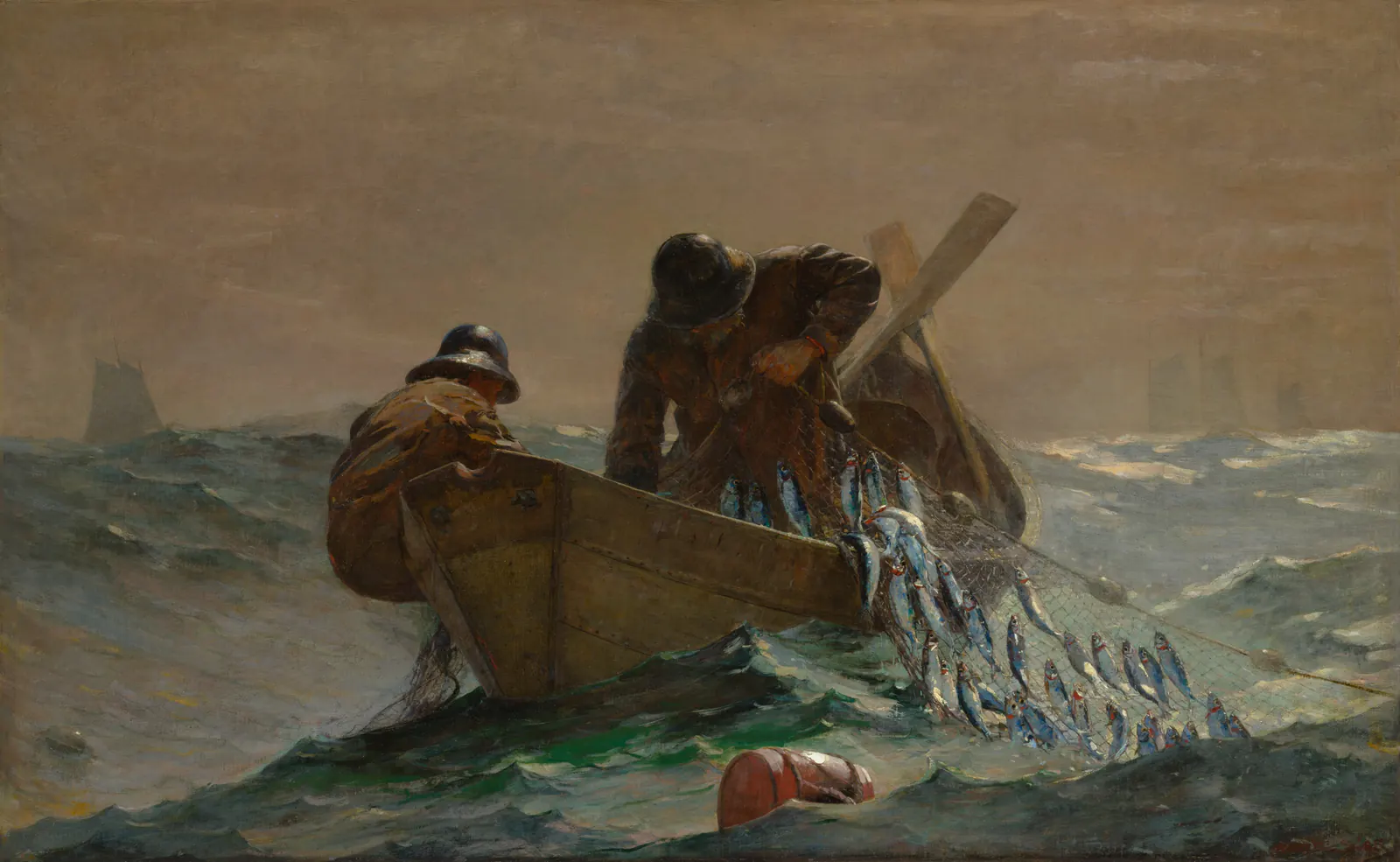
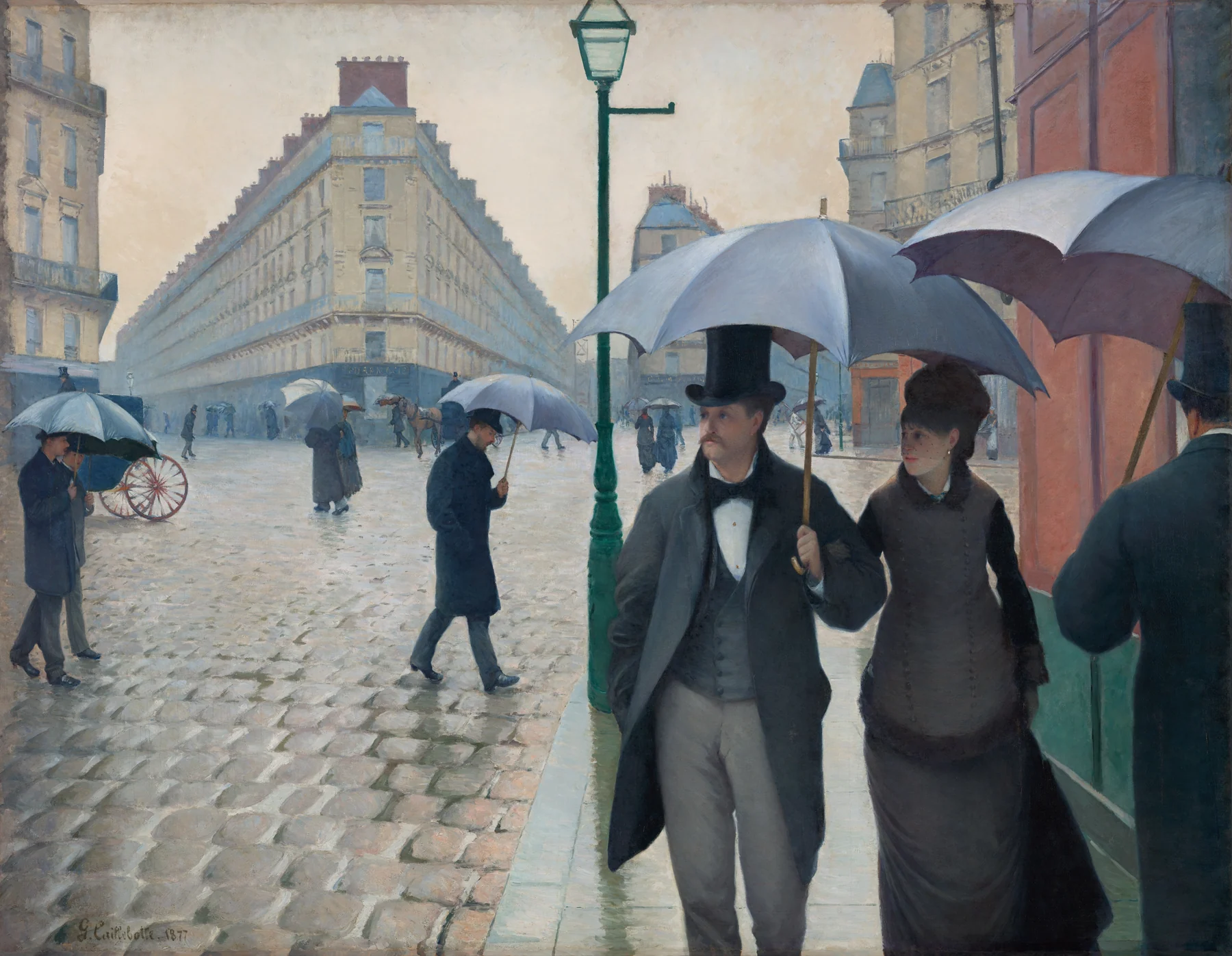
Notice how differently the foreground works. Homer’s boat rises towards us, with no stable pavement to stand on. Caillebotte gives us a broad walkway, but the approaching figures and overlapping umbrellas make that space feel occupied.
Both are oil paintings on canvas. Their different subject labels therefore tell us nothing about a change of medium. Nor do the labels prescribe mood: the sea can be peaceful or threatening, and a city can feel crowded or strangely empty.
Homer’s seascape is also a working scene
In The Herring Net, painted in 1885, the sea is not decorative background. The small boat sits among waves as the figures bring in their catch. The Art Institute’s record connects the painting with Homer’s work in coastal Maine and describes the physical demands of fishing.
Look at the net. Its diagonal line links the person hauling it to the water, where the silvery fish remain partly submerged. The boat’s angled side is answered by the sloping wave beneath it. The figures’ work and the water’s movement cannot be separated without changing the scene.
We can therefore call this a seascape and a picture of labour. We do not have to erase the people to make the first label fit. The category tells us what sort of world we are looking at; it does not exhaust what is happening there.
Caillebotte’s city is more than buildings
Caillebotte painted Paris Street; Rainy Day in 1877. The Art Institute’s collection record identifies its modern Parisian setting. The tall buildings matter, but so do the routes between them and the people using those routes.
Follow the pavement into the distance. Then follow the streets on either side of the wedge-shaped building. These lines make the intersection readable as a space people can cross. The lamppost divides the image, while the umbrellas create smaller rounded shapes against the long straight edges.
The rain connects bodies and architecture. It gathers as a sheen on the paving and makes the umbrellas necessary. A cityscape need not be a building portrait with incidental people added afterwards: it can be about moving through a shared environment.
Where the categories overlap
Imagine a painting of a harbour: warehouses on one side, fishing boats on the other, and a strip of sea beyond. “Cityscape” could describe the built waterfront; “seascape” could describe its maritime setting. Both may be helpful, depending on the question you are asking.
The same is true of a rural river scene. “Riverscape” is a useful, more specific description within the larger language of landscape. It need not replace every broader label. A catalogue can give several subject terms without suggesting that the artist was confused.
For your own looking, choose the term that explains the picture’s main organisation, then add a second if it helps. “A coastal landscape with a harbour” says more than forcing an image into one supposedly perfect box.
Landscape does not mean horizontal
“Landscape orientation” means a rectangle wider than it is tall. “Portrait orientation” means the reverse. These are page and image formats, not reliable descriptions of subject matter.
A tall mountain view remains a landscape. A wide group portrait does not become scenery. Likewise, an upright photograph of a city street can be a cityscape even if a printer’s menu calls its format “portrait”. Separate what the picture shows from which way the rectangle runs.
Choosing a view by looking
Try comparing the route your eye takes: along Cole’s river, across Homer’s moving water, or down Caillebotte’s streets. Then notice the weather, the amount of open space and the role of people. Those features offer more useful distinctions than choosing only by a category name.
If you are comparing reproductions, keep the original’s medium and the new object’s material separate too. A printed cityscape is not an oil painting because its source was painted in oil. Our guide to originals, reproductions and prints explains that final distinction.
Editorial record
About this article
- Author
- Publisher
- GeMarkt
- Published
- Reviewed
- Internal source & rights check. Conducted by GeMarkt Research Review. This is an internal editorial check—not independent peer review.
- Source standard
- Art history source standardPrioritises object records and research sources, distinguishes evidence from interpretation, and states material uncertainty.
Found a claim that needs checking? Report a factual error.