GeMarkt Blog · Reference
Is Young Hare by Albrecht Dürer Public Domain?
Check Dürer’s 1502 Young Hare, distinguish it from later copies, and understand the rights of the exact ALBERTINA image used here.


The short answer
Dürer’s 1502 Young Hare is outside the ordinary author copyright term in Germany and the UK. The particular image shown here is offered under CC BY-SA 4.0, not as an uncredited museum download. Its image credit, licence link and change notice should travel with it.
This check, dated 12 October 2026, concerns the drawing in Vienna’s ALBERTINA, inventory 3073. We have not independently completed its U.S. publication history. The answer is therefore specific to the old drawing, the countries considered and the identified digital file—not permission for every hare image online.
Which hare is Dürer’s?
The ALBERTINA object record calls the work Feldhase, dates it 1502, and records watercolour and bodycolour, heightened with white, on a sheet measuring 25.1 × 22.6 cm. It is a work on paper, not an oil painting or an engraving. The date and familiar AD monogram appear beneath the animal.
Those details are useful when searching for a file. “Dürer rabbit” may bring up the original, an early copy, a contemporary illustration or a shop’s cleaned-up version. The animal’s subject is not an object identifier. The combination of title, date, collection and inventory number is much more dependable.
The English title Young Hare is conventional; A Young Hare and Hare also occur. None of those changes creates a different artwork. A different signature, a landscape setting or altered pose may do so. Before comparing resolution or colour, establish which picture you have actually found.
Look at the sheet, not just the animal
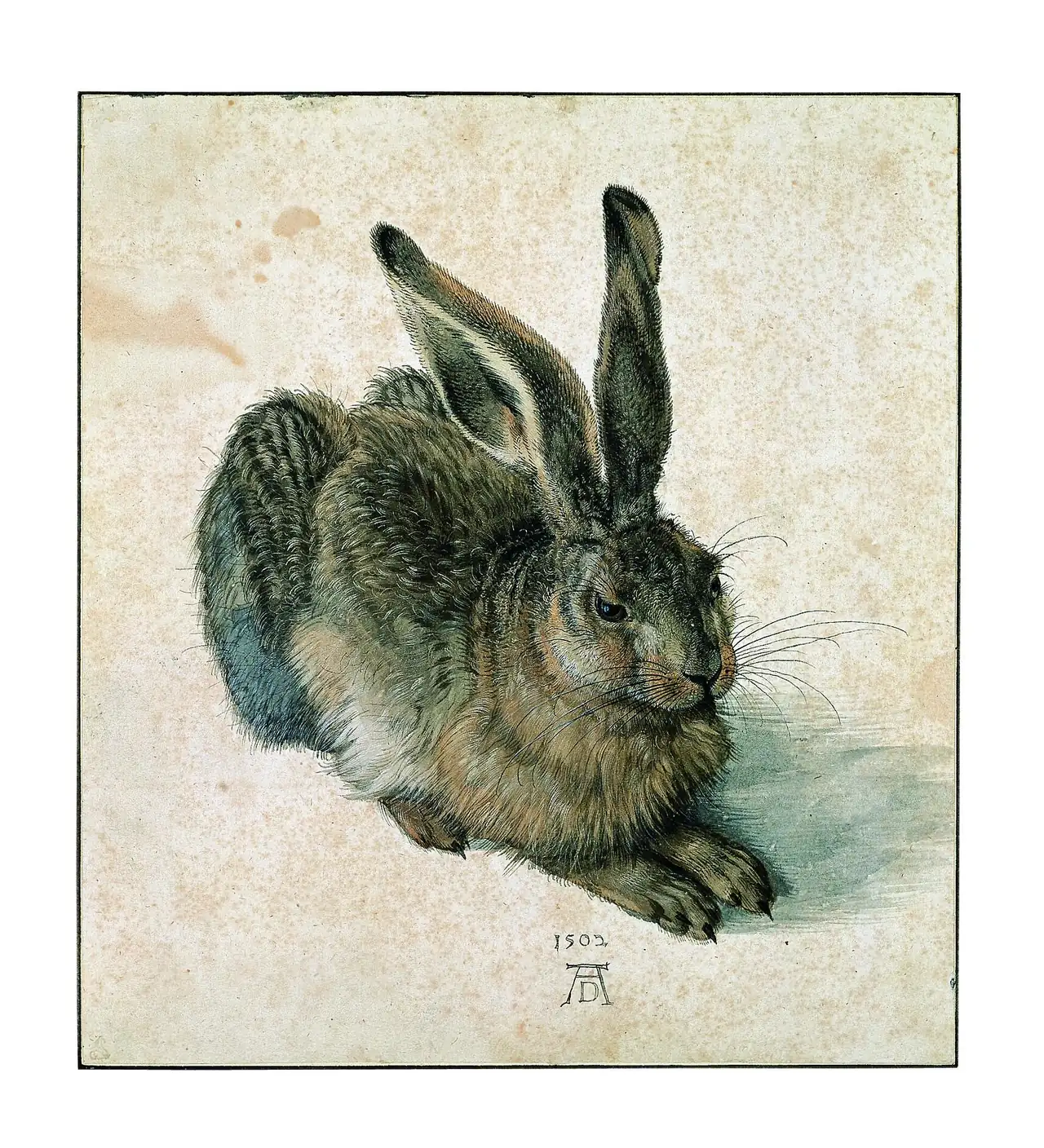
The fur is not an even brown surface. Short pale strokes turn around the back, darker passages deepen the chest, and the ears have sharply different inner and outer edges. The small front paws anchor the animal while the long whiskers reach beyond its compact outline. Much of the apparent softness comes from these changes of direction.
The surrounding paper is equally important. There is no fully described meadow or room. The shadow gives the body weight without filling the space around it. A cut-out on a brilliant white background loses that relationship, even if every part of the animal remains visible.
Our source also retains the sheet’s uneven tone, marks and dark boundary. These are visible features of this digital reproduction, not an instruction to manufacture distressed paper. If you are choosing an image for an article or print, decide whether you want to show the historical object or create a new decorative adaptation. Both the description and the credit should make the choice intelligible.
A famous hare can still be the wrong hare
An especially instructive comparison is Hans Hoffmann’s A Hare in the Forest at the Getty. Its subject owes a clear debt to Dürer, but the surrounding plants and wooded setting make it a separate painting. Getty identifies Hoffmann as its maker, dates it about 1585, and gives accession 2001.12.
That distinction matters more than whether both artists died centuries ago. If you download Hoffmann’s composition and label it “Dürer, 1502,” the problem begins with a false identification. An expired copyright term cannot repair it. Nor should a restoration photograph, a modern painted copy or an enlarged detail inherit the original’s title without explanation.
This is also why a reverse-image result is only a starting point. Compare the position of the ears, the paws, the bottom inscription and the space surrounding the animal. Keep the institution’s object page open beside the file record. Small differences can reveal that two apparently interchangeable downloads describe different objects.
The drawing and the digital file
Dürer died in 1528. Germany’s Copyright Act, sections 64 and 69, and the UK government’s term guidance establish ordinary life-plus-seventy rules. The original author’s term has expired in those jurisdictions. This is not a claim that every country treats every later contribution identically.
The digital source is a separate question. The ALBERTINA website’s general notice reserves rights in its online material and directs reproduction enquiries to the institution. We have not treated the museum’s ordinary collection image as a freely licensed download.
Instead, the illustrated file has its own Commons description page. An account named Albertina pressoffice uploaded it in 2015, identified it as its own work and released it under CC BY-SA 4.0. That explicit file-level statement is the basis for this illustration. It should not be silently applied to another scan or to all ALBERTINA images.

What remains unresolved in the United States
The U.S. question needs publication evidence, not simply “painted in 1502.” Sections 303 and 304 distinguish older published and previously unpublished material; qualifying first publications in 1978–2002 can engage a 2047 minimum term. We have not independently closed that publication inquiry for this drawing.
The museum’s extensive bibliography supplies research leads. A catalogue citation alone does not show whether a book actually reproduced the work, which version appeared or what authority lay behind publication. We therefore do not turn a long list of references into a claimed inspection of old illustrated pages.
That limit does not mean the drawing was secretly made recently, or that its old German author term remains active. It means two questions have different evidence. For a use requiring a definitive U.S. opinion, the next step is to examine the relevant historical reproductions and their circumstances, not to substitute a more confident sentence here.
Using this particular image
The CC BY-SA 4.0 terms permit commercial sharing and adaptation with attribution, a licence link and disclosure of changes; adaptations must use the same or a compatible licence. The licence is not a claim that the museum endorses your project.
For an unchanged editorial illustration, name the artist and object, then separately identify the image contributor. If you crop the ears, remove the signature, isolate the animal or alter the colours, describe that intervention. Do not imply that a modified image is a fresh museum photograph of the complete sheet.
Our version is a proportionally reduced copy of the supplied file. It keeps the source composition and does not reconstruct damaged areas or invent more fur detail. A larger pixel count produced by enlargement would not establish more original information. Likewise, a polished preview on a product listing cannot demonstrate how closely a physical print matches the drawing.
What to keep with your download
Save the file’s source page, contributor name and licence alongside the image. Add Dürer, Young Hare, 1502, ALBERTINA 3073 to the working record. That modest habit prevents a future layout change from stripping away the evidence that made the file useful in the first place.
Keep the chosen crop separate from the untouched source, and write down whether a layout uses the whole sheet or only the animal. When passing the file to a designer, include the credit as text rather than hoping it survives in an image’s embedded metadata.
For the wider artist context, see our Dürer guide. For this particular hare, the useful conclusion is narrower: an old drawing, an identifiable openly licensed image, and a clearly stated limit on the independent publication research. Those are more helpful than a universal “free to use” badge.
Editorial record
About this article
- Author
- Publisher
- GeMarkt
- Published
- Reviewed
- Internal source & rights check. Conducted by GeMarkt Research Review. This is an internal editorial check—not independent peer review.
- Source standard
- Rights guide source standardSeparates the underlying work from the source file, records the review date, and links the evidence used for the conclusion.
Found a claim that needs checking? Report a factual error.