GeMarkt Blog · Reference
Is Whistler’s Mother Public Domain?
Whistler’s 1871 portrait has a documented early reproduction history. Check the original painting separately from the photograph you want to use.


The short answer
Yes: Whistler’s 1871 painting is public domain under the ordinary life-plus-70 rules considered here, and its documented nineteenth-century reproductions support a U.S. public-domain conclusion. That does not make every modern photograph, download service or altered version unrestricted.
This guide concerns Arrangement in Grey and Black No. 1, usually called Whistler’s Mother, in the Musée d’Orsay, accession RF 699. The image shown below is a particular Google Art Project reproduction distributed on Wikimedia Commons with a public-domain designation. It is not a licence to take any picture from the museum’s website.
Which portrait we mean
The familiar nickname can make the picture sound more straightforward than it looks. It is a portrait of Anna Matilda McNeill Whistler, but the formal title asks us to notice an arrangement of tones as well as a person.
The Musée d’Orsay record dates the oil painting to 1871, identifies the sitter and gives its dimensions as 144.3 × 163 cm. Whistler painted it in London; the French state acquired it from him in 1891. Those details identify the canvas, not the date on which a modern image became available.
Several titles describe the same object: Portrait of the Artist’s Mother, the French La mère de l’artiste, and the better-known short English name. An engraved reproduction can use those titles too. Check whether the record says painting, mezzotint, lithograph or photograph before copying its medium into your caption.
Our Whistler artist guide places the portrait within a wider body of work. A permission attached to one file there should still be checked against the particular image you select here.
Look at the room, not only the face
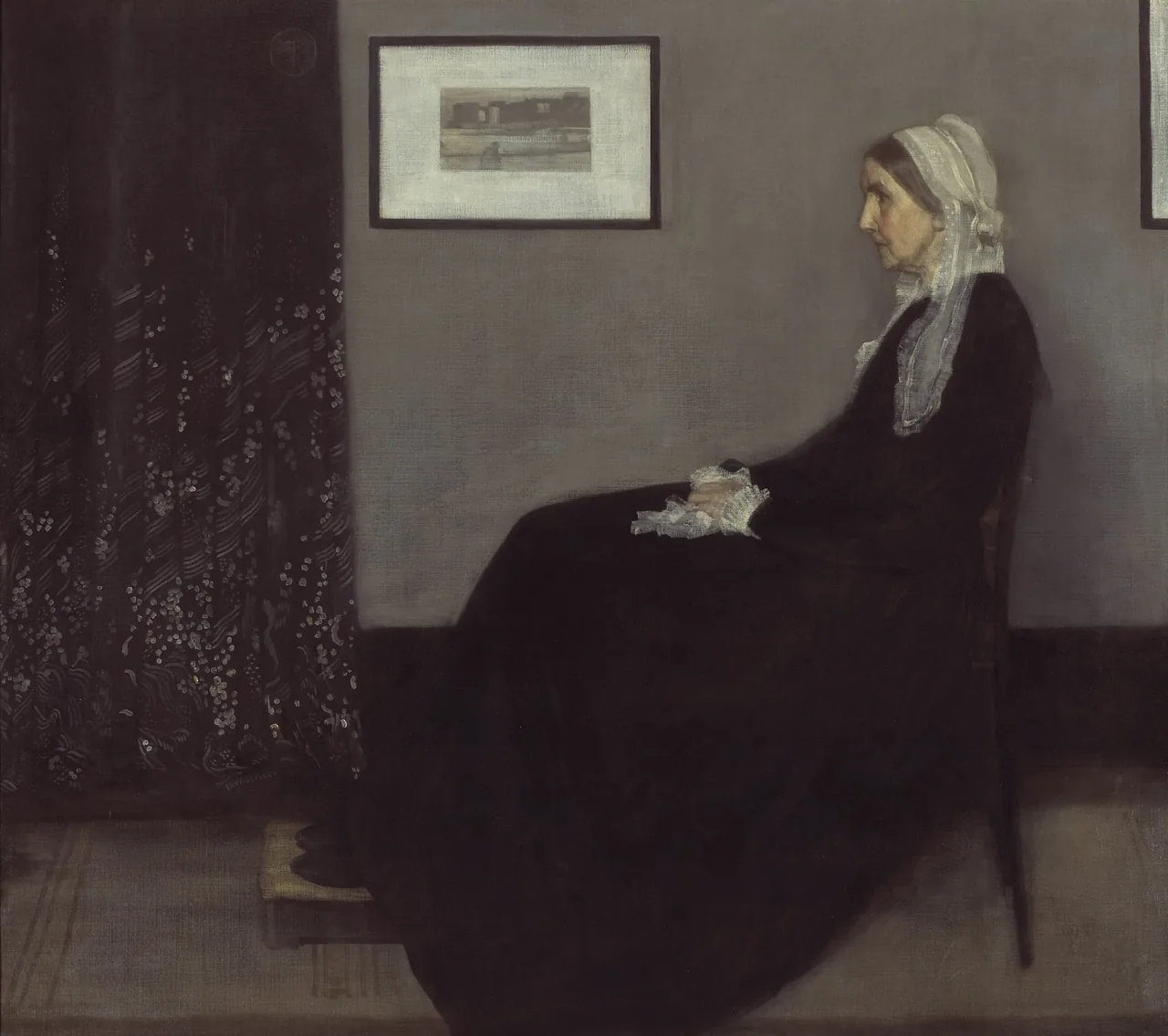
The white cap and small pale hands attract attention because almost everything around them is quieter. The black dress forms a broad shape beneath the sitter’s face. Across the room, the patterned curtain makes a second dark area with a very different surface.
Try covering the left third of the image with your hand. The result still contains a recognisable woman, but the balance changes. The rectangle of the wall print, the curtain’s vertical edge and the low footstool no longer work together in the same way. A tight portrait crop would therefore be a detail of the painting, not an interchangeable replacement for it.
This matters when choosing a download. A file with deeper blacks can seem more dramatic while concealing the chair and dress. A very cool grey treatment can make the room feel different. Public-domain status cannot tell you which colour rendition is faithful; that is a separate image-quality judgement.
The early reproductions matter
For this painting, the evidence goes beyond an old creation date. The University of Glasgow’s Whistler catalogue describes a mezzotint made by Richard Josey and published by Graves. It records Whistler’s 1879 copyright assignment concerning that engraving and reports that 100 impressions had been printed by August that year.
The same institutional history documents a photograph offered for sale at Goupil’s in 1892 and Whistler’s support for a signed photograph in the exhibition album. These are concrete records of reproduction and circulation with the artist’s involvement. They provide a much stronger basis than treating the painting’s 1872 exhibition as publication by itself.
This guide relies on the catalogue’s documented findings; it has not independently examined every underlying contract or surviving impression. Nor does it claim that an engraving and the present colour photograph are the same copyright object. The historical evidence supports the age and authorised circulation of the depicted composition, while the selected digital file needs its own assessment.
Where the copyright answer applies
Whistler died in 1903. His ordinary economic copyright term has expired in jurisdictions using the familiar life-plus-70 rule, including the United Kingdom. This is about the artist’s painting, not a promise that all countries regulate reproduction photographs identically.
For the United States, the early reproduction evidence puts this composition well before the current published-work cutoff described by the Copyright Office. A serious commercial rights file should retain those historical references, rather than reducing the reasoning to “painted in 1871”.
Ownership of the canvas and the right to control a particular photographic service are different questions. So are copyright, contractual download conditions and any suggestion that a museum endorses a product. The public-domain answer should not be stretched to cover claims it never examined.
The file shown here
The selected Commons record identifies a Google Art Project reproduction. It applies PD-Art and Public Domain Mark 1.0, describing the file as a faithful reproduction of a two-dimensional work. That is the repository’s assessment, not a fresh licence issued by the Musée d’Orsay.
The museum’s own collection page credits named photographers for its displayed photographs. Do not copy those credits onto the Commons file, or assume that a public-domain label elsewhere overrides the museum service’s terms. Keep the file, its source page and its rights statement together.
One small metadata trap is worth noting: the Commons page uses 974 in an accession field. That is the museum website’s object identifier; the museum inventory number is RF 699. Use the latter to identify the painting, and the full file-page link to identify the reproduction.
Choosing a printable reproduction
Start with the largest genuine source file available under conditions that fit your use. Then inspect the face, lace, curtain and wall print at actual size. Enlarging a preview may create more pixels without revealing more painted detail.
Leave room for the full composition when fitting a standard frame. A border or mount can preserve the painting’s proportions without removing the curtain or footstool. If you deliberately use a detail, say so and show the crop before someone orders it.
Do not advertise a digitally brightened version as the painting’s definitive original colour. Screens, older reproductions, lighting and image processing can all change the appearance. For a large physical print, a small proof of the darkest areas is more informative than a sharp-looking thumbnail on a phone.
A useful credit and a final check
A clear credit can name James McNeill Whistler, Arrangement in Grey and Black No. 1, 1871; Musée d’Orsay, RF 699; image via Google Art Project/Wikimedia Commons, PD-Art. Link the actual source record rather than the results page where you first found it.
For ordinary reuse, the distinction to remember is simple: the historical painting has a strong public-domain basis; the exact modern file still needs a traceable source. If a planned publication or product requires formal territorial clearance, retain the Glasgow reproduction evidence and obtain advice for that use. This article supplies a documented starting point, not a personalised legal opinion.
Editorial record
About this article
- Author
- Publisher
- GeMarkt
- Published
- Reviewed
- Internal source & rights check. Conducted by GeMarkt Research Review. This is an internal editorial check—not independent peer review.
- Source standard
- Rights guide source standardSeparates the underlying work from the source file, records the review date, and links the evidence used for the conclusion.
Found a claim that needs checking? Report a factual error.