GeMarkt Blog · Reference
Is Wanderer above the Sea of Fog by Caspar David Friedrich Public Domain?
Check Friedrich’s Hamburg painting, the Cybershot800i reproduction and the difference between public-domain art and a restricted museum photograph.


The short answer
Friedrich’s ordinary EU and UK author copyright term has expired. The exact reproduction illustrated here is marked public domain by Wikimedia Commons. Those are separate findings: neither means that every photograph, book cover or museum download of Wanderer above the Sea of Fog has unrestricted reuse terms.
This guide checks the Hamburg painting and a named photographic reproduction as of 12 October 2026. Commons asserts an early U.S. publication basis. We report that designation; we have not independently established the qualifying publication and authorisation for this particular painting.
Which Wanderer are we checking?
The Hamburger Kunsthalle’s current caption identifies Wanderer über dem Nebelmeer, around 1817, oil on canvas, 94.8 × 74.8 cm. It is the upright composition with a standing man, walking stick and rocky foreground, not another Friedrich landscape with a figure seen from behind.
You will also encounter circa 1818 in image descriptions and older captions. A date difference of that scale does not change the ordinary author-term conclusion, but it should not silently become a claim that there are two otherwise identical paintings. Here we follow the museum’s current dating and dimensions.
The selected Commons record identifies the work with inventory 5161 and links the Kunsthalle object record. Its dimensions differ from the museum caption, so we do not copy that field into our object description. A reusable image and an accurate catalogue entry still need to be checked separately.
The Friedrich artist guide covers a wider group of works. This page is narrower: one composition, one illustrated file, and the practical questions that follow from reusing it.
Look at the space around the figure
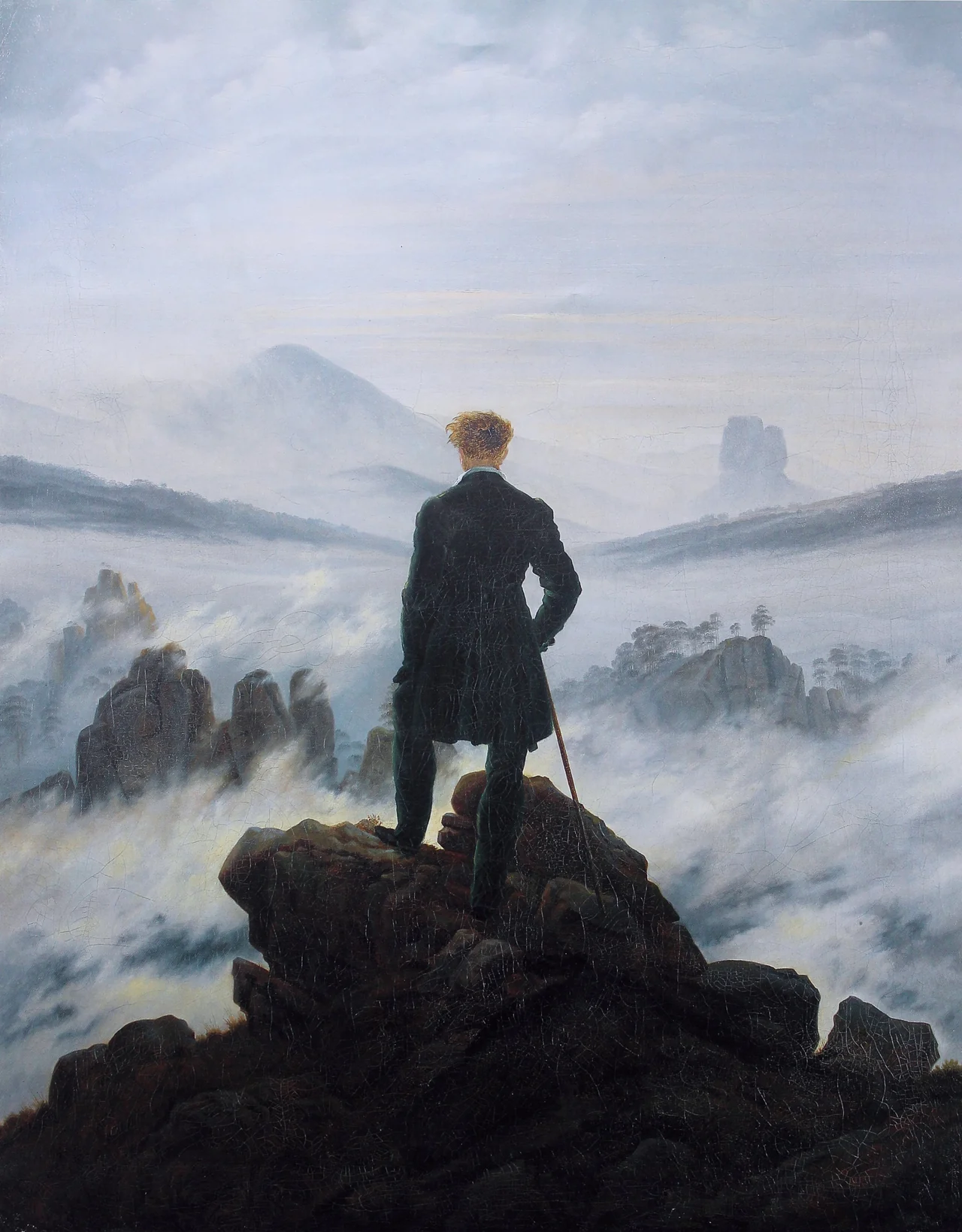
The man’s coat is one of the darkest areas of the painting. His silhouette is easy to recognise even at a small size, but much of the image’s tension lies beyond him. Firm foreground rock gives way to broken peaks and mist, so the apparent certainty of his stance meets a landscape that is difficult to measure.
The figure blocks part of our view. We look in roughly the same direction without being able to occupy his exact position. That makes the picture more complicated than a simple illustration of someone conquering a mountain. Confidence, hesitation and contemplation are possible responses; the visible image does not prove what the man is thinking.
Notice the amount of sky above his head. Cropping tightly to the coat turns the composition into a portrait-like emblem. Keeping the upper space allows the horizon and mist to compete with the figure. A wide crop can make the rocky perch look more secure by removing some of the uncertain space around it.
These observations also help when choosing a reproduction. Excessive sharpening makes cracks compete with painted forms; strong contrast can turn the mist into hard-edged scenery. Compare the complete composition before assuming that a more dramatic-looking download is a more faithful one.
The painting and its reproduction have different records
Friedrich died in 1840, well beyond the ordinary life-plus-seventy terms described by EU guidance and the UK Intellectual Property Office. This is an author-term finding, not a worldwide ruling about every later image.
The Kunsthalle caption credits its displayed photograph to Elke Walford. That is not the photographer named on our selected file. Substituting the museum’s picture while retaining somebody else’s public-domain label would leave the source record wrong, however similar the pictures look.
Likewise, a modern poster can combine the painting with typography, layout and newly added scenery. The age of Friedrich’s canvas does not grant permission to copy that whole design. If you need the unaltered painting, begin with an identifiable reproduction rather than removing text from a finished commercial poster.
The file used on this page
Our exact Commons file names Cybershot800i as the maker of the photographic reproduction. It describes the image as a faithful reproduction of a two-dimensional public-domain work and applies PD-Art / Public Domain Mark 1.0. We use that file, not the Kunsthalle’s separately credited photograph.
The Public Domain Mark records a status assessment rather than granting a new licence. Commons also acknowledges that the treatment of faithful art reproductions can differ between jurisdictions. Our attribution makes the basis visible instead of presenting it as a museum permission letter.
The image here retains the source’s proportions and complete composition. No mountain, patch of fog or painted detail has been generated to fill a screen. Its display size is suited to this article; that is not a promise that the same file is adequate for a large commercial print.
What the US publication check still needs
The Commons record states that the work was published or registered before 1 January 1931, but does not identify the qualifying reproduction in the visible licence statement. We have not independently closed that historical chain. “Around 1817” dates the painting, not an authorised publication.
U.S. term rules distinguish older published works from works formerly unpublished; some transitional cases have later minimum terms. The relevant starting point is the copyright-duration statute, not an assumption that every nineteenth-century painting followed the same publication history.
For a project requiring an independent clearance opinion, look for an identifiable early illustrated edition, its date and evidence connecting its issue to the rights holder. A modern museum display or a catalogue that merely lists a title is not the same evidence. Keep that unanswered question separate from the provider’s explicit public-domain designation.
Using the image without misrepresenting it
A book cover, a lecture slide and a phone wallpaper ask different things of this composition. On a cover, the apparently empty sky can hold a title without covering the figure, but it remains painted space. On a slide, show the full view first so that a later detail has context. On a phone, test the clock and notifications before deciding where the picture should sit.
Do not stretch the standing figure to fit a narrower rectangle. If a crop is necessary, call it a detail or cropped reproduction. If you use a newly interpreted version with extended clouds, make that distinction visible rather than captioning the result as Friedrich’s intact painting.
Commercial use also needs the actual source record retained with the production file. A folder labelled “Friedrich free” will not explain which image was used, who supplied it or whether a later replacement came from a different provider.
A credit that keeps the source findable
Useful credit information is compact: Caspar David Friedrich; Wanderer above the Sea of Fog; around 1817; Hamburger Kunsthalle; photographic reproduction by Cybershot800i; exact Commons file; PD-Art / Public Domain Mark. Keep the linked record as well as the words.
The practical conclusion is a bounded one: the old painting’s ordinary EU/UK term is expired and a specifically identified public-domain reproduction is available. That is much more useful than either “everything online is free” or “the museum owns the picture, so nothing can be reused.” This guide is information, not individual legal advice.
Editorial record
About this article
- Author
- Publisher
- GeMarkt
- Published
- Reviewed
- Internal source & rights check. Conducted by GeMarkt Research Review. This is an internal editorial check—not independent peer review.
- Source standard
- Rights guide source standardSeparates the underlying work from the source file, records the review date, and links the evidence used for the conclusion.
Found a claim that needs checking? Report a factual error.