GeMarkt Blog · Reference
Is Walk on the Beach by Joaquín Sorolla Public Domain?
Check Sorolla’s 1909 Walk on the Beach, Spain’s longer historical term and the separate source conditions of the complete image shown here.


The short answer
Sorolla’s original Walk on the Beach is out of its author copyright term in Spain and the UK. That does not make every digital image of it unrestricted everywhere. The full composition shown here comes from a Google Art Project file that Wikimedia Commons designates as a faithful public-domain reproduction.
This guide, checked 12 October 2026, concerns the 1909 painting in Museo Sorolla, inventory 834. Its independently documented U.S. publication history remains incomplete here. The Commons assessment is attributed to that provider, not presented as a legal guarantee or as a commercial licence issued by the museum.
Identify the Madrid painting
The Museo Sorolla object record identifies Paseo a orillas del mar, an oil painting on canvas measuring 205 × 200 cm. English names include Walk on the Beach and Strolling along the Seashore. They refer here to the same near-square painting, not to a general category of Sorolla’s seaside scenes.
The two women are Sorolla’s wife Clotilde and daughter María. The museum dates the work to the summer of 1909 in Valencia. Their elegant walking clothes distinguish the scene from pictures of children bathing or people working at the water’s edge. It is a family portrait within a coastal setting, rather than an anonymous pair added to a landscape.
A title search alone is particularly unreliable for an artist who repeatedly painted beaches. Confirm the two figures, the sweeping white fabric and the holding collection. A picture of a single woman, a group of swimmers or a different stretch of sand should not inherit this painting’s caption because a retailer has given it a similar English name.
What the full composition shows
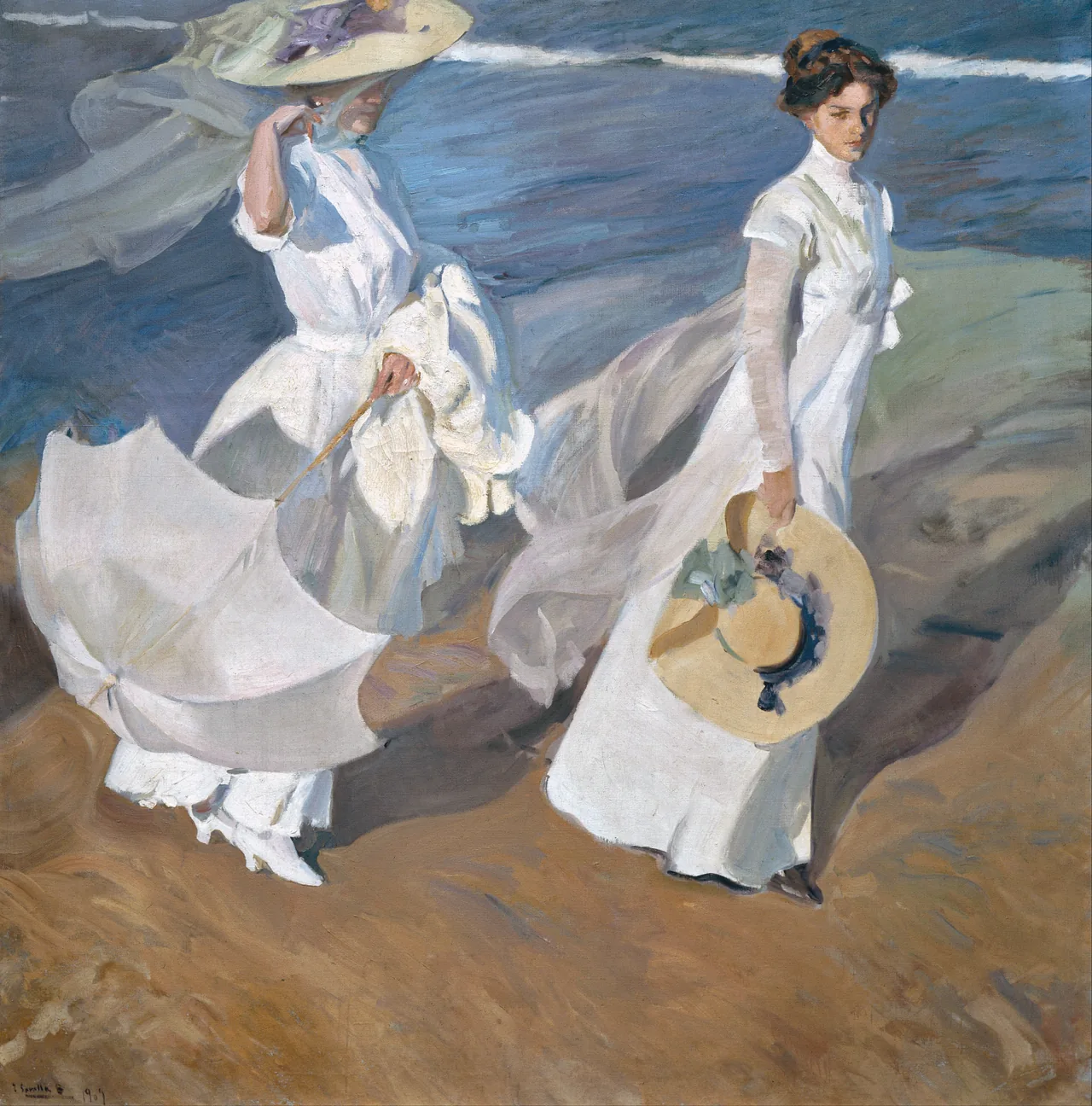
The women fill much of the image, but the space below them is not wasted. Their shoes meet the sand well above the bottom edge. The remaining foreground gives their movement somewhere to continue and makes the dark, diagonal shadows legible. Cropping tightly around the faces and dresses turns an outdoor walk into a much more conventional double portrait.
The figure on the right carries a broad hat low beside her body. Its yellow oval, dark ribbon and flowers offer a compact answer to the much larger pale mass of her dress. On the left, the other hat reaches beyond the top of the composition. Those unequal positions keep the two figures from reading as a symmetrical pair.
The full view also makes the direction of the breeze easier to follow. Fabric stretches across the space between the women, while a translucent veil streams towards the left edge. Their bodies move together, but the cloth describes movement of its own. This is why removing a seemingly empty patch of water can change more than the picture’s proportions.
White clothes without white shadows
At thumbnail size the dresses look simply white. Enlarged, they contain cool blue-grey, lavender, warm cream and narrow darker folds. The broad light areas remain convincing because they are interrupted rather than filled with a single brilliant tone.
Compare the dress on the right with the water immediately behind it. Some of the cool colours seem close enough to connect the figure to the sea, but the sharper edge of her sleeve separates flesh and fabric from the moving background. At the lower hem, small dark accents give the dress weight. The picture feels airy without dissolving into a uniformly pale surface.
These details are useful when judging a reproduction. An aggressively brightened file can flatten the folds into white patches. Heavy sharpening can make the loose marks resemble hard outlines. Strong saturation may produce an attractive blue beach while losing the relationships that make the clothes luminous. A pleasing screen preview is therefore not automatically the most faithful source for a print.
Spain’s longer historical term
Sorolla died in 1923. Spain’s transitional rules retain the older term for authors who died before 7 December 1987, rather than applying a simple life-plus-70 calculation to all of them. The Biblioteca Nacional de España’s public-domain explanation describes the relevant 80-year period.
Applying that term and the calendar-year rule gives 1 January 2004 for the expiry of Sorolla’s ordinary economic author rights in Spain. Spain’s copyright statute, transitional provision four and articles 30 and 41, also makes the calculation and continuing authorship/integrity considerations relevant. The ordinary UK life-plus-70 term has expired too.
This is a country-specific answer about the old painting. It is not a reason to remove a photographer’s name from a licensed photograph, to copy a new essay, or to claim that a museum endorsed a product. Different contributions need to be identified before their permissions can be combined.
The American publication question
The date 1909 tells us when the painting was made. It does not identify an authorised edition of reproductions. Nor does a successful exhibition establish that this particular picture was reproduced and distributed in a way relevant to copyright.
U.S. law distinguishes older published works from works that remained unpublished; some qualifying later publications carry different deadlines. The Copyright Office’s duration provisions are why an early painting date alone is insufficient.
The Commons file labels the work as published or registered before 1931. This guide has not independently established that claim through an identified early reproduction of this exact painting. A catalogue reference should be checked for its illustration, date and authorisation, not merely for a mention of Sorolla’s name. Until then, the independent U.S. branch remains open rather than becoming an unsupported worldwide “yes”.
The exact file is a separate choice
The selected Commons file records its source as Google Art Project and carries PD-Art and Public Domain Mark assessments. Those labels describe a view of the file’s copyright status. They are not a negotiated museum licence and do not eliminate country-specific questions.

The file page also illustrates why metadata deserves scrutiny: some automatically supplied fields disagree with the work’s established identity. The museum’s inventory number, dimensions and visible composition take priority over a stray generated title. Do not reproduce an obvious catalogue mismatch simply because it accompanies a high-resolution download.
Another available photograph of the painting is credited to a living photographer under an attribution licence. Such a file can be a legitimate alternative, but its credit and conditions must travel with it. Choosing a different photograph does not mean that the painting itself has changed copyright status.
Reproducing the painting without changing its identity
For an article, retain the complete view when explaining the walk, the fabric or the shadows. If you need a detail of a face or a fold, call it a detail and provide a route back to the whole composition. A crop should make the discussion easier to follow rather than conceal the source’s limitations.
For a print, inspect the source at the intended output size. Keep a record of where the file came from and avoid describing automatic enlargement as a new museum scan. A digital edit that replaces texture, extends the sand or invents fabric is an adaptation, even when the original painting is old enough to reuse.
The strongest caption is uncomplicated: artist, title, date, collection and the actual image source. Our Sorolla artist guide places this question alongside other works. For Walk on the Beach, the essential distinctions remain the Madrid painting, its country-specific status and the particular file you intend to use.
Editorial record
About this article
- Author
- Publisher
- GeMarkt
- Published
- Reviewed
- Internal source & rights check. Conducted by GeMarkt Research Review. This is an internal editorial check—not independent peer review.
- Source standard
- Rights guide source standardSeparates the underlying work from the source file, records the review date, and links the evidence used for the conclusion.
Found a claim that needs checking? Report a factual error.