GeMarkt Blog · Practical guide
Is Joaquín Sorolla’s Art Public Domain? Light, Paintings and Image Sources
Explore Sorolla’s beach scenes and gardens through two Getty images, twelve museum records and separate checks for Spain, U.S. publication and the exact file.
Rights check · reviewed
The short answer
The two displayed Getty images are supplied under CC0. Sorolla’s ordinary EU/UK author term and Spain’s longer legacy term have elapsed. This guide does not independently establish U.S. publication histories for the twelve paintings, including the two displayed works, or clear every online reproduction.
| What is being checked | Result | Why |
|---|---|---|
| European Union — ordinary author term | Ordinary named-artist term has elapsed | Sorolla died in 1923. The ordinary life-plus-70 term has elapsed, but national exceptions, moral rights, later first-publication rights and separate contributors still require attention. |
| United Kingdom — ordinary artistic-work term | Ordinary artist term has elapsed | A term conclusion is not permission for every photograph, adaptation or older unpublished work. |
| Spain — legacy author term | The older 80-year term has elapsed | Spain’s transitional rule retains the 1879-law term for authors who died before December 7, 1987. Applying 80 years and calendar-year counting to Sorolla’s 1923 death gives January 1, 2004. Authorship and integrity obligations remain separate. |
| United States — all twelve research works | Independent publication histories unresolved | Getty’s designations are attributed, not replaced by an independently proven publication chain. The Prado’s reported 1909 book reproduction of Boys on the Beach is a useful institutional lead; the original book and authorisation were not independently inspected. A signed year or exhibition is not publication proof. |
| Selected digital files | Two exact Getty Open Content / CC0 files | The Wounded Foot, 78.PA.68, and Hall of the Ambassadors, Alhambra, Granada, 79.PA.154, each have an exact official object record carrying CC0 and a preserved official image derivative. Full image extents are retained. |
| Other works and files | Ten display HOLDs, not ten findings of copyright | No reviewed display image was acquired for the other ten records. The current Met isPublicDomain:false and AIC is_public_domain:false flags were not silently changed to CC0; they are provider file flags, not blanket legal conclusions about the paintings. |
Twelve exact research objects, two selected Getty CC0 images and ten display HOLDs. Getty’s official 1600px IIIF derivatives are identified as derivatives, not original-resolution scans. The Met and AIC non-open API flags are preserved; no catalogue-wide or worldwide permission is claimed.
This is a documented research summary, not legal advice. Copyright and moral-rights rules can vary by country and by the history of a particular work.

What we’ll look at
Which Sorolla painting and which image file can you actually identify and use?
Short answer: The two Sorolla images shown here are available through Getty’s Open Content programme under CC0. His ordinary EU/UK author term has elapsed, as has Spain’s longer legacy term. That does not make every online Sorolla image unrestricted: this guide does not independently establish the U.S. publication history of every painting, including these two.
Sorolla is often reduced to white clothes and dazzling water. Those are memorable ingredients, but they leave out the encounters, working bodies and carefully arranged spaces that make his pictures more than sunny scenery. A useful introduction should help you see those things—and distinguish a specific painting from a vaguely labelled download.
Light with something happening
Joaquín Sorolla y Bastida lived from 1863 to 1923. Born in Valencia, he developed a substantial practice in portraiture, landscapes and scenes of everyday life. The Prado’s artist biography places his study of older Spanish painting alongside his increasing interest in natural light.
That combination is worth remembering. His pictures can look spontaneous without being casual about composition. An arm cut by the edge, a dark shadow across sand or a stretch of brilliant cloth directs attention. The brushwork may stay visible rather than dissolve into a smooth photographic surface.
Calling every bright Sorolla “Impressionist” can also flatten the differences between pictures. A formal portrait, a garden view and an injured child on a beach ask different things of colour and space. Start with what is happening in the particular work before reaching for a movement label.
The wounded foot
The opening painting is Getty’s The Wounded Foot, dated 1909, accession 78.PA.68. The scene interrupts a day’s bathing with a small, recognisable problem: one child attends to another’s foot while activity continues behind them.
Look at the hands near the lower left. They give the eye somewhere to settle after it moves through the rippling water. The straw hat creates a second bright focus above them. The children lean towards one another, making a close, temporary space within the crowded beach.
The water is not one continuous blue. Lavender, turquoise, grey and warm brown strokes cross the surface. The same range touches the children’s skin and clothing, so the figures belong to the light around them rather than appearing pasted over a background.
The view stops abruptly at the left edge, cutting into a figure. Getty connects this immediate, snapshot-like effect with Sorolla’s outdoor painting. It is a choice within the historical composition, not an invitation to crop away more of it. Preserve the lower hands and foot when comparing reproductions: remove them and the painting’s subject becomes difficult to understand.
Light without bathers
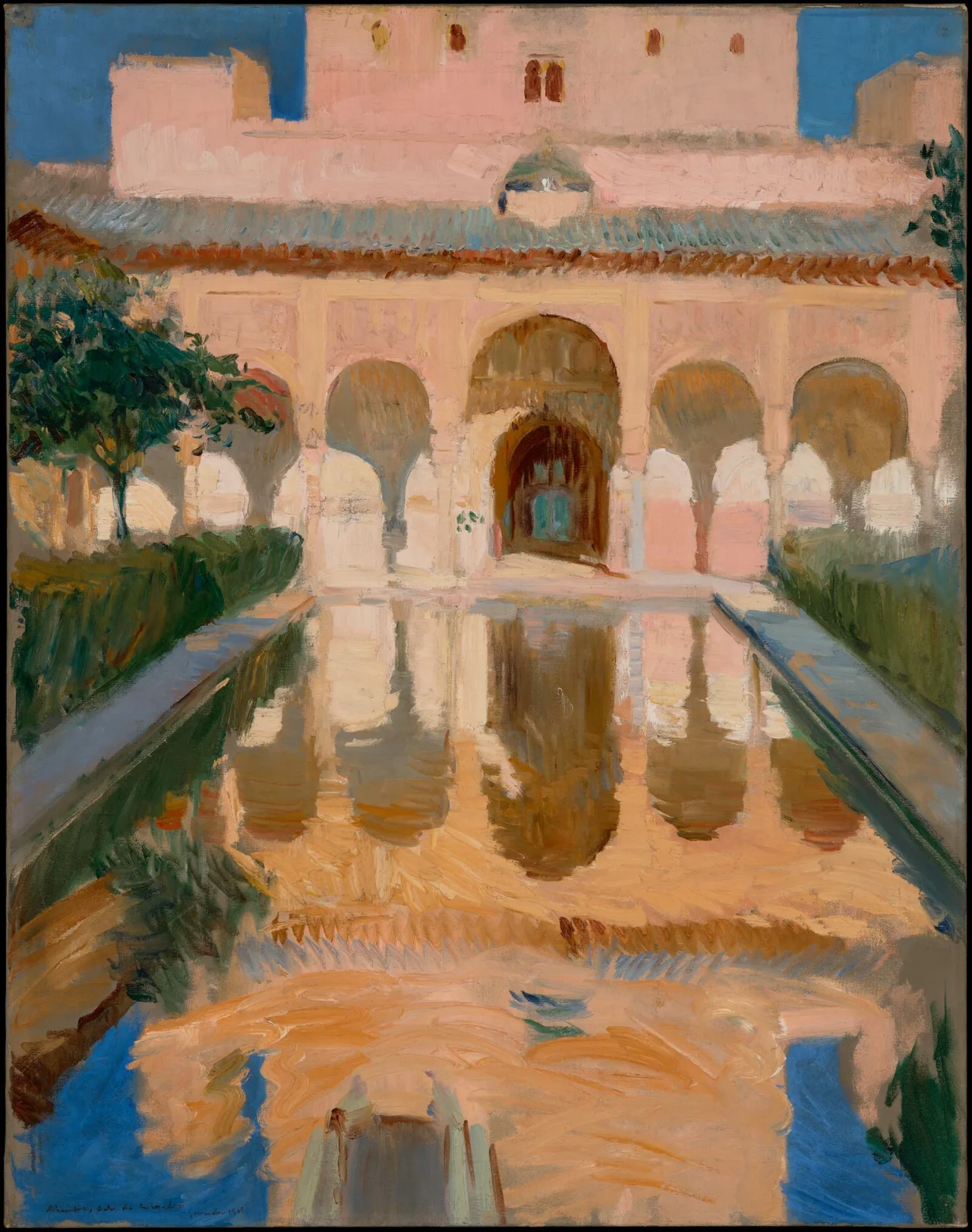
Here the people disappear, but the interest in moving light remains. The long pool leads towards the central opening. Above it, the architecture is built from fairly solid pink and cream masses; below, those masses become wavering bands.
Compare the two central arches, one real and one reflected. Their approximate symmetry establishes order, while the broken edges in the water disturb it. At the sides, the green hedges form rails that pull the gaze inward. The blue patches at top and bottom help connect sky with reflected sky.
Getty describes Sorolla’s interest in the interaction of architecture, water and light at the Alhambra. You can see the paint doing that work: broad strokes construct substantial walls, then loosen into reflections. A reproduction sharpened until every mark becomes a hard outline would misrepresent that distinction.
The date matters, too. This is a 1909 Granada painting, not one of the 1910 Alcázar views in Seville. Similar warm walls and garden settings do not make those titles interchangeable.
More than a beach painter
Sorolla’s portraits offer another way in. The Met’s Señora de Sorolla in Black depicts his wife, Clotilde, in 1906. Its dark dress and composed presentation make a useful counterpoint to the outdoor movement of Strolling along the Seashore, painted in Valencia in 1909. The Museo Sorolla’s account identifies the women there as Clotilde and their daughter María.
The sea also meant labour and danger. And They Still Say Fish Is Expensive! is not a holiday scene: the Prado’s record situates the 1894 work within Sorolla’s socially engaged painting. Looking at it beside the later beaches complicates the idea that sunshine was his only subject.
Dates deserve the same care as titles. The Museo Sorolla catalogue currently dates Mother broadly, 1895–1901. Its entry explains changes to the dating rather than offering one unproblematic year. Use that range when identifying the object instead of silently choosing the year most often repeated online.
Twelve paintings to identify
Only the two Getty images above are displayed here. The other ten are research links, not reviewed image downloads. Museum titles and accession numbers help separate similar subjects.
| Painting | Date | Exact collection record |
|---|---|---|
| The Wounded Foot | 1909 | Getty 78.PA.68 |
| Hall of the Ambassadors, Alhambra, Granada | 1909 | Getty 79.PA.154 |
| Corner of the Garden, Alcazar, Sevilla | 1910 | Getty 79.PA.155 |
| Court of the Dances, Alcázar, Sevilla | 1910 | Getty 79.PA.151 |
| Señora de Sorolla in Black | 1906 | Met 09.71.3 |
| Two Sisters, Valencia | 1909 | Art Institute of Chicago 1911.28 |
| Strolling along the Seashore | 1909 | Museo Sorolla 00834 |
| Mother | 1895–1901 | Museo Sorolla 00324 |
| The Horse’s Bath | 1909 | Museo Sorolla collection presentation |
| Boys on the Beach | 1909; signed 1910 | Prado painting |
| The Painter Aureliano de Beruete | 1902 | Prado portrait |
| And They Still Say Fish Is Expensive! | 1894 | Prado painting |
Country, publication and file
Spain needs its own check. The BNE explains that authors who died before December 7, 1987 fall under the older 80-year term. Applying that rule to Sorolla’s 1923 death, with calendar-year counting, gives January 1, 2004—not a life-plus-70 shortcut. Spain’s copyright law, transitional provision four and Articles 30 and 41, also distinguishes expiry of exploitation rights from respect for authorship and integrity.
Ordinary EU and UK terms have elapsed, but national exceptions and older unpublished material still need attention. A country-term conclusion does not license somebody else’s modern photograph or adaptation.
The United States requires a work-specific history. In 2026, the ordinary 95-year publication term has elapsed for works published through 1930; that is not a cutoff for when paint touched canvas. Copyright Office Circular 15A explains the different rules for older published and unpublished works. The Prado reports a December 1909 book reproduction of Boys on the Beach, explaining why its signed 1910 date is misleading. That is a useful institutional publication lead, not a claim that we inspected the original book or cleared the entire catalogue.
Check the exact file. Getty explicitly offers the two displayed images under CC0. Our current Met and AIC API checks did not flag their Sorolla images as public domain; we have not relabelled or downloaded those files. A provider’s flag is evidence about its offering, not a complete legal judgment about the painting.
Choosing a useful reproduction
Keep the museum title, date, accession and source link with your file. Compare its full edges with the collection image, and inspect hands, faces and brushwork at normal viewing size. Avoid enlargements that invent detail or turn coloured shadows black. Sorolla’s brightness depends on relationships between neighbouring colours; simply increasing saturation will not preserve it.
Sources and review method
We checked the artist chronology against museum records, treated each named jurisdiction separately, and recorded the provider policy for the image set. These sources support the legal framework and artist dates used above; the source file for any individual image still needs its own record.
- The Wounded Foot, 78.PA.68 — J. Paul Getty Museum. 1909 painting, exact accession, scene and official CC0 image metadata.
- Hall of the Ambassadors, Alhambra, Granada, 79.PA.154 — J. Paul Getty Museum. Exact 1909 Granada painting, distinct from the 1910 Seville works; official CC0 image.
- Open Content Program — J. Paul Getty Trust. CC0 policy for designated images; not permission for every image on every museum website.
- Joaquín Sorolla y Bastida — Museo Nacional del Prado. Artist dates, development and relationship to Spanish painting.
- Madre, 00324 — Museo Sorolla / CERES. Current broad 1895–1901 painting date, separate from the later frame date.
- Boys on the Beach — Museo Nacional del Prado. 1909 creation despite 1910 signature, and institution-reported 1909 publication lead; no claim of independent inspection of that book.
- Autores en dominio público — Biblioteca Nacional de España. Spanish legacy 80-year term for authors dying before December 7, 1987.
- Consolidated Intellectual Property Law — Boletín Oficial del Estado. Transitional provision four and Articles 30 and 41: legacy term, calendar-year counting and continued respect for authorship and integrity.
- Copyright in the EU — European Union, Your Europe. Ordinary life-plus-70 term; national exceptions and other contributors are separate.
- How long copyright lasts — UK Intellectual Property Office. Ordinary artistic-work term, not clearance of every older unpublished work or photograph.
- Duration of Copyright, Circular 15A, April 2026 — U.S. Copyright Office. Publication-based term and conditional older-unpublished rules. Creation, description and exhibition are not publication evidence by themselves.
Editorial record
About this article
- Author
- Publisher
- GeMarkt
- Published
- Reviewed
- Internal source & rights check. Conducted by GeMarkt Research Review. This is an internal editorial check—not independent peer review.
- Source standard
- Rights guide source standardSeparates the underlying work from the source file, records the review date, and links the evidence used for the conclusion.
Found a claim that needs checking? Report a factual error.