GeMarkt Blog · Reference
Is Vertumnus by Giuseppe Arcimboldo Public Domain?
Identify Arcimboldo’s 1591 portrait of Rudolf II and the exact Skokloster photograph, separating public-domain marking from country and file checks.

The short answer
Arcimboldo’s 1591 Vertumnus is beyond the ordinary author-copyright term, and Skoklosters slott marks the particular Jens Mohr photograph used here Public Domain. That is a documented institutional source assessment, not a blanket promise covering every image, adaptation or country.
The exact painting is 11615_SKO, the portrait of Emperor Rudolf II made from plants and produce. The exact photograph is DIG 3224, dated 2010. We checked the current official records on 13 October 2026. A separate early authorised U.S. publication history has not been independently completed for this guide; the painting’s age and physical travels are not offered as substitutes.
Which Vertumnus this guide covers
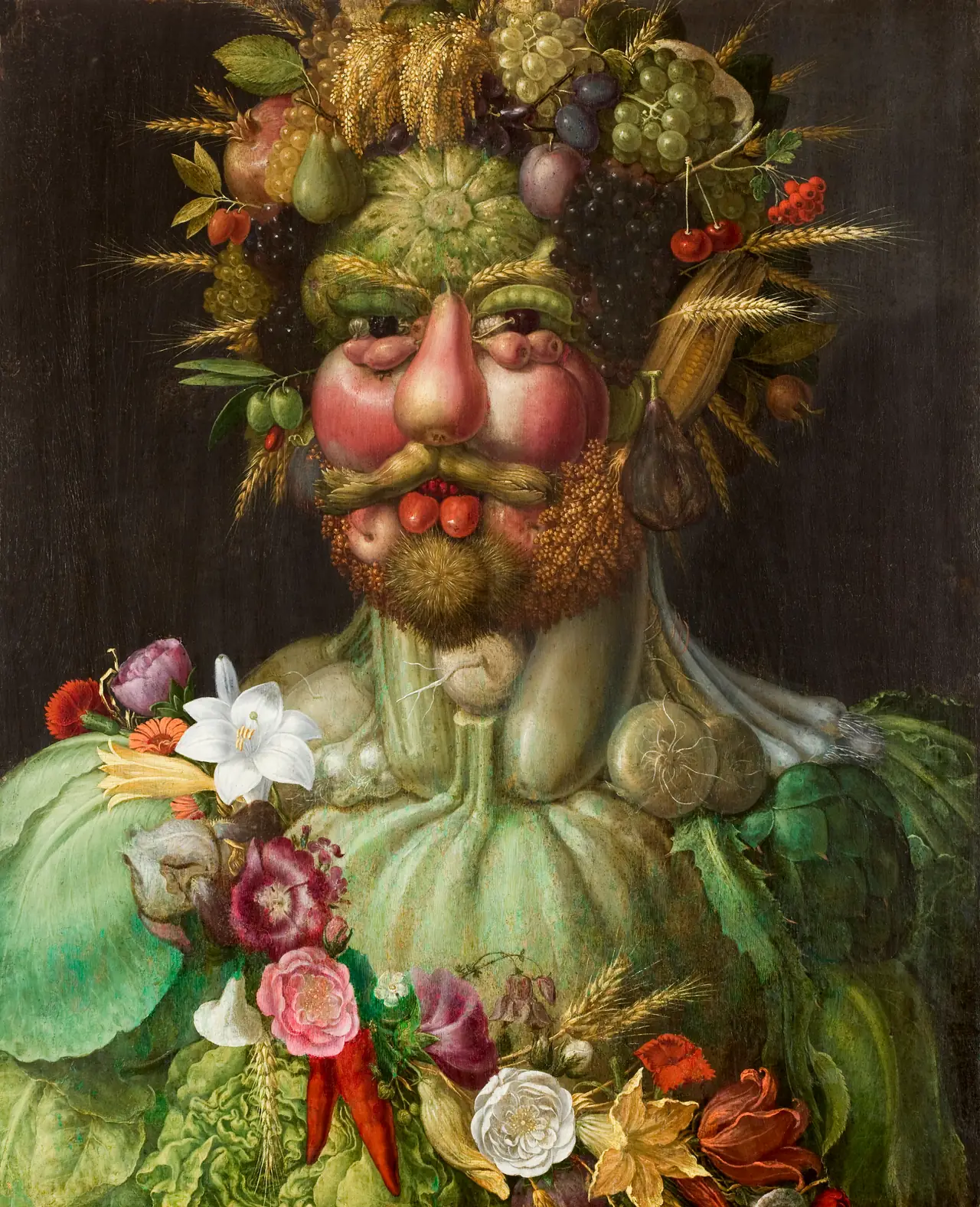
The official collection record gives 1591, oil painting on panel and 70 × 58 cm. It identifies Rudolf II as Vertumnus, a Roman deity associated with seasonal change and vegetation. Fruits from different seasons appear together: the portrait presents abundance rather than a botanical snapshot of one harvest.
Those identifiers matter because “Arcimboldo fruit portrait” is an imprecise search. It can return one of his seasonal heads, a later copy, a contemporary sculpture or a newly assembled face borrowing the idea. A resemblance does not make those objects this painting.
The object number also separates the panel from its frame and photographs. The collection supplies several views credited to different photographers. Their shared subject is not a reason to discard the individual media record when choosing a download.
Look at the face and then the ingredients
From a distance, the portrait has an almost conventional structure: a head, a direct gaze, broad shoulders and something like a floral sash. Move closer and those bodily forms turn into individual objects. A pear-shaped nose sits between rounded red cheeks. Grapes and ears of grain build up the head, while roots and leaves construct the neck and torso.
The joke depends on seeing both readings at once. If the image is reduced too far, the small ingredients disappear and the face becomes merely lumpy. If it is cropped tightly around the eyes, the shoulders and flowers no longer explain how far Arcimboldo carries the transformation.
Dark ground is part of that effect. It separates the silhouette from its setting, so the produce looks gathered into a single living presence. Lifting every shadow to make a brighter download can change the balance. A rights label will not tell you whether someone has already made that alteration.
For a wall print, compare the full composition at the intended size before choosing a detail. For an explanatory article, an image like this one lets readers move between portrait and still life without relying on a verbal list of vegetables. Our reproduction supports that comparison; it does not claim that the screen’s colours are a calibrated match to the panel.
A travel history is not a publication history
Skokloster’s account of the painting’s journey places it within the art taken from Prague by Swedish troops in 1648. The collection record cites Prague inventories from 1621 and 1635, and a Skokloster inventory from 1845.
These records help establish the object’s identity and custody. They do not, by themselves, show when an image of it was distributed to the public. A written inventory can describe a fruit-faced portrait without reproducing its appearance. A painting can also move between collections without a printed image travelling with it.
This is a useful distinction even for such an old work. A provenance entry answers “where was the panel?” An illustrated book or distributed print might answer “what image was published, when, and with whose authority?” An online photograph has still another source and date.
We have not turned the Swedish acquisition story into a copyright permission. Nor have we treated a modern exhibition announcement as proof of a sixteenth-century publication. The historical narrative and the reuse record are both useful, but they do different jobs.
The specific photograph and the museum’s mark
The selected official media page names Jens Mohr, gives 2010 as the photography date and explicitly applies Public Domain Mark. Its alternative identifier is DIG 3224. We downloaded the file linked from that record, rather than taking a similarly named image from a poster retailer.
SHM’s licence information makes an important distinction: its descriptive metadata is CC0, while media carry their own individual markings. Some images use PDM, others CC BY or more restrictive terms. “The catalogue is open” therefore is not sufficient evidence for an arbitrary photograph found within it.
Here the image itself has the PDM designation. The Creative Commons explanation describes that mark as identifying a work free of known copyright restrictions, including for commercial copying. It also warns that the status may differ between jurisdictions and that other rights can remain. PDM is a status marker, not an additional layer of copyright that the museum sells back to the viewer.
Our credit retains the artist, title, museum and photographer even though the institution does not make attribution a PDM condition. That helps another reader find the exact record. If we replaced this file with a different photograph, we would need to check its own designation and credit again.
Countries and the remaining U.S. question
The museum’s account of Arcimboldo gives his life dates as 1527–1593. The ordinary life-plus-seventy term described in EU guidance and UK guidance is consequently long past for his own painting. A modern adaptation or independently protected photograph does not inherit that age.
U.S. analysis needs a different distinction. The law separates public display from publication. Its older-work provisions include rules for previously unpublished works, with a possible 2047 floor following qualifying publication before the end of 2002. We do not claim that this exception applies to Vertumnus; we have not established the facts needed to invoke or dismiss it independently.
For this guide, SHM’s exact-file PDM statement is the recorded institutional assessment. It is not rewritten as our own fully researched U.S. publication verdict. A project requiring a formal U.S. clearance should trace an actual early reproduction and its circumstances, or obtain suitable advice, instead of citing “1591” alone.
What to check before reusing the image
Keep the painting’s accession and the photograph’s identifier together. Save the downloaded file and source statement so that a later change of filename does not break the evidence trail. Do not substitute a larger uncredited image while retaining Mohr’s name merely because the face looks the same.
Label a detail, recolouring or other adaptation honestly. A newly made fruit portrait can refer to Arcimboldo’s idea without being a newly discovered Arcimboldo. A photograph of a contemporary sculpture needs an assessment of that sculpture and photograph, not this panel’s PDM record.
The Arcimboldo artist guide places this work among his composite heads. For this particular reuse question, the practical answer remains narrower: an identified historic painting, an explicitly marked museum file and a country check that does not confuse custody with publication.
Editorial record
About this article
- Author
- Publisher
- GeMarkt
- Published
- Reviewed
- Internal source & rights check. Conducted by GeMarkt Research Review. This is an internal editorial check—not independent peer review.
- Source standard
- Rights guide source standardSeparates the underlying work from the source file, records the review date, and links the evidence used for the conclusion.
Found a claim that needs checking? Report a factual error.