GeMarkt Blog · Reference
Is Rousseau’s Tiger in a Tropical Storm Public Domain?
Identify Rousseau’s 1891 Surprised!, National Gallery NG6421, and separate the old painting from museum downloads, Commons files and modern tiger adaptations.


The short answer
Yes under the ordinary life-plus-70 author term: Rousseau’s historical painting is out of copyright. But choose the digital image separately. This guide concerns the 1891 Surprised!, often called Tiger in a Tropical Storm, held by the National Gallery, London, as NG6421.
The illustration here is a separately identified Commons PD-Art reproduction, not a download licensed by the National Gallery for unrestricted commercial use. Commons also records a U.S. public-domain assessment; this guide does not independently prove the painting’s early authorised publication history. Those limits matter if you want a documented clearance decision rather than a simple answer about the artist’s ordinary term.
One painting with more than one name
The National Gallery record titles the work Surprised! and identifies oil on canvas, 129.8 × 161.9 cm, dated 1891. A tiger crouches among grasses, with a dark sky and lightning above. Its teeth are visible, and rain cuts diagonally across the scene.
Searching by “Rousseau tiger” can produce other paintings, modern illustrations or decorative patterns using similar animals and leaves. The longer title helps, but the collection number is the firmer identifier. Match NG6421 and the whole composition before treating two files as interchangeable.
The exclamation mark belongs to the museum’s title. It does not settle what surprised whom. The tiger might be reacting to the weather or preparing to attack. You do not need to resolve that ambiguity to identify the painting or choose a usable file.
A caption should make the alternate titles clear, rather than leave readers thinking Surprised! and Tiger in a Tropical Storm are two canvases.
The tiger is not the whole composition
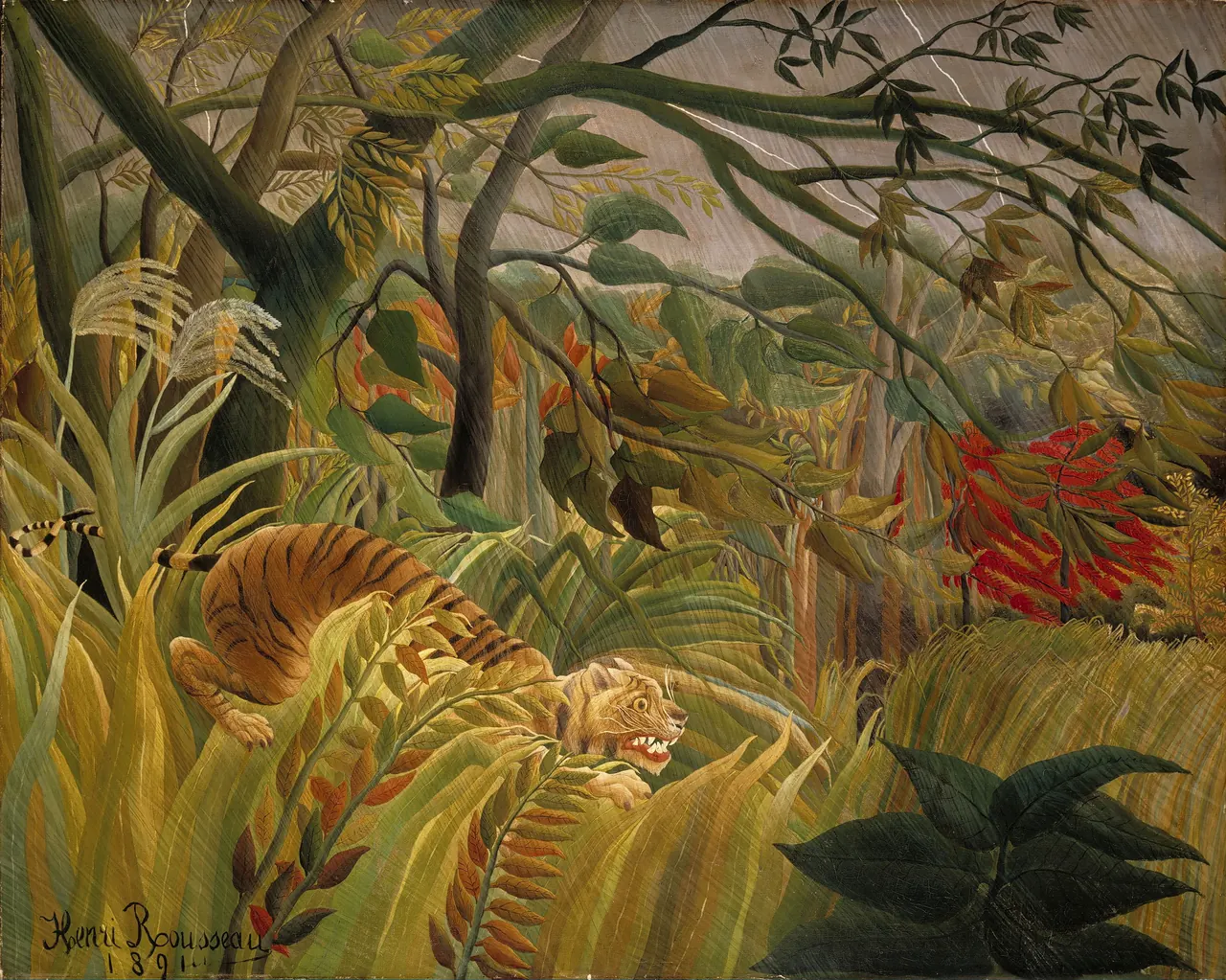
The animal occupies the lower-left part of the image rather than its centre. Its curved back and long tail weave through the vegetation. The nearest leaves partly hide its body, while taller plants rise behind it. You have to look through the scene to find the tiger, even though it is the subject most viewers remember.
The storm is spread across a much larger area. Diagonal rain passes over sky, branches, animal and foreground plants. The broad branch near the top bends towards the right. Dark leaves at the lower right make another strong shape, balancing the tiger without competing with its face.
These relationships matter when choosing a crop. A tight animal portrait may be useful for discussing its expression, but it removes much of the weather. A very narrow phone image can make the tiger look as though it is simply hiding in foliage. The title then promises a storm the viewer can barely see.
For an article or classroom slide, begin with the whole painting. Add a labelled detail only when it helps explain something specific. The full image lets someone follow your description rather than imagine what lies outside a decorative crop.
A jungle made in France
The museum explains that Rousseau’s jungle was imagined rather than painted during tropical travel. He did not leave France. Plants and animals available to him in Paris helped feed that imagination. The picture was exhibited at the Salon des Indépendants in 1891.
That context changes how to describe the image. It is not evidence of an expedition or an eyewitness record of a particular habitat. A caption calling it a “photographic view of the jungle” would mislead even if the reproduction were perfectly sharp and lawfully obtained.
You can see the imaginative arrangement without dismissing the painting as a mistake. The leaves repeat emphatic shapes; the tiger appears among overlapping bands of growth; the rain adds a second pattern across everything. The picture rewards attention to those decisions rather than a test of whether every plant could naturally grow in the same place.
For a broader introduction to the artist, see our Henri Rousseau guide. The question here remains this particular storm, not a blanket permission for every image that imitates Rousseau’s jungle style.
Copyright in the painting
Rousseau died in 1910. His ordinary economic copyright term has expired under the seventy-year posthumous rule described by the UK government. That conclusion concerns the old painting, not new photographs, explanatory diagrams or creative adaptations.
For older works in the United States, publication can change the analysis. The Copyright Office’s duration guide distinguishes published and unpublished works; the painting’s 1891 date does not itself prove an authorised publication in 1891. Exhibition is not automatically the distribution of copies.
The Commons file applies an expired-copyright assessment, including a pre-1931 publication or registration statement. No independently inspected early authorised reproduction is established here for NG6421. Keep that limit with any U.S. claim. It is not a finding that copyright remains active, but it prevents a provider’s label from being presented as a publication history we have reconstructed ourselves.
Nor should the special rules for old unpublished works be turned into an automatic warning that this painting is protected until 2047. Section 303 makes that possible minimum depend on particular conditions. An unexplained date is not a substitute for applying those conditions to the work.
The Commons file and the museum file
The image shown here comes from Surprised-Rousseau.jpg on Commons. Its record identifies a faithful reproduction and applies PD-Art / Public Domain Mark 1.0. It credits a historical National Gallery of Art, Washington, exhibition page as the source. That credit does not make the London painting part of Washington’s collection or establish a new CC0 release.
The National Gallery, London, website terms separately describe non-commercial downloads, including certain images under CC BY-NC-ND 4.0, and direct commercial image enquiries to its picture library. The museum’s factual collection record and its supplied photograph need not have the same conditions.
Choose a route and keep its evidence. If you download from the museum, follow the conditions of that download. If you use the identified Commons reproduction, retain its file record and understand that PD-Art is a rights assessment, not a promise that every jurisdiction treats all photographs identically.
Do not replace the selected file with a higher-resolution search result and assume the old record still covers it. A different photographer, restoration, colour treatment or composite background can introduce a different question even when the tiger is instantly recognisable.
Using a detail or making an adaptation
The painting contains many fine lines. Heavy smoothing can remove rain; excessive sharpening can make leaf edges appear cut out. Judge a file at the size at which people will actually see it. More pixels are helpful only when they contain useful information rather than invented texture.
If you turn the leaves into a repeating pattern, remove the tiger or expand the sky, describe the result as an adaptation after Rousseau. An altered design may be attractive, but it should not be presented as an intact reproduction of NG6421. Keep an unchanged source copy so that your edits remain traceable.
A label such as “detail from Surprised!” is usually enough for an ordinary crop. Do not use “restored original” for a new colour filter or generated extension. Those words imply evidence and treatment of the historical object that a digital redesign does not provide.
A practical credit and download record
A useful credit is Henri Rousseau, Surprised! (Tiger in a Tropical Storm), 1891. National Gallery, London, NG6421. Image: the linked Commons reproduction, PD-Art / Public Domain Mark. Identify a crop or adaptation beside the image if there is one.
Save the source page, downloaded file and date of checking together. That gives your future self a clear answer about what was used. The practical conclusion is not “all tiger pictures are free”; it is that an old painting and a specifically documented reproduction can be used without confusing their histories or inventing a museum endorsement.
Editorial record
About this article
- Author
- Publisher
- GeMarkt
- Published
- Reviewed
- Internal source & rights check. Conducted by GeMarkt Research Review. This is an internal editorial check—not independent peer review.
- Source standard
- Rights guide source standardSeparates the underlying work from the source file, records the review date, and links the evidence used for the conclusion.
Found a claim that needs checking? Report a factual error.