GeMarkt Blog · Reference
Is The Tower of Babel by Pieter Bruegel the Elder Public Domain?
Identify Bruegel’s 1563 Vienna painting, distinguish the Rotterdam version and check the exact reproduction before using The Tower of Babel.


The short answer
Bruegel’s ordinary author copyright term has expired in the EU and UK, and the specific reproduction illustrated here is designated public domain by Wikimedia Commons. That does not make every download called The Tower of Babel interchangeable or give blanket permission for a museum’s image service.
This guide covers the 1563 painting in Vienna, checked on 12 October 2026. The smaller Rotterdam painting is a separate object. Commons supplies a U.S. public-domain rationale for our file; this article does not independently establish the original painting’s authorised publication history. Keep that distinction when a commercial project needs formal clearance.
Which Tower of Babel?
The Kunsthistorisches Museum’s object record identifies the Vienna painting as 1563, inventory GG 1026. Its current overall panel measurements are 114.4 × 155.5 cm. The museum’s Google Arts & Culture record provides another institutional route to the same work.
Do not confuse it with The Tower of Babel at Museum Boijmans Van Beuningen, Rotterdam. That museum dates its painting to about 1568 and records 59.9 × 74.6 cm, accession 2443 (OK). A caption that says “Rotterdam, 1563” beneath the Vienna composition has mixed two records.
These distinctions also matter for a print. The paintings have different proportions and details; one is not simply a smaller photograph of the other. This page illustrates only the Vienna version. It does not supply or clear a Rotterdam reproduction, a later copy or another artist’s treatment of the biblical story.
Look at the building and its surroundings
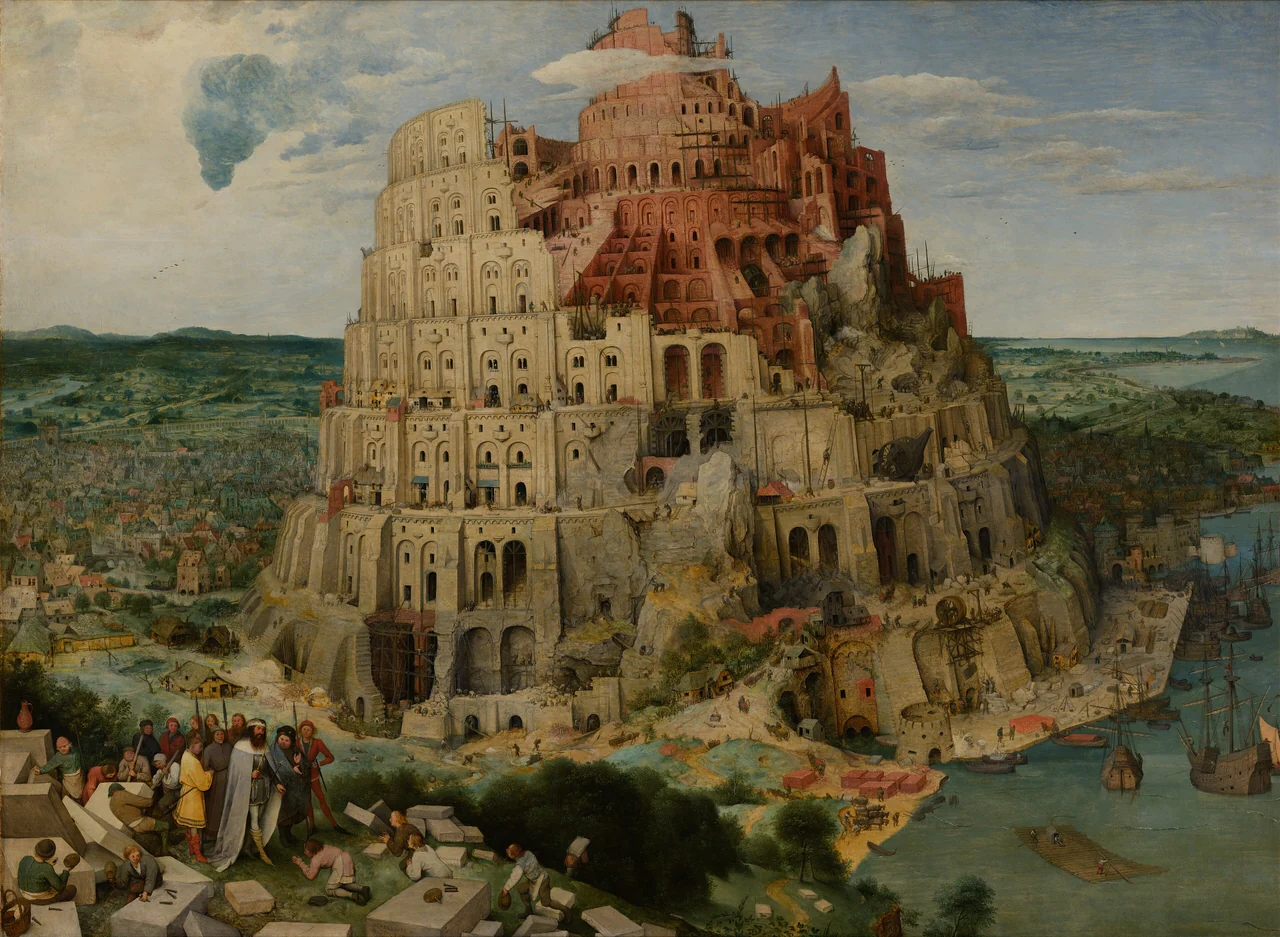
The tower is enormous, but it does not look finished. Pale outer walls cover some sections, while reddish masonry and irregular rock remain exposed elsewhere. Rows of arches suggest order; the uneven upper levels resist it. A cloud crosses the building rather than sitting safely above it.
At the bottom left, a group in elaborate clothes stands near workers and blocks of stone. Boats gather at the right. Behind the tower, roofs become tiny marks stretching towards the horizon. The eye keeps moving between the engineering project and the much smaller bodies sustaining it.
That difference in scale is easily lost in a tight crop. Removing the foreground leaves a spectacular building, but removes some of the evidence of how big it is meant to feel. Removing the harbour weakens the sense that materials and people arrive from beyond the frame. A detail can be useful; it should not be presented as the full composition.
For the wider artist context, see our Pieter Bruegel the Elder guide. The purpose here is narrower: identifying which image you have and what supports its reuse.
The painting and the museum download
Bruegel died in 1569. His ordinary economic term is long past under the EU’s life-plus-seventy framework and the UK’s ordinary rule for artistic works. Ownership of the wooden panel is a different question from that historical author term.
KHM’s image database nevertheless offers private-use downloads and directs other users towards a reproduction request. Its published image-use terms describe a non-commercial licence for content in which the museum holds rights. We have not treated that download as an unrestricted commercial release.
For a museum-supplied file, ask about the actual intended use: an article, paid advertising, merchandise or a book cover. Do not attach an unrelated open licence to it. Equally, a museum copyright line does not by itself revive Bruegel’s expired author copyright. The file, any agreement and the law of the relevant country still need to be distinguished.
The specific file used here
Our illustration comes from this exact Commons file page, which identifies a Google Art Project reproduction of GG 1026. Commons applies PD-Art and Public Domain Mark 1.0, treating it as a faithful reproduction of a two-dimensional public-domain work.
That is an attributed source finding, not a claim that KHM issued us a commercial licence. The Public Domain Mark labels a copyright status; it is not the same instrument as an author’s CC0 waiver. Commons also warns that treatment of reproductions can differ between jurisdictions.
We retain the full composition of that source, with proportional resizing for this page. There is no new colour scheme, reconstructed corner or generated brushwork. A different website’s brighter image may have a different editing history, even when its title and dimensions look plausible.
What is and is not established for the US
The file page states that the work was published or registered before 1 January 1931. That statement is Commons’ rationale; we have not independently checked a qualifying historical publication and its authorisation for this painting. The 1563 signature is evidence of the work’s date, not a substitute for that investigation.
U.S. duration law distinguishes older published works from previously unpublished works. An exhibition date or a collection’s acquisition date does not automatically resolve the relevant publication history. This guide therefore does not promise that every U.S. use has received independent legal clearance.
For a project requiring a documented legal opinion, start with the exact Vienna object and file rather than a search for “Bruegel copyright”. A historical illustrated catalogue might supply evidence, but its presence, date and relationship to the painting must actually be checked.
Using the image without misidentifying it
For an illustrated article, keep the artist, title, 1563, KHM Vienna and source link together. Do not use the museum’s logo to imply a partnership. If you print a detail, say which area it shows; if you change the colour, do not call the result a faithful colour reproduction.
For a screen background, check the composition at the final shape before exporting. A wide desktop crop can remove the lower-left figures, while a phone crop may discard almost the entire harbour and town. Keeping the whole picture with space around it is more honest than stretching its proportions.
A room mockup adds another layer: the wall, frame and lighting belong to that photograph or generated scene, not to Bruegel. A public-domain designation on the painting should never be copied across to an unrelated seller’s mockup.
Before you publish
Match GG 1026 to the pictured Vienna composition; save the exact file page and its current designation; identify your territory and use; and keep any edits visible in the caption where they matter. If your evidence is only a museum preview marked for private use, stop at that boundary rather than treating “old painting” as permission for the download.
The workable answer is not “every Babel image is free”. It is: this particular old painting can be approached through an identified public-domain-designated reproduction, with the file’s provenance and the remaining U.S. evidence limit stated clearly.
Editorial record
About this article
- Author
- Publisher
- GeMarkt
- Published
- Reviewed
- Internal source & rights check. Conducted by GeMarkt Research Review. This is an internal editorial check—not independent peer review.
- Source standard
- Rights guide source standardSeparates the underlying work from the source file, records the review date, and links the evidence used for the conclusion.
Found a claim that needs checking? Report a factual error.