GeMarkt Blog · Reference
Is The Tortoise Trainer by Osman Hamdi Bey Public Domain?
Check the 1906 Pera Museum painting, its early catalogue reproduction and the exact Google Art Project file. The 1907 version and museum permissions are separate.


The short answer
Osman Hamdi Bey’s ordinary economic copyright term has expired in Türkiye, the EU and the UK, and the exact reproduction shown here carries a Wikimedia Commons PD-Art / Public Domain Mark designation. That is not blanket permission for every museum photograph or every worldwide commercial use of The Tortoise Trainer.
This guide concerns the 1906 painting at Pera Museum, not the other version dated 1907. The check is current to 12 October 2026. Pera documents an early catalogue reproduction, but this article does not claim a completed independent U.S. publication-and-authorisation analysis. That remaining limit is separate from Commons’ own public-domain finding.
Identify the 1906 Pera painting
The museum’s Google Arts & Culture record identifies The Tortoise Trainer, 1906, oil on canvas, 221.5 × 120 cm, in the Suna and İnan Kıraç Foundation Collection. In Turkish, the familiar title is Kaplumbağa Terbiyecisi.
The displayed composition is unusually tall. A man in a red robe occupies much of its height; five tortoises move across the floor below him. Blue tiles frame the chamber, while light enters through a low opening at the left. Match those features and the date before accepting a download as this version.
A title alone is insufficient. A detail, an alternative version and a modern interpretation can all be advertised with the same English words. A file that shows only the man’s head cannot independently establish which complete painting it reproduces.
For other works and the artist’s wider career, see the Osman Hamdi Bey guide. Permission for one image in that guide does not automatically transfer to a different photograph of this canvas.
Look beyond the red robe
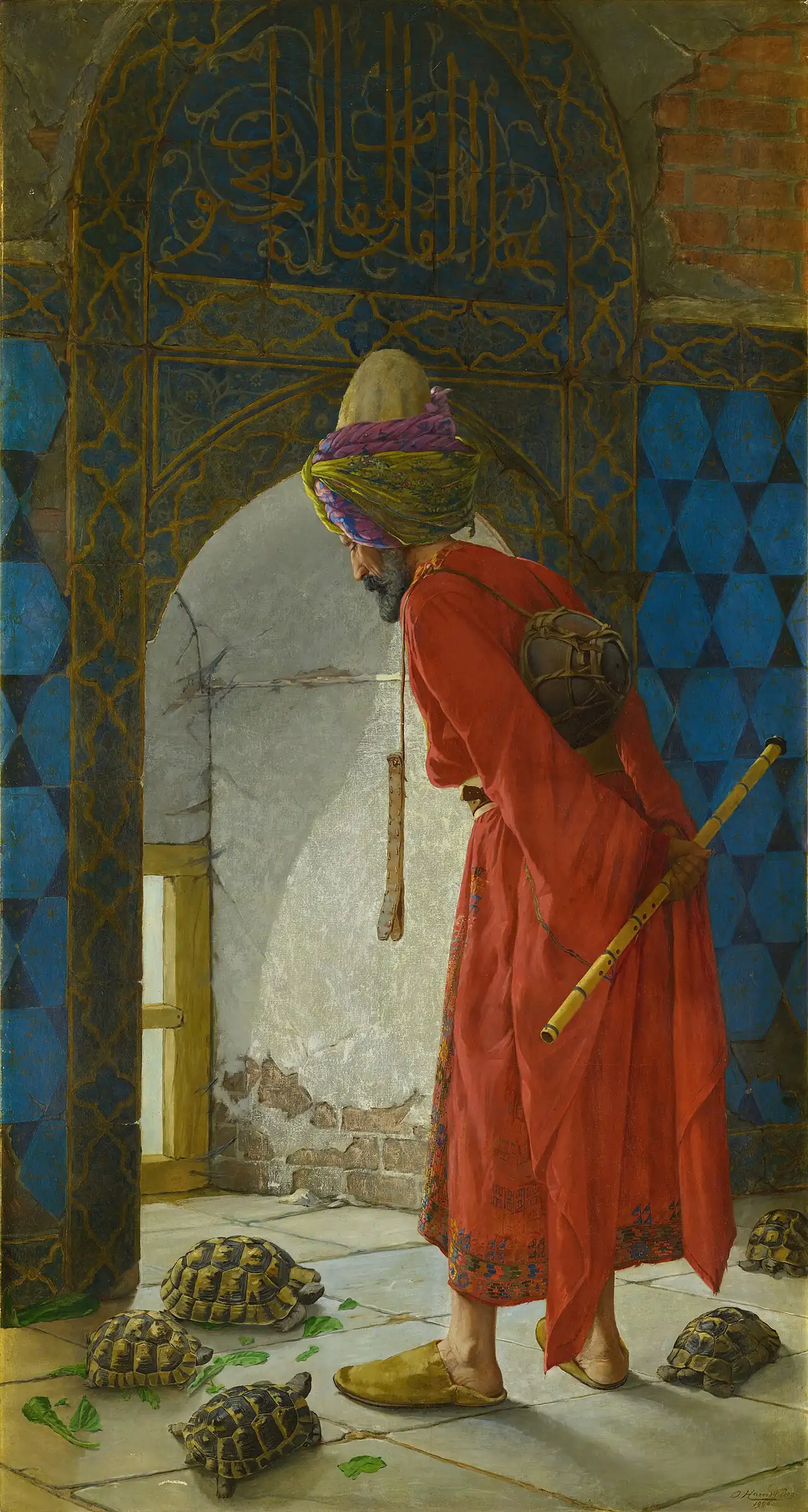
The figure bends forward, but his hands remain behind his back. A reed flute runs diagonally through that space; a small drum hangs against the robe. His attention points downwards while his body remains almost still. The animals, by contrast, are distributed irregularly near his feet and the edges of the scene.
Pera identifies the setting as an upper chamber of the Green Mosque in Bursa and the figure as the artist posing in dervish attire. Its account notes that the costume’s elements do not identify a single specific order. Those details are more precise than treating the picture as an anonymous documentary view of daily religious practice.
The strong red catches the eye first. Then the pale wall, damaged plaster, patterned blue tiles and low light begin to register. The bare patches and uneven surfaces prevent the setting from feeling like a perfectly decorated stage. The figure and tortoises inhabit a room with visible wear.
The scene invites readings about patience, persuasion and the difficulty of change. An interpretation can be compelling without being a proven statement of the painter’s single intended message. Describe what the picture and a cited source actually support; do not turn a popular anecdote into the artist’s documented explanation.
The author term is not the file policy
Osman Hamdi Bey died in 1910. Türkiye’s Ministry of Culture explains that the ordinary economic-rights term lasts for the author’s life plus seventy years, calculated from the following year. That term has elapsed. The ordinary EU and UK author terms have elapsed too.
A painting can nevertheless be encountered through many different files: an institutional reproduction, a visitor’s room photograph, a catalogue spread or a newly designed poster. The end of the painter’s economic copyright does not make all of those surrounding contributions identical.
The Pera-supplied object record credits the Foundation in its rights field; it does not declare a blanket CC0 image release. Do not describe it as one. If your project needs a museum-supplied commercial image agreement, ask about the particular file and use rather than assuming that the painting’s age answers that contractual question.
The 1906 catalogue is a real publication lead
Pera’s curator documents the painting in the 1906 Paris Salon catalogue. It appeared as number 783, under “Hamdy Bey”, with the title L’homme aux tortues. The museum also identifies an engraved reproduction in the catalogue, captioned Tortoises, and shows the page.
That is more substantial evidence than merely saying “the painting was exhibited in 1906”. An image printed in a distributed catalogue is a publication lead that can be investigated. The U.S. Copyright Office distinguishes public display from publication; authorised sale or distribution can be relevant, while display alone is insufficient.
What remains uncompleted here is the legal assessment of that historical reproduction’s authorisation, distribution and effect on the underlying painting. The catalogue evidence is therefore reported as evidence, not silently upgraded into a lawyer-reviewed conclusion. Commons separately asserts pre-1931 U.S. publication or registration for its file.
The distinction matters because U.S. duration provisions treat historical published and previously unpublished works differently. The painting’s creation year is not a substitute for establishing which rule applies. For a substantial U.S. commercial project requiring independent clearance, take this specific catalogue lead into that review.
The specific Google Art Project reproduction
The exact Commons file page identifies the source as Google Arts & Culture and applies PD-Art / Public Domain Mark 1.0. Commons regards the image as a faithful reproduction of a two-dimensional public-domain artwork, while noting that treatment of such reproductions can differ outside the United States.
The Public Domain Mark is a status designation, not an individual permission letter from Pera. Our illustration uses the existing reproduction from that page; it is not a new photograph or a generated reconstruction of the painting.
Keep this file page with the image. A general museum home page cannot replace it, and a “free wallpaper” label on another site does not explain how that site acquired its version. If another source has clearer terms for your territory and use, assess that exact alternative rather than mixing its licence with the Commons file.
What a crop can remove
This canvas resists an automatic landscape crop. Cutting from the bottom removes tortoises and changes what the man appears to be watching. Cutting the upper section compresses the room and loses the tilework that gives his figure its architectural setting.
A portrait detail can still be useful in an article discussing the face or costume. Present it beside the complete painting and label it as a detail. For a full reproduction, retain the complete supplied composition rather than stretching the narrow picture to fill a standard frame ratio.
The same care applies to colour. Strong brightening can flatten the difference between the dim tilework and the lit wall. A more vivid red may sell a dramatic thumbnail, but it is not evidence of a more accurate reproduction.
A practical reuse decision
For a sourced editorial illustration, this is an identifiable historical painting with a specifically public-domain-designated reproduction. Credit the artist, title, 1906, collection and file source. Keep any edits separate from the untouched download.
For a commercial project, resolve the destination-country and exact-file requirements first, especially if independent U.S. clearance or a museum contract is required. Do not imply endorsement by the Foundation or claim to own the historic painting.
The useful conclusion is not “everything is forbidden” or “every image is free”. The ordinary author term is over, this file has a stated reuse basis, and the remaining U.S. evidence and source-policy boundaries are explicit. That lets a reader make a better decision without confusing the 1906 painting, its historical reproduction and today’s digital download.
Editorial record
About this article
- Author
- Publisher
- GeMarkt
- Published
- Reviewed
- Internal source & rights check. Conducted by GeMarkt Research Review. This is an internal editorial check—not independent peer review.
- Source standard
- Rights guide source standardSeparates the underlying work from the source file, records the review date, and links the evidence used for the conclusion.
Found a claim that needs checking? Report a factual error.