GeMarkt Blog · Reference
Is Fragonard’s The Swing Public Domain?
The eighteenth-century painting and a modern museum photo are different rights questions. Identify the Wallace canvas and check the exact reproduction.


The short answer
Fragonard’s original painting is out of its ordinary life-plus-70 copyright term; a modern photograph of it does not automatically come with unrestricted reuse permission. The Wallace Collection maintains its own image-use conditions, including a commercial licensing route.
This guide concerns The Swing, c. 1767–68, Wallace Collection, P430. It uses an older Yorck Project reproduction carrying a Commons public-domain designation, not the museum’s recent conservation photography. The page does not independently establish the painting’s historical publication status under U.S. law, and the selected Commons record’s missing U.S.-tag warning is not concealed.
Identify the Wallace painting
The Wallace Collection record names the work Les hasards heureux de l’escarpolette, usually shortened to The Swing. It dates the oil painting to c. 1767–1768 and gives the painted image as 81 × 64.2 cm. The accession P430 is a useful anchor when a search result supplies only “Fragonard swing”.
The woman in the pink dress, the airborne shoe and the man reclining below her distinguish this composition. Fragonard made another painting called The Swing, now in the National Gallery of Art in Washington. A permission or open image for that work does not identify the Wallace canvas.
Similarly, a copy “after Fragonard” may reproduce this arrangement while being a separate physical object. Its location, maker and date should not be borrowed from P430 simply because the central figure looks familiar.
Our Fragonard artist guide covers a broader selection. Here, the accession keeps the answer attached to the painting most readers have in mind.
The figures around the swing
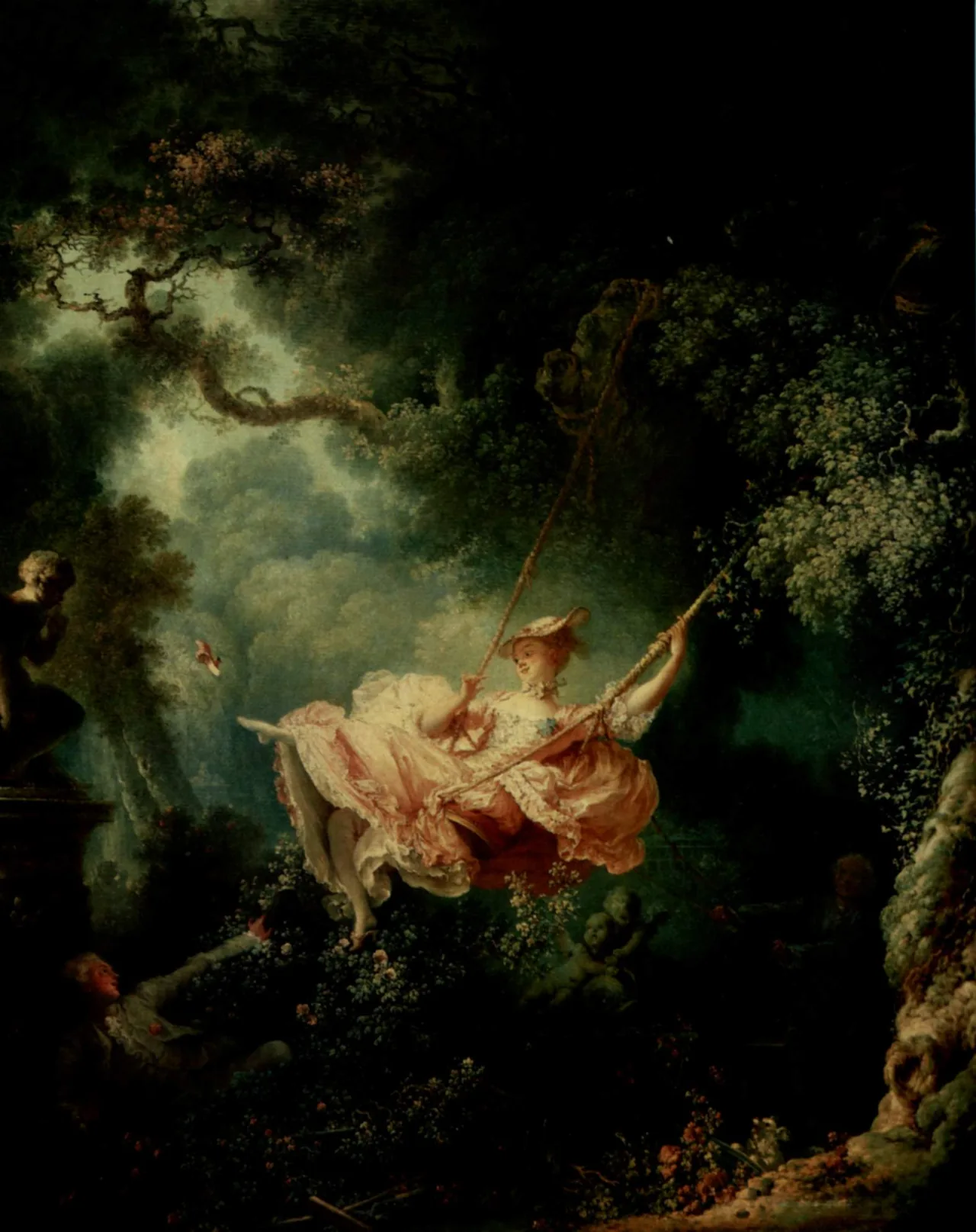
Start with the shoe rather than the dress. It has separated from the woman’s foot and travels towards the left, making the motion visible even though the painting is still. Beneath it, the reclining figure looks up. At the right, another figure works the ropes, partly swallowed by foliage and shade.
The sculpture on the left joins this network of looks and gestures. The surrounding garden is not simply a floral border: it conceals some actions and makes others conspicuous. The pink dress is the brightest point, but the scene depends on what happens around it.
The museum interprets the picture as an erotic encounter involving a lover and an unwitting husband. That reading should be attributed rather than turned into a biographical claim about named sitters. A lively caption can explain the scene without pretending we know every participant’s identity.
A tight crop of the dress changes the story. It may suit a discussion of fabric or brushwork, but it cannot replace the full image when explaining the relationships between the figures.
Old painting, new photographs
Fragonard died in 1806. Under the ordinary UK life-plus-70 rule for artistic works, the painter’s term is long expired. That does not mean every modern photographic service has dedicated its files to the public domain.
The Wallace Collection’s image policy describes conditions for its online imagery and directs commercial requests to a licensing service. It is not a blanket CC0 release. For a commercial publication using the museum’s supplied photography, use that route and establish the relevant conditions.
Do not copy a museum photograph from a search thumbnail and attach a different repository’s licence to it. Nor should a user-uploaded licence label automatically outweigh a contradictory photographer credit embedded in the file. When those accounts conflict, the sensible response is to resolve the discrepancy or choose a better-documented image.
The historical file used here
Our selected Commons file comes from The Yorck Project’s 2002 collection of reproductions. Its description treats the individual reproduction as public domain and applies Public Domain Mark. It separately identifies a compilation copyright under the GNU Free Documentation License; the two statements concern different things.
This is a record of the provider’s assessment, not a claim that the Wallace Collection has licensed the file to us. The description also contains a warning asking for a U.S. public-domain tag. That omission matters to anyone seeking a fully documented U.S. clearance file and should not vanish when the picture is downloaded.
We selected the complete historical reproduction rather than a modern image with inconsistent photographer information. Its limitation is visual as well as documentary: it shows an older appearance of the painting. That makes it suitable for identifying the composition, not for promising the latest post-conservation colours.
Why two correct images can look different
The museum’s conservation account describes treatment carried out in 2021, including removal of discoloured varnish and old overpaint. The work revealed clearer colour relationships and details that had become harder to see.
An older reproduction and a recent museum photograph can therefore depict the same canvas while looking substantially different. The difference is not automatically evidence that one is a fake. Image capture and processing can also contribute, so do not attribute every tonal variation to the conservation itself.
For a printed product, choose a colour reference before adjusting a file. Avoid brightening an old image until it merely resembles a new thumbnail, then advertising it as the museum’s restored version. That would mix two sources without establishing either fidelity or permission.
For an article, label the historical reproduction and link to the museum’s conservation account. The reader can then understand why a visit to the gallery may look different from the image on the page.
The United States evidence limit
The Copyright Office’s duration guidance distinguishes older published works from works with different publication histories. A painting’s creation date is not itself a publication date. Nor does a nineteenth-century exhibition automatically prove authorised distribution under the relevant law.
This guide has not reconstructed the qualifying historical publication events for P430. It reports the expired ordinary life-based term and the selected reproduction’s stated status without inventing a first-publication year or converting a repository label into a legal opinion.
That limited finding should not be read as a claim that the eighteenth-century painting remains generally copyrighted. It means that a project requiring independent U.S. documentation still needs that research. A licence for a contemporary photograph may answer a separate file-access question without supplying the missing historical evidence.
Choosing and crediting a file
Begin with the object: Fragonard, The Swing, c. 1767–68, Wallace Collection, P430. Then record which reproduction you are actually using, who supplied it, its stated conditions and whether it shows the pre- or post-conservation appearance.
For the image on this page, a suitable credit names The Yorck Project via Wikimedia Commons, Public Domain Mark, with the exact file link. Do not label it “Wallace Collection open access” or copy a recent photographer’s name onto it.
If your project needs a current colour reference, resolve the museum photograph’s terms first. If it needs the historical composition for explanation, the older documented image can be useful with its limitations visible. In either case, choosing the right Swing is the first step; choosing the right file is the next.
Editorial record
About this article
- Author
- Publisher
- GeMarkt
- Published
- Reviewed
- Internal source & rights check. Conducted by GeMarkt Research Review. This is an internal editorial check—not independent peer review.
- Source standard
- Rights guide source standardSeparates the underlying work from the source file, records the review date, and links the evidence used for the conclusion.
Found a claim that needs checking? Report a factual error.