GeMarkt Blog · Reference
Is The Scream by Edvard Munch Public Domain?
Check Munch’s 1893 Scream, the 1895 lithograph and the exact museum photograph separately, including country rules and image attribution.

The short answer
Munch’s 1893 Scream is beyond the ordinary life-plus-seventy author term, and the National Museum offers its photograph under CC BY 4.0. That is not a worldwide clearance for every Scream image. The painting, Munch’s lithograph and a modern photograph need separate identification.
This guide checks the 1893 National Museum painting, NG.M.00939, alongside a specific 1895 lithograph at the Art Institute of Chicago. As of 13 October 2026, we have not independently closed the painting’s U.S. publication and authorisation history. The museum’s reuse statement is useful evidence of its position; the photo licence is not a substitute for that separate country check.
Which Scream are you looking at?
The mouth and hands are instantly recognisable, but they do not identify a single object. MUNCH’s account of the versions distinguishes four colourful works: two paintings and two drawings in pastel and crayon. The museum also holds impressions of the lithograph, including one hand-coloured by Munch.
That distinction changes what a reproduction represents. A hand-coloured impression is not simply the black print with colour settings adjusted. A pastel is not a faded copy of the painting. Nor does the existence of an early print automatically establish the publication history of every painted version.
For the two examples illustrated here, keep these identifiers together:
| Object | Identifying record | What it is |
|---|---|---|
| The Scream, 1893 | National Museum, NG.M.00939 | Tempera and crayon on cardboard; the coloured painting shown below |
| The Scream, 1895 | Art Institute of Chicago, 1963.282 | Black lithograph on cream card; catalogue references Woll 38 B and Schiefler 32 |
The museum, accession and medium are more dependable than a filename such as “original-scream.” They also make it possible to correct a mistaken caption without changing the whole rights conclusion.
The 1893 painting in Oslo
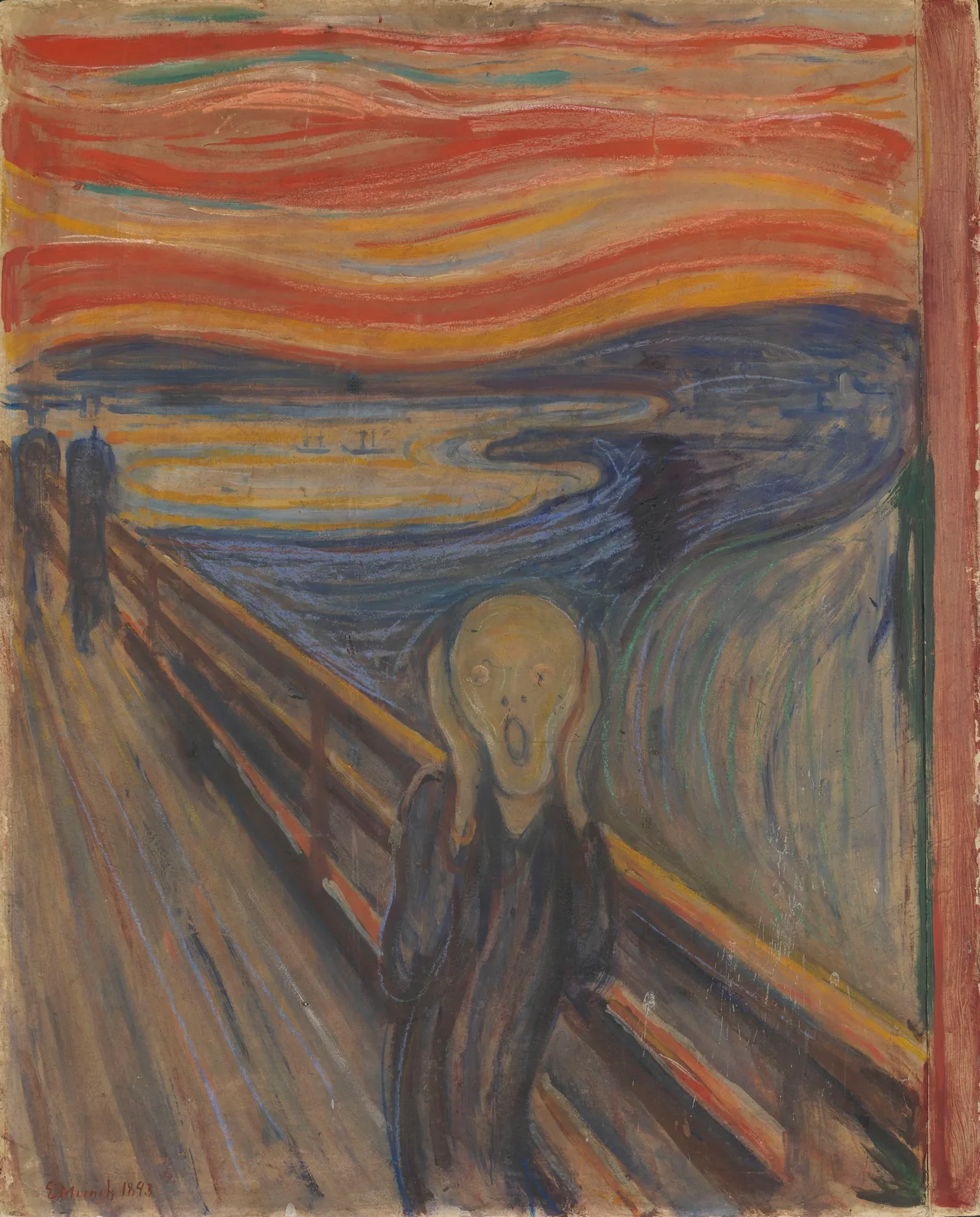
The National Museum’s record identifies a work measuring 91 × 73.5 cm, given by Olaf Schou in 1910. Those are the physical painting’s dimensions and acquisition history, not the resolution or publication date of our download.
Look beyond the face. The railing cuts firmly across the picture, while the sky and water move in long, wavering bands. Two small figures continue towards the distance. Their upright shapes contrast with the foreground figure’s curved body and the hands pressed against its head.
The red sky is therefore not a detachable decorative background. It participates in the same movement that seems to pass through the figure. A tight face-only crop removes the straight railing, distant walkers and much of that contrast. It may work as a recognisable detail, but it should not be described as the complete painting.
Our illustration retains the supplied composition. Its purpose is identification and close looking, not a claim that this screen image supplies definitive colours for a commercial print.
The lithograph is not a desaturated painting
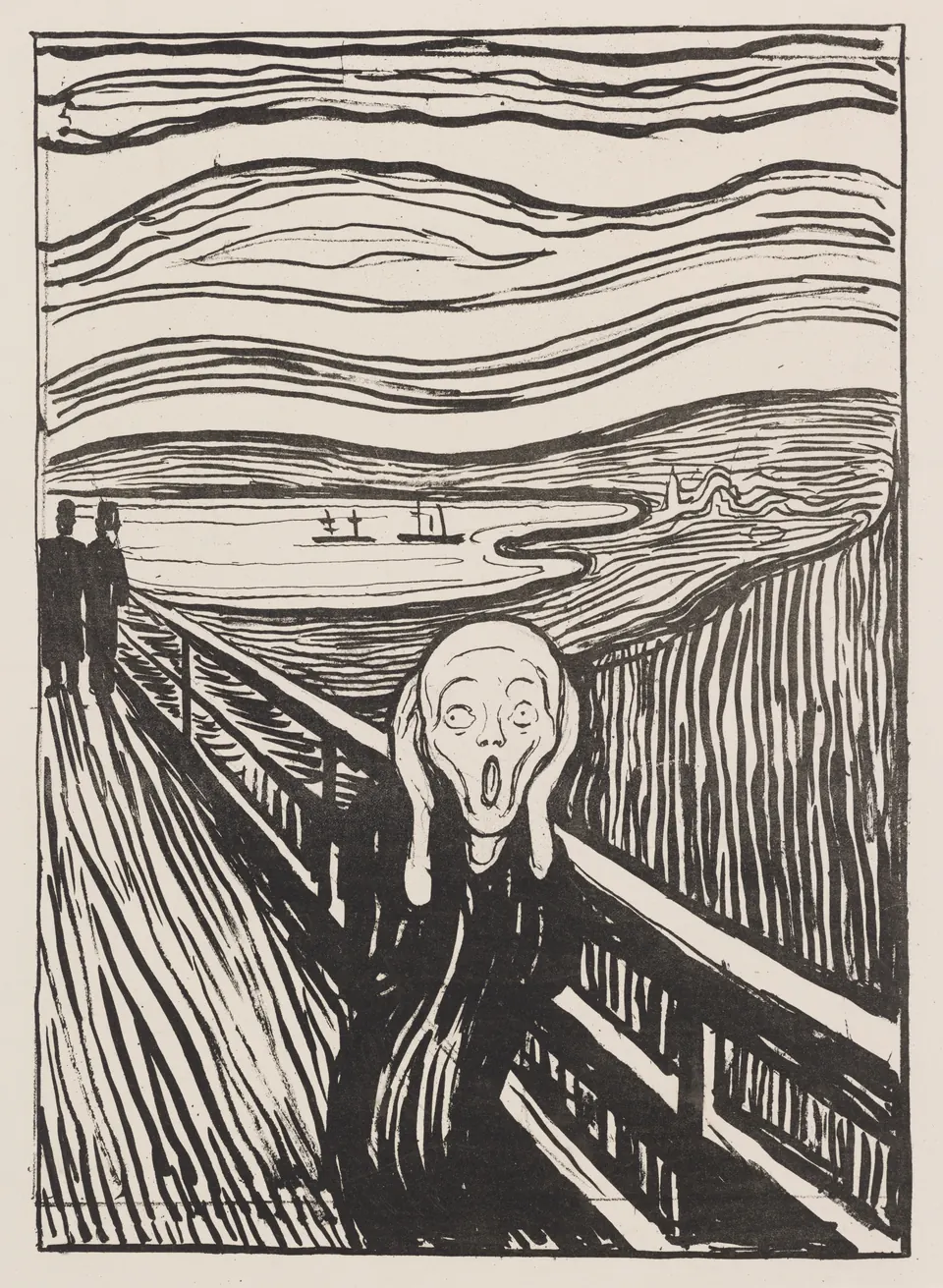
Here the bands of colour become networks of black lines. The pale face and hands stand against a densely worked setting. The visible cream support belongs to an impression on card, not a small photograph of a canvas. This reproduction does not document every margin and inscription on the physical sheet.
The Art Institute’s official record identifies this particular impression as 1963.282 and marks it public domain. Its image, rather than an unrelated scan from an auction catalogue, is the source of the existing illustration reused here.
The record also lists Schiefler’s 1907 catalogue, number 32, and a 1923 publication, plate 18. These are relevant print-history references. We have not freshly inspected those historical pages and their authorisation circumstances for this guide, so we report them as institutional bibliography, not as newly proved publication evidence for the 1893 painting.
What the dates establish
Three dates can sit beside the same reproduction and mean different things. 1893 identifies when the painting was made. 1910 records its gift to the National Museum. The date on a downloaded photograph records a later digital object or catalogue update. None is automatically the first authorised distribution of reproductions.
The U.S. definition of publication distinguishes distributing copies from merely displaying a work. An exhibition catalogue containing only a title is also different evidence from a catalogue that reproduces the image. A reference to “The Scream” must be matched to the version actually illustrated.
This is especially important when borrowing a date from a print record. An early lithograph demonstrates a related graphic composition. It does not necessarily account for the painted sky’s colours, the precise surface or another version’s distinctive details.
And what the country check still needs
The National Museum’s artist record gives Munch’s death as 1944. The ordinary artistic-work term described by UK guidance and EU guidance is life plus seventy. That calculation has elapsed; it is not an assertion that every national transitional rule or moral right is identical.
For a U.S. assessment, works published by 1930 fall beyond the maximum ninety-five-year publication term in 2026. But the relevant event must actually be established. Section 303 also contains rules for older works that were unpublished and not already copyrighted before 1978, including possible protection through 2047 after qualifying later publication.
We do not assert that this exception applies to the Oslo painting. We also do not erase it by assuming that fame proves an early publication. A U.S.-facing reproduction project needs the missing version-specific evidence, rather than an unsupported “1893, therefore free everywhere.”
The photograph and its credit
The current National Museum download identifies Børre Høstland as photographer. Its image policy permits reuse of works without a copyright label and gives its photographs a CC BY licence. The exact object’s download data links CC BY 4.0; we retain that attribution for the photographic contribution.
The licence allows commercial reuse with its conditions. Name the artist and work, photographer and museum, link the licence and indicate changes. Do not imply museum endorsement. This page credits a proportional reduction; it does not claim ownership of the underlying image.
Other providers have different terms. MUNCH’s reproduction policy distinguishes non-commercial use and specified publishing uses from other commercial requests. A permission attached to our National Museum file should never be pasted onto a MUNCH download.
Choosing a file without losing the work
Save the exact source page, accession, downloaded filename and licence with your image. Check whether the file includes a painted surface, a complete print sheet, a frame or someone’s later alterations. Keep that distinction visible in the caption.
For a face-only detail, identify the crop. For a colourised black print, identify the alteration and do not present the result as Munch’s own hand-colouring. If you replace the file with a sharper version, check its source again rather than carrying over the old credit.
The useful answer is specific: this version, this country analysis and this file. Our broader Munch artist guide provides additional print examples; it is not permission to treat every image bearing his name as interchangeable.
Editorial record
About this article
- Author
- Publisher
- GeMarkt
- Published
- Reviewed
- Internal source & rights check. Conducted by GeMarkt Research Review. This is an internal editorial check—not independent peer review.
- Source standard
- Rights guide source standardSeparates the underlying work from the source file, records the review date, and links the evidence used for the conclusion.
Found a claim that needs checking? Report a factual error.