GeMarkt Blog · Reference
Is Aivazovsky’s The Ninth Wave Public Domain?
The Ninth Wave has a public-domain-designated reproduction, but the painting, file and local rules are separate. Identify the 1850 Russian Museum canvas.


The short answer
Aivazovsky’s ordinary EU and UK author term has elapsed, and the exact Google Art Project reproduction shown here carries Wikimedia Commons’ PD-Art / Public Domain Mark designation. Neither statement is blanket clearance for every photograph, every territory or every commercial use associated with The Ninth Wave.
This guide concerns the 1850 State Russian Museum painting, Ж-2202, as checked on 12 October 2026. An independent U.S. publication history remains unresolved here. Russian museum-related and local commercial conditions also require their own enquiry; a Commons file notice should not be presented as a comprehensive Russian permission.
Identify the Russian Museum canvas
The Russian Museum object record identifies The Ninth Wave, 1850, an oil painting measuring 221 × 332 cm. It records receipt in 1897. The inventory is Ж-2202, which is more precise than a search label such as “Aivazovsky storm”.
The title appears in several languages and spellings. That is not, by itself, evidence of different paintings. Look for the group holding onto wreckage low in the composition, the large green wave to the left and the luminous sky above. Those features distinguish this scene from many other storms and shipwrecks painted by the artist.
The broader Aivazovsky artist guide includes moonlit ships, coastal views and other marine subjects. The permissions recorded for one of those images do not transfer to this one merely because the painter is the same.
The survivors change the seascape
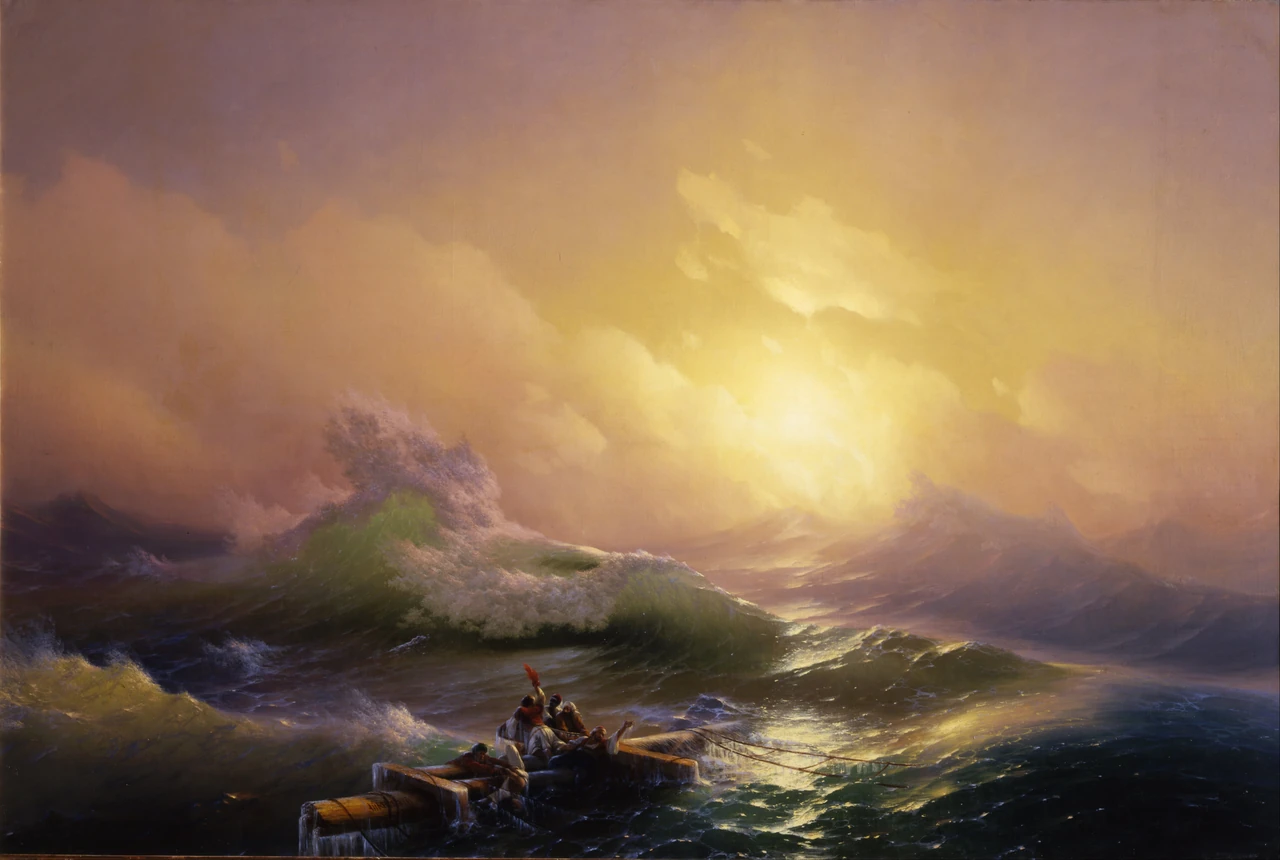
At first glance, the warm light might make the image seem welcoming. Look lower and the reading changes. People are clinging to broken timber rather than travelling safely in a boat. The beautiful colour does not remove their danger; it makes the contrast between the scene’s splendour and its vulnerability more striking.
The large wave rises at the left while a darker ridge of water crosses the foreground. Between them, a route of reflected light leads towards the people. They are small, but not incidental. Without them the painting would become a very different kind of picture: an impressive sea rather than a scene of survival.
Notice also how much of the image is sky. It gives the waves space to rise and sets their dark contours against a broad luminous field. Cropping that sky too tightly can turn a sweeping composition into an isolated close-up of water.
These are observations of the displayed reproduction, not proof of a particular shipwreck, hour or weather event. A dramatic title and a convincing wave do not make the canvas a documentary photograph or a scientific record of wave sequences.
The selected reproduction
The file comes from the specific Commons Google Art Project page. That page identifies a faithful reproduction of a two-dimensional artwork and applies PD-Art / Public Domain Mark 1.0. Its supplied original is a 5090 × 3420-pixel image. The smaller illustration here retains the full supplied composition.
The Public Domain Mark is a status designation, not a licence negotiated with the museum for a particular project. Commons also states its view of the reproduction’s U.S. status. Those statements are useful source information, but should remain attributed rather than becoming a claim that GeMarkt has examined all underlying historical evidence.
This is a historical digital reproduction, not a guarantee of the painting’s latest conservation appearance. A different scan may vary in colour, surface detail or the amount of painted edge included. Compare files as files: record where each came from instead of treating the brightest one as automatically the most accurate.
Three different dates to keep apart
The date 1850 identifies the painting’s creation. 1897 identifies the museum receipt recorded on the object page. The date of an online upload identifies something else again: when a particular digital file entered that platform. None of these labels should casually replace the others.
For U.S. purposes, the Copyright Office’s duration guidance distinguishes historical publication from creation and treats certain older unpublished works separately. A pre-1931 creation date alone is not the complete test. The Commons page states pre-1931 publication or registration, but the supporting historical chain is not independently established here.
That unresolved point is a limit on this answer, not an assertion that the painting must still be protected. It tells a publisher which evidence needs further attention if a formal U.S. clearance opinion is required. An authorised historical sale, distribution or reproduced edition may be relevant; a bare exhibition date should not be made to carry a legal conclusion it does not establish.
Copyright expiry is not a museum image agreement
Aivazovsky died in 1900. The ordinary life-plus-70 terms described in EU copyright guidance and the UK duration guide have elapsed. This is an ordinary author-term conclusion, not a claim to settle every exceptional or local condition.
The museum owns and cares for the physical painting; the selected online file has its own source history. An agreement to supply a particular photograph is another matter again. Keeping those relationships separate avoids two opposite mistakes: assuming museum possession renews the painter’s copyright, or assuming an old painting makes every museum service and website file unrestricted.
For a project involving Russia, do not turn a foreign public-domain label into a statement that local museum-related commercial requirements have been checked. No such comprehensive clearance is given here. Identify the proposed territory and use, then seek the relevant current institutional or qualified legal guidance where that distinction matters.
Cropping and colour change the meaning
A mobile background centred on the bright sky might remove the survivors almost entirely. It could still make an attractive design, but it would no longer explain the same relationship between people and sea. If you publish such a crop, call it a detail or adaptation and show the full work when discussing its composition.
Avoid stretching the sea to fit a frame. At a 60 cm image width, the canvas dimensions recorded by the museum imply a height of about 39.9 cm. That calculation concerns the painting’s proportions; a source photograph can include a slightly different edge, and a printed border adds further area.
Increasing saturation until the wave becomes fluorescent or replacing surface texture with invented detail changes the supplied image. An altered file should not be advertised as an untouched museum original. Keep an unmodified source alongside the working version so that a future editor can see what was changed.
Keep the rights record with the image
Save the object identity Ж-2202, the museum link, the exact Commons source page and its file designation together. Note the version acquired and any later alterations. This takes little space but prevents a familiar title from hiding an unfamiliar source.
The practical answer remains bounded: the ordinary EU/UK author term has expired and a specifically identified public-domain-designated reproduction is available. Independent U.S. publication evidence, other photographs and Russia-specific conditions are separate questions. Preserving those boundaries is more useful than an unqualified “free everywhere”. This guide provides general research information, not an individual legal opinion.
Editorial record
About this article
- Author
- Publisher
- GeMarkt
- Published
- Reviewed
- Internal source & rights check. Conducted by GeMarkt Research Review. This is an internal editorial check—not independent peer review.
- Source standard
- Rights guide source standardSeparates the underlying work from the source file, records the review date, and links the evidence used for the conclusion.
Found a claim that needs checking? Report a factual error.