GeMarkt Blog · Reference
Is The Large Blue Horses by Franz Marc Public Domain?
Check the Walker painting, an actual 1917 reproduction, its ordinary European copyright term and the separate source of the image used here.


The short answer
The Large Blue Horses is beyond Franz Marc’s ordinary author copyright term in the UK and EU. There is also a verified reproduction in a 1917 book, providing substantial evidence for an early-publication U.S. analysis. That does not make every digital photograph free to use.
This guide concerns the Walker Art Center’s 1942.1, painted in 1911, and a particular Commons reproduction. Checked 12 October 2026, the file is marked public domain; its page also carries a missing U.S. rights-tag warning. We have inspected the historical book image, but have not independently established the publisher’s authorisation to reproduce Marc’s painting. The answer is therefore narrower than “any file, anywhere, for anything.”
Which blue horses are we checking?
The Walker collection record identifies Die grossen blauen Pferde, or The Large Blue Horses, as a 1911 oil painting on canvas. Its broad horizontal composition contains three closely grouped horses. The museum acquired it in 1942 through the T. B. Walker Foundation, Gilbert M. Walker Fund.
Do not confuse it with Blue Horse I, a much taller composition dominated by one horse, or assume that all search results headed “Marc blue horses” reproduce this canvas. A similar animal, palette and date are not enough to identify a work. For this check, the reliable combination is title, three-horse composition, Walker collection and accession 1942.1.
That combination also helps when an old book uses a shortened German title. The words Blaue Pferde alone might seem ambiguous. Matching the positions of the heads, the pale trunks and the distant hills makes the historical illustration useful evidence for this particular composition.
Three animals, one rhythm
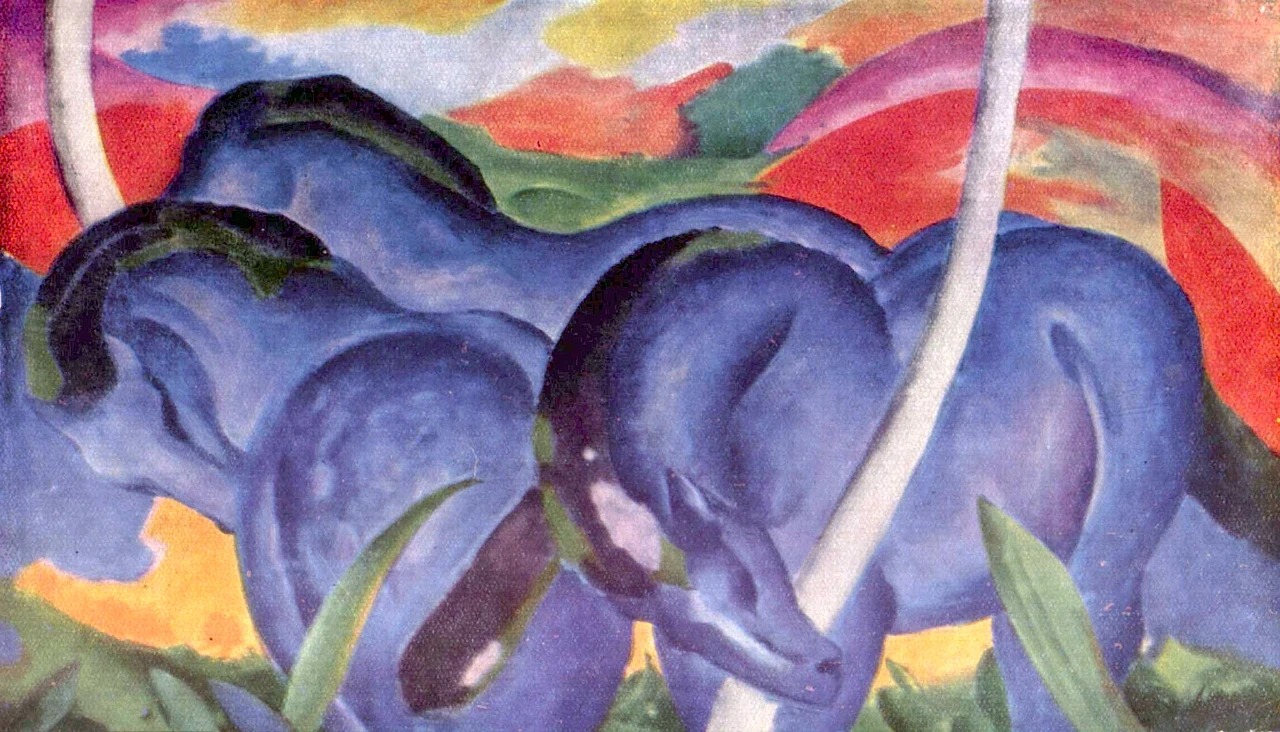
The horses are crowded together without looking like a row of separate portraits. Their backs make broad rising and falling curves. Their lowered heads bring the movement towards the foreground, where pointed green leaves interrupt the heavy blue forms. The pale trunks cut vertically through this mass, giving the eye something slender to follow upwards.
Behind the animals, bands of red, pink, green and yellow repeat the movement of their bodies. The blue is not merely a surprising coat colour applied to otherwise naturalistic horses. It helps unite the three animals, while the warmer landscape sets them apart. Even before identifying individual legs or ears, we read a large, continuous blue shape.
This is why the whole horizontal picture matters. A square crop can remove the horse at the left or turn the nearest head into the main subject. Either may make a striking detail, but neither should be labelled the complete painting. When comparing a historical illustration with a modern file, match those edges as carefully as the central animals.
A reproduction we can actually date
Fritz Burger’s Einführung in die moderne Kunst supplies more than a catalogue mention. A digitised copy from the Solomon R. Guggenheim Museum Library contains the matching composition on printed page 130, figure 145. The actual page scan shows all three horses beneath a heading naming Marc. The copyright leaf identifies Akademische Verlagsgesellschaft Athenaion and 1917.
The reproduction is monochrome. It establishes that the composition appeared in that book; it does not establish the colour accuracy of a modern JPEG. Nor does the book’s general copyright notice, by itself, demonstrate a permission agreement covering every illustration. We have not located such an agreement for this plate.
There is useful corroboration from the Walker’s own history of the painting: it dates the circulation of purchasable reproductions to 1919. That is evidence about copies, unlike the museum’s later acquisition and gallery displays. It strengthens the publication history without turning the 1942 acquisition date into a copyright starting point.
The distinction is practical. “Painted in 1911” tells us when Marc made the work. “Reproduced on this page in 1917” gives us a specific printed object to examine. A source-backed rights note should preserve both facts rather than compress them into one date.
What the country check establishes
Marc died in 1916. The ordinary artistic-work term described by UK government guidance and EU guidance is life plus seventy years. That ordinary author-term period has elapsed; special national rules and separate rights in later material still require their own checks.
The United States needs a different question. U.S. law distinguishes publication from public display. The 1917 reproduction is therefore more relevant than an exhibition date. An authorised 1917 publication would be well beyond the maximum ninety-five-year published-work term described in the older-work provisions. The remaining qualification here is authorisation, not whether 1911 is sufficiently old.
This is not a conclusion about every work Marc left behind. Another painting could have a different publication history, even if it was completed in the same year.
The file on this page is not the Walker’s download
Our illustration comes from the specified Commons file, whose source names the Yorck Project. Commons records a 2013 replacement described as having improved colours, alongside its public-domain assessment. We have retained the supplied composition and made no further colour adjustment.
The Public Domain Mark records an assessment, not a new permission granted by the museum. The Commons page’s broad wording and missing U.S. tag should be read together; neither substitutes for the historical evidence above.
By contrast, the Walker’s terms restrict commercial reuse of its site content and direct reproduction enquiries to a request process. We have not downloaded that museum file or treated the existence of its collection page as a licence. Different files depicting the same painting can arrive through different rights arrangements.
Choosing a reproduction without changing the painting
Look for the entire left-hand horse, both pale trunks and the sweep of the hills. Then compare the blue areas: a version with almost black horses may conceal the divisions between bodies; a highly saturated version can erase the quieter green and violet transitions.
A more vivid file is not automatically more faithful. The reproduction used here is useful for identifying forms and discussing the painting, but it is not a colour-calibrated production master. Neither the museum’s name in a caption nor a large pixel count certifies print quality.
Keep a record of the image you actually choose. If you replace it later, repeat the file check rather than carrying the old credit over to a visually similar download. This is especially important when a replacement includes a frame, gallery setting, restoration comparison or new graphic elements.
Before you reuse the image
Record the Walker identity, the country where you will use it, the 1917 publication evidence and its authorisation limit, and the exact file’s rights statement. Preserve the source link with your working file, not just on a page that may later be redesigned.
For an explanatory article, a clear complete reproduction and an honest source credit are a sound starting point. For a commercial print run relying on U.S. clearance, resolve the remaining publication question rather than treating this guide as a permission certificate. Our Franz Marc artist guide explains why that work-by-work approach matters across his wider output.
Editorial record
About this article
- Author
- Publisher
- GeMarkt
- Published
- Reviewed
- Internal source & rights check. Conducted by GeMarkt Research Review. This is an internal editorial check—not independent peer review.
- Source standard
- Rights guide source standardSeparates the underlying work from the source file, records the review date, and links the evidence used for the conclusion.
Found a claim that needs checking? Report a factual error.