GeMarkt Blog · Reference
Is The Lady of Shalott by John William Waterhouse Public Domain?
Check Waterhouse’s 1888 Lady of Shalott, its distinct later versions, U.S. publication limits and the licence of the photograph you actually use.


The short answer
The ordinary UK and EU author copyright term for Waterhouse’s 1888 painting has expired. That does not make every photograph of it an unrestricted download. The illustration here is Sailko’s own photograph, released under CC BY 3.0, not a Tate-supplied image.
This check, dated 12 October 2026, concerns the boat scene at Tate, N01543. We have not independently established its complete U.S. publication history. Do not turn either the year 1888 or the photographer’s licence into a worldwide clearance of the underlying painting.
Which Lady of Shalott?
The familiar horizontal picture shows a white-robed woman leaving a wooded riverbank. The vessel carries a richly patterned textile, candles and a small crucifix. Tate’s own partner record identifies Waterhouse’s 1888 work and its presentation by Henry Tate in 1894.
That is not the same object as “I am half sick of shadows,” said The Lady of Shalott, Waterhouse’s 1915 painting in the Art Gallery of Ontario. The AGO record identifies that later oil as 71/18. A search for the character’s name can produce both pictures, even though their compositions and collections differ.
Keep the year and museum beside the title when gathering files. A folder labelled only “Waterhouse Shalott” is easy to mix up. It can also absorb a drawing, a recent painted copy or an illustration by another artist. Similar subject matter is not enough to carry one file’s rights statement onto another.
Our Waterhouse artist guide considers other works. This page stays with the 1888 canvas and the particular photograph shown below.
Read the boat before cropping it
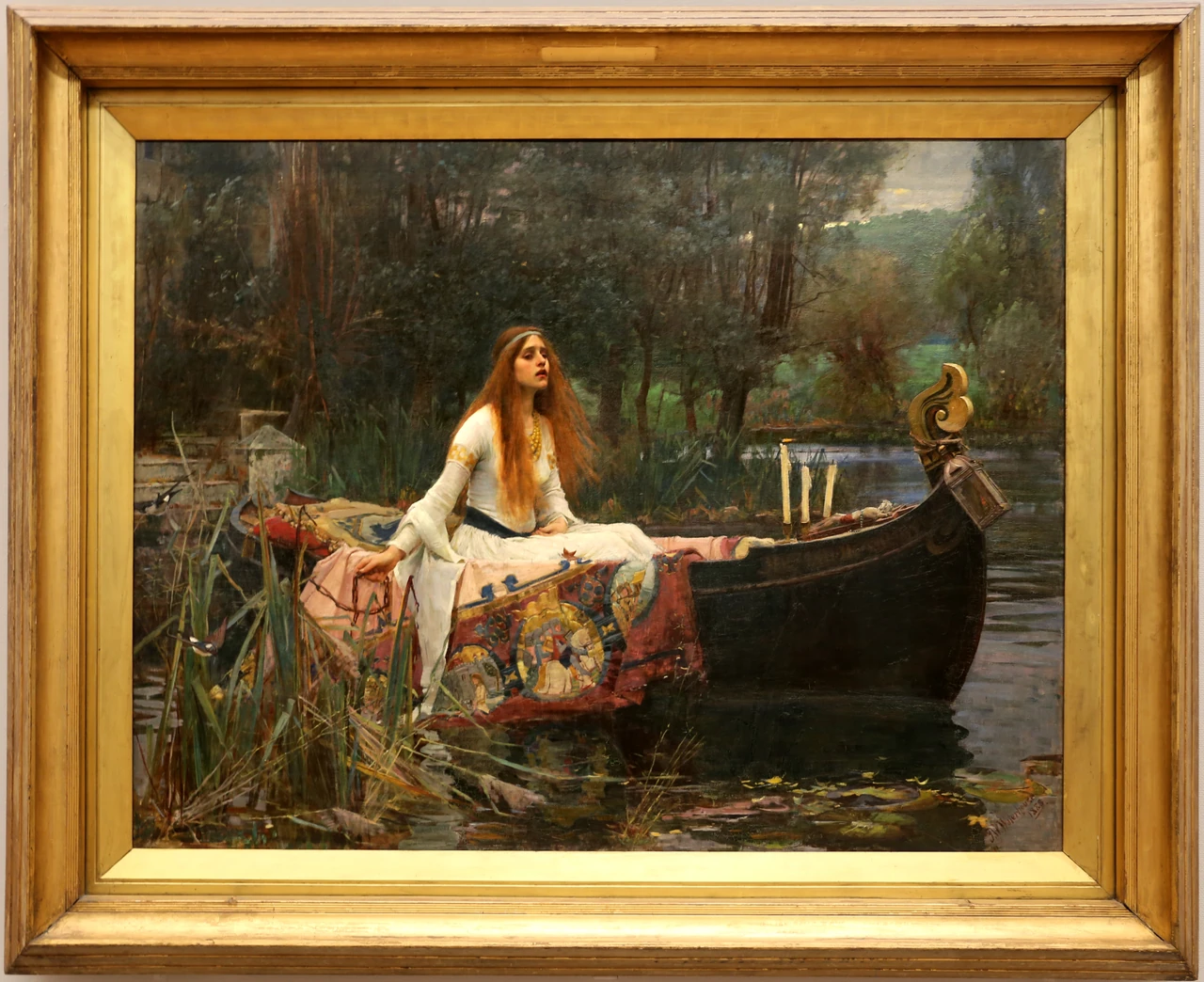
The white dress attracts the eye, but the figure does not occupy the whole scene. Reeds crowd the left foreground. The boat stretches across the lower half, with a high prow pointing into open water at the right. Behind it, the trees make a dark enclosure. That arrangement allows the departure to remain legible even at a modest display size.
Look at the textile hanging over the side. Its bright patches interrupt the brown boat and connect the woman to a world of images. Tate relates it to the web she has woven in Tennyson’s poem. The museum also identifies the released mooring chain and the candles, two already extinguished, as part of the narrative of her final journey.
A close crop of her face produces a different experience: an expressive portrait, but not a complete explanation of this painting. A phone wallpaper might sacrifice the boat’s right end; a square product mockup might remove the departure point on the left. Those can be deliberate design choices, but they should not be presented as the complete composition.
The golden surround in our illustration belongs to the photographed frame. It is not a yellow band within Waterhouse’s painted river scene. If you use the photograph in a layout, keep that distinction clear—especially beside anything a reader might mistake for a framed product for sale.
The poem is not the photograph
Waterhouse died in 1917. His painting falls outside the ordinary life-plus-seventy author term described by the UK government and the EU’s copyright guidance. This is a bounded author-term conclusion, not a statement that every country applies identical rules.
There are also several different creative works in play. Tennyson supplied the literary subject; Waterhouse made this painted interpretation; a photographer produced the digital view. A modern translation, narrated video, decorative layout or newly commissioned illustration adds further material. Calling the underlying painting public domain does not automatically describe those additions.
For a simple article, the practical distinction is easy to preserve: name Waterhouse as the painter and credit the photographer separately. Do not credit Sailko as the creator of the nineteenth-century composition, or erase the photographic credit because Waterhouse’s ordinary term has expired.
What we can and cannot say about the U.S.
Creation and public display are not a complete publication record. U.S. rules distinguish older published works from previously unpublished works; sections 303 and 304 provide different routes. The 1930 publication cutoff relevant in 2026 is not a painting-date cutoff. Some qualifying works first published in 1978–2002 can remain protected through 2047 under section 303.
The museum’s 1888 date identifies the painting. Its 1894 acquisition identifies a transfer into a collection. Neither statement, by itself, supplies an authorised early reproduction that we have inspected. This guide therefore leaves the independent U.S. publication chain unresolved, rather than reporting a date calculation as an archival discovery.
If your project needs a firm U.S. conclusion, look for the actual illustrated publication or issued reproduction, establish which composition it contains, and check the relevant publication circumstances. A catalogue entry naming the painting is not necessarily a reproduction of it. Preserve what you found so that the next person does not have to repeat the same search.
A file with an identifiable photographer
The selected file description records Sailko, own work, photographed 28 February 2017. Its original file measures 4,236 × 3,456 pixels. We made a proportional 1,280-pixel-wide version without changing the photographed composition.
CC BY 3.0 allows commercial reuse and adaptation under its conditions. Give appropriate credit, link the licence and identify changes. Do not imply the photographer endorses your project. That permission concerns the photographer’s rights; it does not settle an independently unresolved underlying-work question for every destination.
We did not treat the Tate/Google Art Project image as interchangeable with this photograph. A source can be excellent for identifying an artwork without being the source you choose for reusable pixels. A screenshot of a museum viewer likewise comes without an automatic licence merely because you can make it.
Using the picture without misdescribing it
For a reading page, this photograph shows the full scene clearly enough to discuss the boat, textile and surrounding space. For a large print, inspect the original at the intended output size. The resolution of a file does not establish colour accuracy, and a photographed frame uses pixels that are not part of the painted surface.
Avoid silently stretching the picture to fill a different aspect ratio. If you need a detail, label it as a detail. If you change the background, remove the frame or substantially adjust colour, keep both the source and a record of those changes. A later reader should be able to tell where Waterhouse’s composition ends and your presentation begins.
A credit that travels with the file
A useful credit is: John William Waterhouse, The Lady of Shalott, 1888, Tate, N01543. Photograph: Sailko, Wikimedia Commons, CC BY 3.0; proportionally resized, photographed frame retained. Keep the linked file page and licence with it.
That is more informative than “image from Google” and more honest than “copyright-free everywhere.” It identifies the picture, the actual photograph and the limits of this check without making the credit carry a legal promise it cannot support.
Editorial record
About this article
- Author
- Publisher
- GeMarkt
- Published
- Reviewed
- Internal source & rights check. Conducted by GeMarkt Research Review. This is an internal editorial check—not independent peer review.
- Source standard
- Rights guide source standardSeparates the underlying work from the source file, records the review date, and links the evidence used for the conclusion.
Found a claim that needs checking? Report a factual error.