GeMarkt Blog · Reference
Is Hunters in the Snow by Pieter Bruegel the Elder Public Domain?
Check the 1565 KHM painting, the exact Google Art Project reproduction and the difference between an old artwork and a museum download licence.


The short answer
The ordinary EU and UK author term for Bruegel’s Hunters in the Snow has expired. The exact reproduction shown here is marked public domain on Wikimedia Commons. That is not a licence for every museum download, modern winter poster or photograph showing the painting in a gallery.
This check concerns the 1565 panel in the Kunsthistorisches Museum, Vienna, and is current to 12 October 2026. Commons states a pre-1931 U.S. publication basis for its file. We report that designation without claiming an independent reconstruction of the painting’s authorised publication history.
Identify the winter panel
The museum-supplied Google Arts & Culture record identifies Hunters in the Snow (Winter), 1565, inventory GG 1838, oil on wood, approximately 117 × 162 cm without its frame. The KHM collection page is the corresponding object record.
The key visual markers are the hunters and dogs at the left, the slope falling towards frozen water, a village beyond and sharp mountains at the right. Those features distinguish the work from other Bruegel winter scenes and from later paintings by artists with similar names.
This is one panel from a seasonal series, not a print issued as a modern Christmas illustration. KHM places it alongside other seasonal landscapes, including The Harvesters. That relationship helps explain why work, weather and leisure coexist in the picture. It should not be labelled a documentary view of a particular present-day ski resort.
Use the artist’s full name, Pieter Bruegel the Elder, in a research note or catalogue. A file labelled only “Brueghel winter” leaves room for a different artist, a workshop copy or a different composition. For more examples, see the artist guide.
Why the whole landscape matters
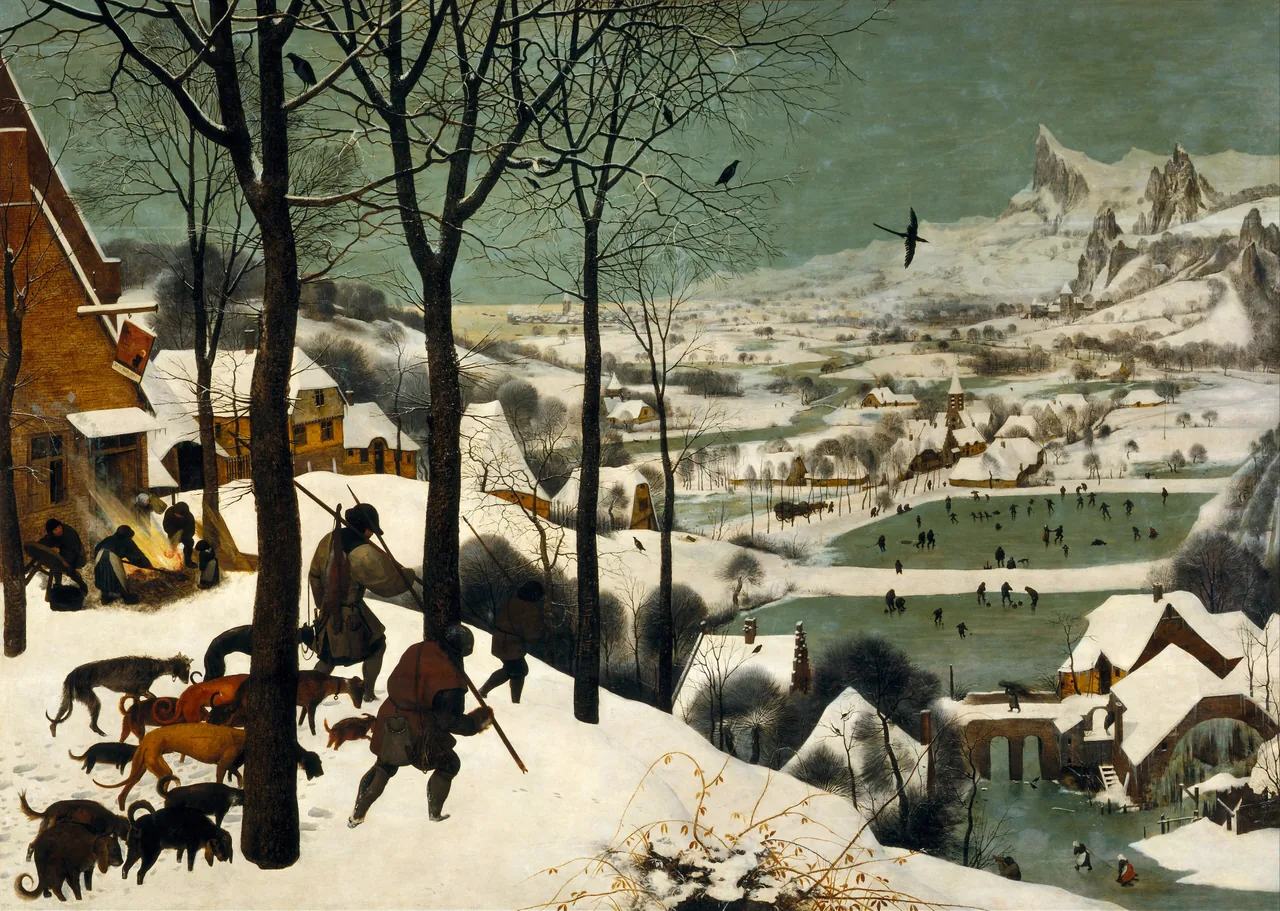
Look first at the dark tree trunks. They divide the pale slope into uneven strips, while the men and dogs move between them. The descending diagonal carries the eye towards the village. Farther away, tiny people spread across the ice; their activity is a counterweight to the much heavier figures in the foreground.
The snow is not a featureless white sheet. Footprints, brown stems, roof edges and the dark streams break it up. The sky and frozen water share a greenish tone, bringing distant areas together. A small orange fire beside the building at the far left is conspicuous because warm colour is scarce elsewhere.
These are visible relationships in the reproduction, not claims about a uniquely correct symbolic interpretation. They also provide a useful quality check. If a download turns the sky vivid turquoise or wipes out the branches, compare it with the institutional record before presenting its appearance as dependable.
A crop centred on the skaters can be attractive, but it no longer explains the title. A crop centred on the hunters can lose the landscape into which they are returning. Both may serve a particular design; neither should be captioned as the complete painting.
Ordinary copyright and the exact download
Bruegel died in 1569, far outside the ordinary EU and UK life-plus-seventy terms. That does not automatically settle rights in a new photograph, a designed book spread or accompanying text.
KHM’s image-use terms provide a non-commercial route for content in which it owns rights. A private-use download is not evidence of permission to use that supplied file in advertising or on merchandise. This article does not grant, or claim to have obtained, a separate KHM commercial image licence.
If a project specifically needs the museum’s current photograph, keep that request separate from the age of Bruegel’s work. A file’s colour profile, permitted use and required credit can matter even when the painter’s ordinary economic rights have elapsed.
Our illustration and its source
The selected Commons file names the Google Cultural Institute / Google Art Project as its source and identifies GG 1838. It applies PD-Art / Public Domain Mark 1.0 to the faithful two-dimensional reproduction. This page uses that identified file, not a different KHM download with a borrowed licence label.
The Public Domain Mark is a statement about status, not an exclusive licence or museum endorsement. Commons’ treatment of the reproduction is explicitly attributed here; its page also notes that legal treatment can vary outside the United States.
Our displayed version keeps the source’s full composition and proportions. It has not been repainted, extended with invented scenery or given synthetic snow. The source record should travel with a downloaded working copy so that a future editor can distinguish it from a visually similar replacement.
The US publication limit
Commons states that the work was published or registered before 1 January 1931. This guide has not independently established the qualifying early publication and authorisation. The painting’s 1565 date is not that evidence, nor is its presence in a museum collection.
The U.S. Copyright Office’s duration guidance distinguishes historical published works from works governed by other term rules. Do not convert “painted centuries ago” into an invented publication date. For formal commercial clearance, keep the Commons finding and the uncompleted independent publication check as separate entries.
That limit does not require calling the painting a modern copyrighted work. It requires describing the evidence honestly. An attributed public-domain file designation is a usable source fact; a claim that this article has examined every relevant historical publication would not be.
A winter card, a print or a wallpaper?
For a seasonal card, decide whether text can sit outside the artwork. A pale snowfield looks like spare space at thumbnail size, but may contain footprints or distant figures. Placing words over it changes the image, and a heavy border can remove the last dogs at the left.
For a wall print, compare the chosen paper shape with the complete composition. Do not stretch the width to fill a standard frame. A visible margin or a clearly identified crop is preferable to distorted people and buildings. The display file on this page is not a promise of a particular large-format print resolution.
For a wallpaper, preview the image with the clock and interface visible. The dark foreground and lighter valley offer very different text contrast. If only a narrow vertical slice survives, name it a detail instead of allowing the title to imply a full reproduction.
Keep the file history with the picture
Record the artist, 1565, GG 1838, the exact source URL and any changes you make. Keep your reproduction separate from a seller’s room mockup, modern lettering or packaging: the painting’s designation does not automatically cover those additions.
The practical conclusion is specific: an identified public-domain-designated reproduction is available, while museum-supplied downloads and independent U.S. publication clearance remain separate questions. Accurate identification is the first step; preserving the composition and the source record makes the answer useful after the image leaves this page.
Editorial record
About this article
- Author
- Publisher
- GeMarkt
- Published
- Reviewed
- Internal source & rights check. Conducted by GeMarkt Research Review. This is an internal editorial check—not independent peer review.
- Source standard
- Rights guide source standardSeparates the underlying work from the source file, records the review date, and links the evidence used for the conclusion.
Found a claim that needs checking? Report a factual error.