GeMarkt Blog · Reference
Is John Constable’s The Hay Wain Public Domain?
Constable’s old painting and a modern photograph have different rights. Identify NG1207, check the publication evidence and credit the selected photo.


The short answer
The Hay Wain is beyond Constable’s ordinary UK economic copyright term, but the photograph used on this page is not being offered as an unrestricted public-domain file. It is a separate photograph by Sailko, licensed CC BY 3.0, with attribution and licence conditions to follow.
The painting examined is the National Gallery’s finished 1821 canvas, NG1207, not a preparatory study. As of 12 October 2026, the U.S. historical publication question is kept separate from the artist’s death date. The evidence includes a documented early sale, but this page does not present a completed historical legal determination.
The finished painting is NG1207
The National Gallery record identifies an oil painting measuring 130.2 × 185.4 cm, presented by Henry Vaughan in 1886. Constable lived from 1776 to 1837. The title The Hay Wain refers to the cart in the water, but the picture originally went to the Royal Academy in 1821 as Landscape: Noon.
The gallery explains that this Suffolk view was painted in Constable’s London studio, using outdoor studies. It is therefore misleading to describe the finished canvas simply as a view dashed off beside the river. Looking closely at nature and composing a large exhibition painting were connected activities, not necessarily the same moment.
Record the inventory number with the title. “Constable landscape” can return another scene, while “Hay Wain” can return studies, later prints, details and photographs of the framed painting. All can be worthwhile images, but they answer different questions.
Look beyond the cart
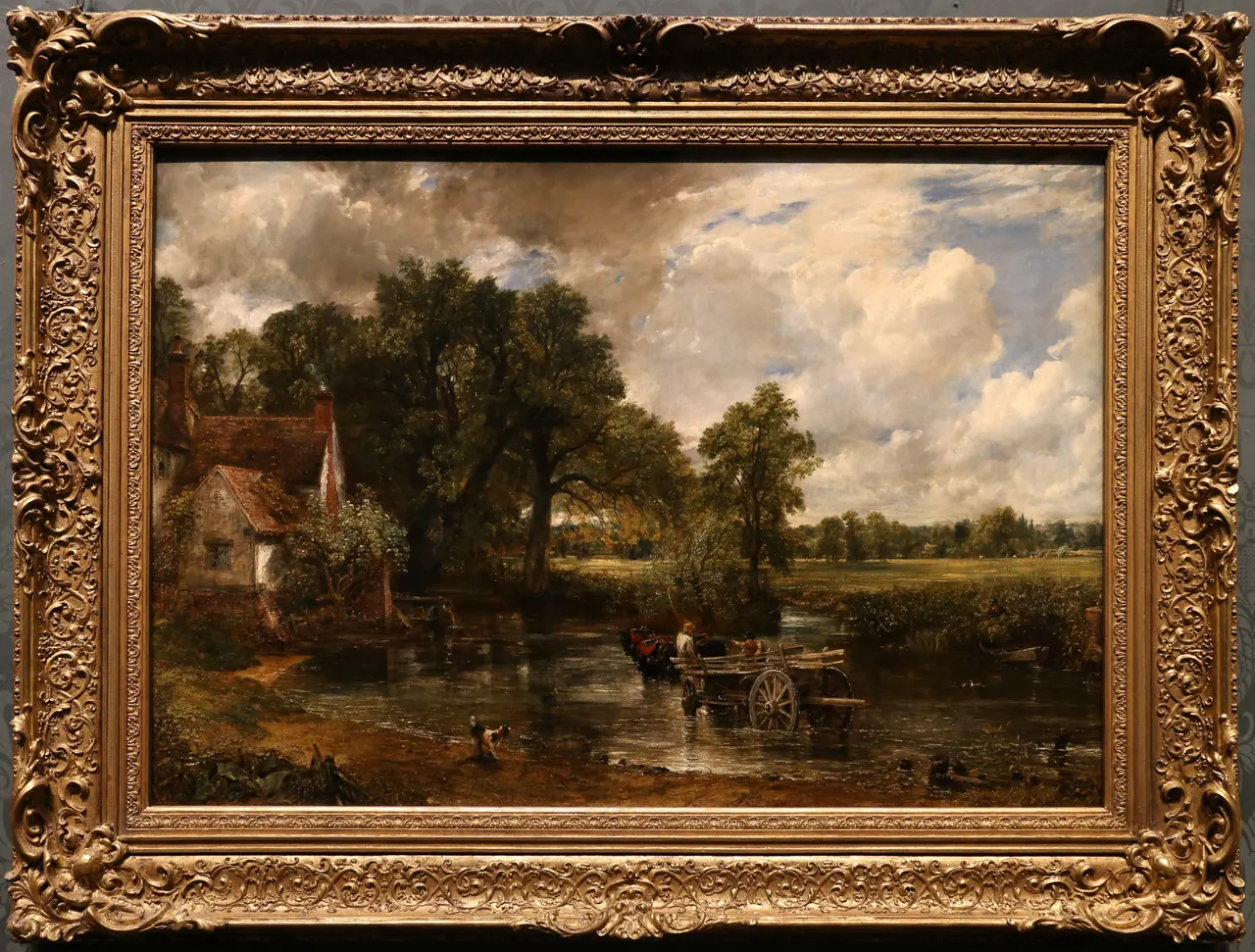
The cart occupies only a small part of the painting. The cottage and tall trees make a dark, substantial mass at the left, while the field opens towards the right. Above both is a broad sky whose changes of light are as important as the named object below.
Look at the difference between water and land. Reflections break the darker forms into short horizontal marks; farther back, the field reads as a more continuous band. The dog near the water’s edge gives the foreground a small point of attention without becoming the subject of the whole scene.
The visible frame also changes the encounter. It reminds us that this is a photograph of an exhibited object, not a neutral sheet of colour ready for a printer. Gallery lighting, the surrounding frame and the camera’s view belong to this particular image. They should not be mistaken for additions painted by Constable.
This photograph is useful for showing that distinction. It is not described as a colour-certified reproduction suitable for manufacturing an exact facsimile.
A photograph with its own licence
The exact Commons file page names Sailko as the photographer and supplies Creative Commons Attribution 3.0 Unported. Under the licence, reuse requires appropriate credit, a licence reference and acknowledgement of relevant changes; it must not imply the photographer endorses the use. This licence permits commercial reuse subject to its conditions.
Here the photograph is shown at reduced size with its full supplied view retained. The caption gives the photographer, source and licence. The painting’s age does not remove those requirements from this chosen file.
That also explains why we do not call every online copy “the National Gallery image”. One image may be a museum photograph, another a visitor’s photograph, another a scan of an older publication. A public-domain notice attached to one reproduction does not automatically govern the others.
If you choose a different file, follow its own record rather than copying this credit. Crediting Sailko beneath someone else’s photograph would be inaccurate even if the painting and frame look much the same.
What the early sale establishes
Constable’s death in 1837 puts his ordinary economic term far beyond the UK’s usual life-plus-70 duration for artistic works. That is the straightforward part of the answer. It does not determine a modern photographer’s rights or every possible national treatment of a later reproduction.
The National Gallery’s provenance records purchase from the artist by John Arrowsmith in 1824, followed by the painting’s move to Paris. This is more informative than merely knowing that it was painted in 1821. It identifies an artist-linked transaction that a historical publication enquiry can assess.
The U.S. Copyright Office distinguishes display alone from publication and recognises that authorised sale or distribution of an original can matter. It would therefore be wrong to demand only evidence of a printed book reproduction. Equally, applying present-day explanatory language to a nineteenth-century transaction requires attention to the rules then applicable.
An independently completed U.S. analysis is not supplied here. The early sale is meaningful evidence, not a substitute for that analysis. The creation date, a later exhibition and Vaughan’s gift to the gallery should remain separately labelled events rather than becoming three interchangeable “publication dates”.
Do not substitute the study
The V&A identifies a separate full-scale study for The Hay Wain, about 1821, museum number 987-1900. Constable’s working studies can look surprisingly close to the finished composition in a small search thumbnail. A changed tree or looser handling may become apparent only when the image is enlarged. Copying the finished picture’s caption onto such a file gives the reader the wrong object even if both works are beyond the ordinary author term.
The title, date and artist are therefore only the first checks. Compare the holding institution, accession, dimensions and the actual image. A study can be reproduced honestly as a study; it does not need to pretend to be NG1207 in order to be interesting.
The same applies to an engraving after Constable. It may reverse the composition or translate coloured brushwork into lines. That is a separate printed object with an engraver, publisher and edition history to consider. Our Constable artist guide introduces that wider range of material.
Choosing a copy for your project
For an article about the painting as a museum object, a frame-inclusive photograph can be a good choice. For a detail about the cart, use a clearly labelled detail and provide the full scene nearby. For a large print, first find a suitable full-composition source whose reuse conditions and quality fit the intended production.
Do not stretch the picture into a convenient shape. Using the gallery’s dimensions, a 50 cm-wide image of the canvas would be about 35.1 cm high. The photographed frame occupies additional area and does not belong in that calculation. Separating canvas size, image size and frame size prevents an attractive preview from becoming a misleading product specification.
A warm photograph should not be promoted as the painting’s uniquely correct colour. If reliable colour matching matters, obtain an appropriate source and proof the output. Automatic saturation or sharpening is not evidence that an older-looking reproduction has been accurately restored.
The record to keep
Save NG1207, the National Gallery object link, the selected photograph’s source page, the photographer’s name and CC BY 3.0 with the file. Keep any later crop or adjustment note in the same folder. The next person using the image can then distinguish Constable’s canvas from the photograph and from your own adaptation.
The useful answer is yes for the expired ordinary UK term of the painting, with a specific licensed photographic route shown here. Preserve the licence conditions and unresolved jurisdictional details instead of flattening them into a blanket “free image” label. This is general research guidance, not personal legal advice.
Editorial record
About this article
- Author
- Publisher
- GeMarkt
- Published
- Reviewed
- Internal source & rights check. Conducted by GeMarkt Research Review. This is an internal editorial check—not independent peer review.
- Source standard
- Rights guide source standardSeparates the underlying work from the source file, records the review date, and links the evidence used for the conclusion.
Found a claim that needs checking? Report a factual error.