GeMarkt Blog · Reference
Is Millet’s The Gleaners Public Domain?
Millet’s 1857 painting is out of its ordinary life-plus-70 term. Identify the Orsay canvas, check the exact file and keep U.S. publication evidence separate.


The short answer
Yes under the ordinary life-plus-70 rule: Millet’s copyright term in the 1857 painting has expired. A particular downloadable image is a separate question. The Google Art Project file used here carries a Commons public-domain designation; the museum’s own photographs should not automatically be treated as having the same terms.
This guide identifies The Gleaners, Musée d’Orsay, RF 592. It does not independently establish the painting’s early authorised publication history for a U.S. legal conclusion. The 1857 date and its appearance at the Salon are not, on their own, that evidence. The Commons U.S. public-domain assertion is reported as a source assessment, not presented as a historical finding made here.
The painting behind the title
The Musée d’Orsay record identifies the painting as Des glaneuses, dated 1857, in oil on canvas, measuring 83.5 × 110 cm. It records the work’s appearance at the 1857 Salon and its donation by Madame Pommery in 1890.
“Gleaning” means gathering what remains after the main harvest. In the image, the three women work close to the ground while larger quantities of grain occupy the distance. Recognising that activity prevents a deceptively simple miscaption: they are not sowing seed or cutting the standing crop.
The English title appears as both The Gleaners and Gleaners. The French title may appear without an initial capital. Those variations are not different versions of the painting. Conversely, a drawing or print with a similar title is not necessarily a reproduction of this precise canvas.
For a wider introduction to his rural subjects, see our Millet artist guide. Here the focus stays on one object and one usable, identifiable reproduction.
Why the distant harvest belongs in the image
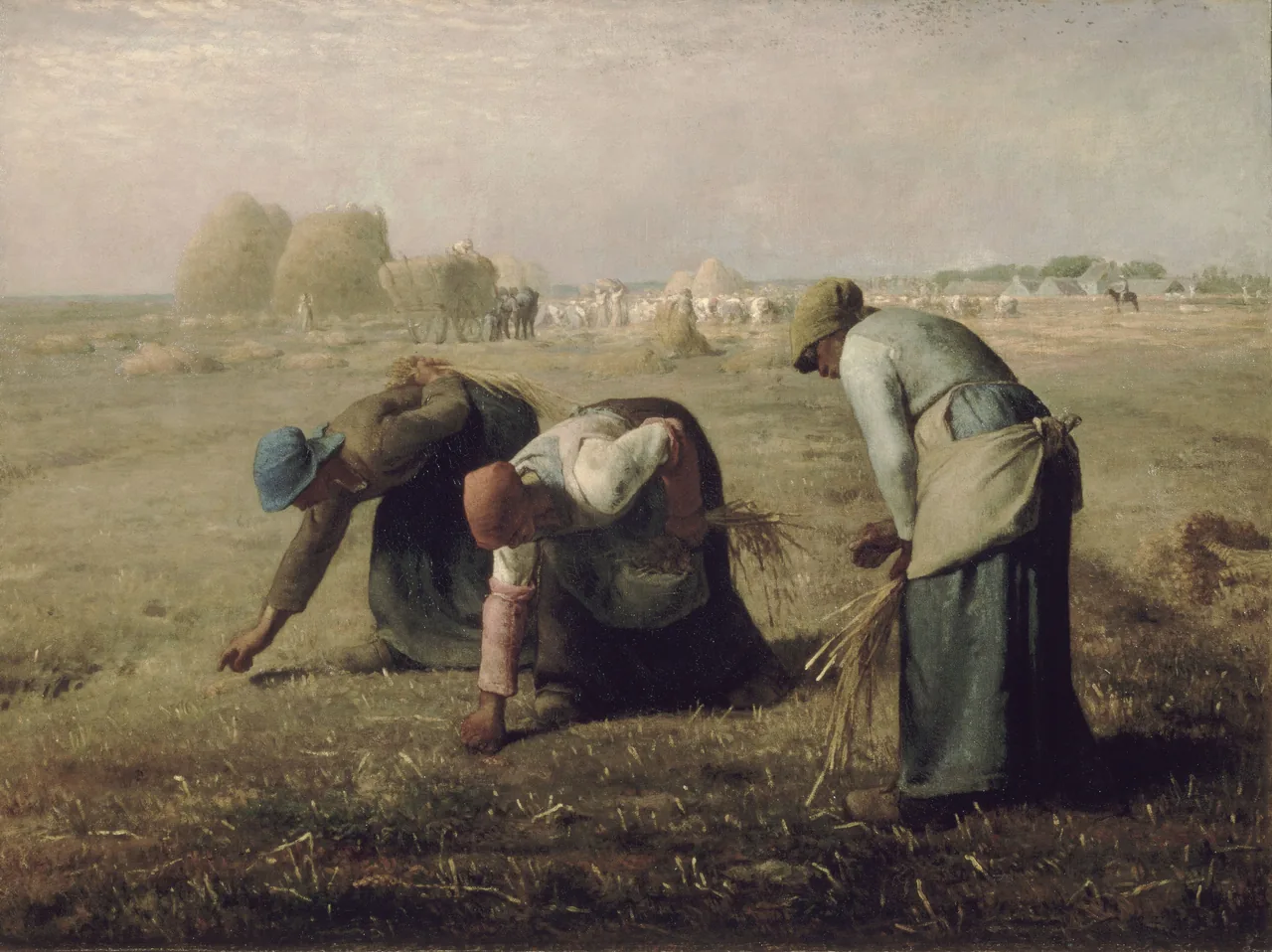
The figures make three variations on a bending movement. At the left, an arm reaches down; in the middle, the body folds into a low arch; on the right, a woman is a little more upright. Their hands and backs connect the activity across the foreground without turning it into a symmetrical pattern.
Behind them, the field opens out. The harvest looks plentiful, but its abundance is distant from the small gleaned bundles. That visual contrast is visible in the painting itself. It does not require us to invent the women’s names, exact wages or thoughts.
A crop that enlarges only the women can be useful when discussing gesture. As the only image accompanying a general explanation, however, it removes much of the relationship between figures and landscape. Keep a full view available and identify a detail as a detail.
Colour also matters here. The picture’s muted clothing and warm earth are not simply a sepia filter. Aggressive brightening can flatten the distance, while excessive contrast can hide the gestures that make the foreground readable.
What 1857 does and does not prove
Millet died in 1875. His ordinary economic term is long past under the standard rule stated in French copyright law, Article L123-1, which extends through seventy years after the calendar year of death. That statement concerns the underlying painting, not every later image of it.
U.S. treatment of older works also depends on publication history and the rules applicable to it. The Copyright Office distinguishes publication from display: an authorised sale or distribution may matter, while exhibition alone does not establish publication.
This review has not reconstructed the relevant historical transactions or an authorised early reproduction chain for RF 592. It therefore does not turn the Salon date into a precise U.S. clearance date. That is a limit of the evidence assembled here, not a claim that Millet’s painting is newly protected.
For a rights-sensitive U.S. project, resolve that historical question alongside the chosen image’s terms. A generic date calculator cannot do both jobs simply because the title and painter are famous.
The selected download is a separate question
The Commons file used in this article traces its source to Google Art Project and marks the faithful reproduction PD-Art / Public Domain Mark 1.0. It also asserts pre-1931 publication or registration for the United States. That tag does not supply the independently inspected historical event missing from this guide.
This is not the same as a museum-issued CC0 waiver. The d’Orsay record credits named photographers on its own images. A Commons assessment of one reproduction does not grant access to another service’s full-resolution file or erase conditions attached to obtaining it.
The selected file’s identity is nevertheless clear. Its full composition matches RF 592. An accession field on Commons gives 342, which is the museum webpage identifier; the inventory number to use in an artwork credit is RF 592. Recording that distinction makes future checking easier.
Three common mix-ups
First, do not substitute The Angelus. Millet’s paired figures standing in a field are recognisable, but they belong to another painting with another record. A filename containing “Millet peasants” is not adequate identification.
Second, a historical engraving after The Gleaners deserves its own attribution. The engraver translated painted colour into a printed surface. Its date, maker, impression and source image belong in the record; they should not be hidden behind “Millet, 1857”.
Third, an image with a decorative border or mock frame is a presentation of a reproduction, not the dimensions of the original canvas. Download the artwork image itself where possible. Do not calculate the painting’s proportions from a photographed frame, angled wall view or cropped shop thumbnail.
Using the image without losing the work
For an article about rural labour, put the full painting next to the passage that explains the women’s actions. For a closer discussion of hands or posture, add a clearly labelled detail while preserving the wider context nearby.
For a print, decide whether the whole composition will fit before choosing a standard frame. A mount is often preferable to removing the sky or cutting a figure at the edge. The original is wider than it is high; stretching it into another ratio changes bodies and distances, not merely the border.
Keep any restoration, colour adjustment or imaginative reconstruction separate from the documentary source image. If you sell a modified design, show what was changed and avoid suggesting that your alterations are newly discovered features of Millet’s canvas.
A practical answer for your project
A useful credit identifies Jean-François Millet, The Gleaners, 1857, Musée d’Orsay, RF 592, followed by the exact reproduction source and its stated rights status. Save that page with the file rather than relying on a remembered search result.
The bounded answer is: Millet’s ordinary term has expired; the selected Commons image has a documented public-domain assessment; an independent U.S. publication audit remains outside this guide. For a project needing formal clearance, investigate that remaining point and the destination’s rules before committing to production. For understanding the picture, keep the three women and the distant harvest together.
Editorial record
About this article
- Author
- Publisher
- GeMarkt
- Published
- Reviewed
- Internal source & rights check. Conducted by GeMarkt Research Review. This is an internal editorial check—not independent peer review.
- Source standard
- Rights guide source standardSeparates the underlying work from the source file, records the review date, and links the evidence used for the conclusion.
Found a claim that needs checking? Report a factual error.