GeMarkt Blog · Reference
Is The Garden of Earthly Delights by Hieronymus Bosch Public Domain?
Separate Bosch’s original triptych, its open and closed views, and the exact digital reproduction. Check the Prado record and Commons file terms.


The short answer
Bosch’s ordinary EU and UK author copyright term has expired, and the exact reproduction illustrated here is designated public domain by Wikimedia Commons. That does not make every Prado download, modern photograph or adaptation of The Garden of Earthly Delights available on the same terms.
This guide concerns the Prado triptych, P002823, checked on 12 October 2026. Our image shows its open interior, not its closed exterior or a standalone central-panel painting. The file provider asserts a U.S. public-domain basis; this article does not claim an independent, complete investigation of the work’s early authorised publication.
Identify the Prado triptych
The Museo Nacional del Prado’s collection record gives the title The Garden of Earthly Delights Triptych, dates it 1490–1500 and identifies oil and grisaille on oak panel. It records a height of 185.8 cm, with a central panel 172.5 cm wide and wings 76.5 cm wide each.
Those measurements describe the panels rather than a generic poster rectangle. A reproduction can include the dark divisions and surrounding edges; its pixel proportions need not equal a casual sum of the painted surfaces. Do not use a web thumbnail to overwrite the museum’s physical measurements.
You may encounter broader or different date ranges in image repositories and older captions. Here, the museum’s current date is used for the artwork; the actual digital file is identified separately. Updating a caption to the institutional date is not a claim that the repository itself has changed its record.
For the painter’s other works, start with the Hieronymus Bosch guide. A work “after Bosch” or inspired by this triptych is not automatically the Prado original, however familiar its monsters may look.
The three panels are not interchangeable
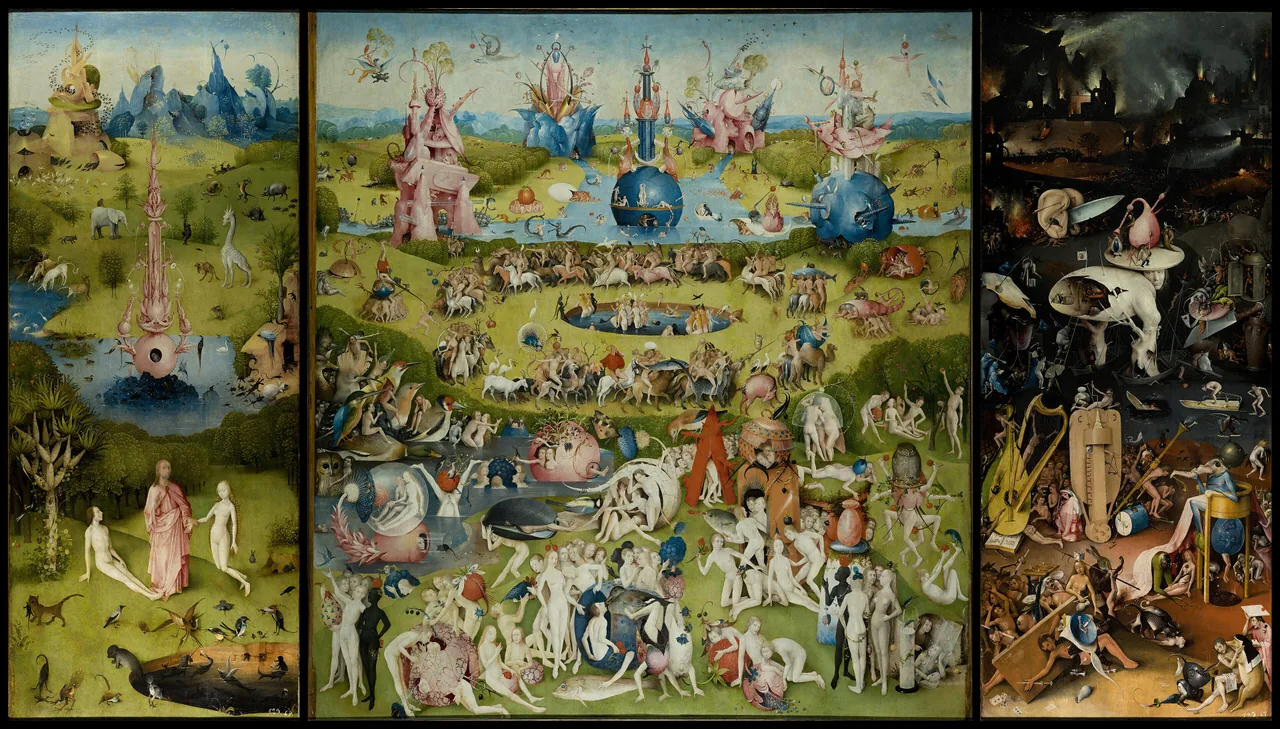
At the left, a comparatively small group of people sits within a landscape full of plants, animals and water. The centre is crowded: bodies, oversized fruit, birds and improbable structures compete for attention. The right wing changes the atmosphere sharply, bringing dark buildings, fire and pale figures into a much more threatening space.
Across the left and centre, water and a distant horizon create a visual connection. The vertical panel divisions interrupt that continuity without erasing it. At ordinary screen size, the contrast between bright landscape and dark wing remains clear even when individual incidents are too small to identify.
The Prado’s accessible introduction explains the folding structure and the greyish creation scene visible when it is closed. Its account reads the interior in relation to sin and its consequences. That is a museum interpretation, not a reason to insist every tiny object has one securely decoded meaning.
For reuse, the simple distinction is crucial: full open triptych, closed exterior, one panel, or detail. Each describes a different view. A caption should tell the reader which one is present, rather than letting a popular title cover any fragment with a bird-headed creature.
A painting, a digital reproduction and a museum service
Bosch died in 1516. His ordinary economic term has elapsed under the EU and UK author-term rules. The old painting’s status is distinct from rights or conditions attached to a new creative photograph, editorial layout or text.
The Prado’s commercial image archive notice directs users to request reproduction permission for commercial, academic, editorial and audiovisual projects. Its personal-download option is not a blanket commercial image release. This article does not claim that the museum supplied us with such a permission.
If you need the Prado’s current high-resolution photography for a publication, follow the conditions of that service. If you choose another source, identify that actual file and its basis instead. Do not download one provider’s image and attach a different provider’s open-status statement merely because both depict Bosch.
The file shown on this page
The exact Commons page identifies its source as The Prado in Google Earth. It presents the image as a faithful reproduction and applies PD-Art / Public Domain Mark 1.0. Our displayed file is a proportional derivative of that recorded image, preserving the open composition and dark panel divisions.
This is Commons’ designation, not an exclusive licence from the Prado. The Public Domain Mark describes status rather than granting new rights; jurisdictional differences can still matter. The source page itself notes that reuse of reproductions may be restricted in some countries.
The page also links to separately edited versions. A colour-adjusted file, a sharpened detail and an alternative photograph should not inherit one another’s metadata by accident. Keep the particular file title and URL, not just “Wikimedia”, in your working notes.
The US evidence boundary
Commons states that the work was published or registered before 1 January 1931. That is the provider’s assertion; this guide has not independently completed the original work’s publication-and-authorisation history. An early account of seeing the painting is not, by itself, proof of publication in the copyright sense.
The U.S. Copyright Office distinguishes public display from publication, while federal duration provisions separate historical published and previously unpublished works. The painting’s age should not be turned into a made-up publication date.
This matters when someone asks for a formal commercial clearance record rather than an illustrated introduction. A bibliography can point to early reproductions; it does not establish that every listed volume contains an authorised image. Our answer keeps the provider’s stated basis visible without inventing that extra investigation.
Crops, copies and modern interpretations
The central panel is often the easiest portion to fit on a square cover. Cropping away both wings, however, removes the contrast between the quieter left side and the dark right side. A design can use that fragment deliberately, but it should say central panel detail rather than complete triptych.
A small creature extracted for a sticker presents another practical problem: its outline may be intertwined with neighbouring forms. Automated background removal can delete painted details or invent a tidy edge that the picture never contained. Preserve a reference to the full composition so that the alteration is visible and reversible.
A newly drawn “Bosch-style” scene is not a reproduction of this work. Nor is an immersive projection, a commercial animation or a photograph of a staged installation identical to the underlying painting. The old artwork’s public-domain designation does not clear music, camera work, lettering or other new contributions.
For a large print, assess detail at the intended size before ordering. More pixels created by an upscaler do not prove that newly crisp faces or textures were present in the source. A reliable reproduction should not silently turn ambiguity in the old surface into invented certainty.
A useful credit and a final check
A practical caption identifies Hieronymus Bosch, The Garden of Earthly Delights Triptych, 1490–1500, Prado P002823, the view shown and the exact reproduction source. If you use only the right wing, name it; if you recolour the image, disclose the change. Do not imply that the museum endorses a product.
The answer is therefore specific: a public-domain-designated reproduction of the open triptych is available, but that designation must stay attached to its actual file. Identify the panels, preserve the source record and treat museum-service conditions and independent U.S. legal clearance as separate checks.
Editorial record
About this article
- Author
- Publisher
- GeMarkt
- Published
- Reviewed
- Internal source & rights check. Conducted by GeMarkt Research Review. This is an internal editorial check—not independent peer review.
- Source standard
- Rights guide source standardSeparates the underlying work from the source file, records the review date, and links the evidence used for the conclusion.
Found a claim that needs checking? Report a factual error.