GeMarkt Blog · Reference
Is The Creation of Adam by Michelangelo Public Domain?
Separate Michelangelo’s fresco from a modern Vatican photograph, using a documented 1913 book reproduction to explain publication and image rights.

The short answer
Michelangelo’s historic composition is beyond ordinary author-copyright terms. The specific 1913 printed reproduction shown here is also an old published image; that does not make a current Vatican photograph free to reuse.
This guide concerns The Creation of Adam on the Sistine Chapel ceiling, not Michelangelo’s separate Creation of the Sun, Moon and Plants. Our illustration is a black-and-white photographic reproduction printed in a book. It shows how the fresco was presented to readers more than a century ago, not its present colour or conservation condition. The distinction is central to the answer, checked on 13 October 2026.
For a modern colour poster, an advertisement or a book cover, the remaining question is which exact image you intend to use. A famous title is not a licence attached to every file bearing that title.
Identify the fresco and the image
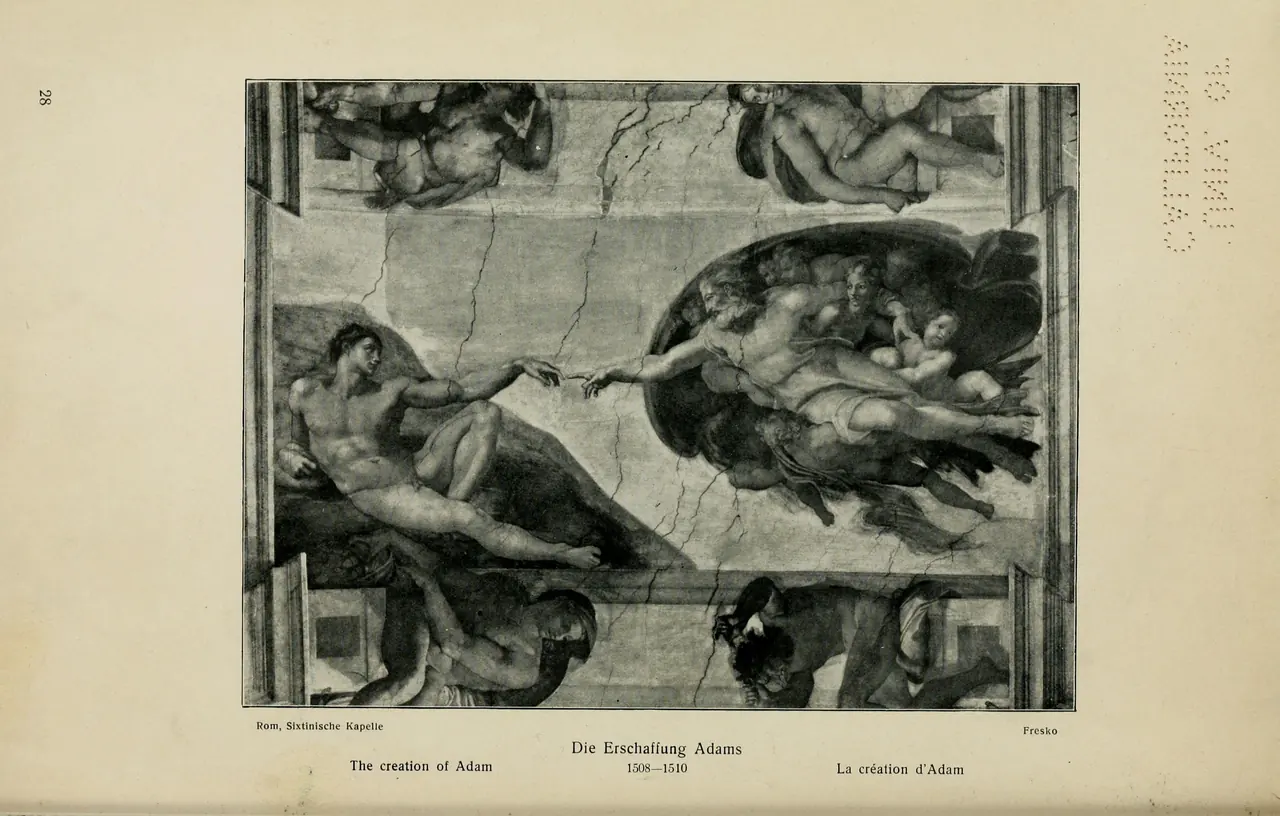
The Vatican Museums’ ceiling account places the ceiling campaign between 1508 and 1512. Nine Genesis scenes occupy its central sequence, surrounded by prophets, sibyls and other figures. The Creation of Adam belongs to that larger arrangement: it was not painted as an independent rectangular canvas intended for a domestic wall.
The historical plate gives the scene a shorter date range in its caption. We retain that caption as part of the old page, but use the museum’s account for the ceiling campaign rather than silently adopting every statement in an early twentieth-century book.
The page also includes surrounding decoration. That matters when comparing a file with a familiar hands-only crop. Both may derive from the same fresco, but one presents a much larger field of painted space. Neither should be labelled “the complete Sistine Chapel ceiling.”
Look beyond the two hands
The almost-touching fingers are easy to recognise even in this small monochrome reproduction. Yet the bodies explain the gesture. Adam rests along the ground at the left, with a bent knee and an arm extending towards the approaching group. God reaches across from the right, surrounded by figures within the sweep of a cloak. One side feels supported by the earth; the other gathers into a moving cluster.
The museum’s description of the scene treats the gesture as the transmission of life. It is more useful to start there than to present a disputed interpretation of the cloak’s shape as an established anatomical discovery. A rights guide need not turn every resemblance into a factual claim.
In the displayed plate, dark fissures and uneven tones remain visible. They belong to the photographed and printed state transmitted by this source. They are not a reliable map of the fresco’s current appearance. Nor can a black-and-white plate establish the original hue of Adam’s skin, the cloak or the background.
A crop around the fingers can serve a discussion of that gesture if identified as a detail. It cannot support claims about the whole ceiling’s colour balance. Choosing the right amount of the picture is an editorial decision, separate from whether copyright has expired.
What the 1913 volume establishes
The digitised volume’s title page identifies The Work of Michelangelo, published by Brentano’s in New York in 1913. Its copyright leaf carries an earlier 1908 notice. The inspected page numbered 28 actually reproduces the scene; this is not merely a catalogue entry mentioning its name.
Those observations establish a dated printed reproduction by 1913. They do not establish the exposure date of its source photograph, identify the photographer, or prove that this was the first reproduction ever published. The library scan’s much later digitisation date is not the publication date of the printed page.
The Internet Archive item metadata records the University of California Libraries as contributor and a United States “not in copyright” assessment. Our use follows the old published plate and that source assessment. It does not borrow a permission statement from an unrelated colour image.
For research, save the title page, copyright leaf and actual plate together. A date in a search result is weaker evidence than a dated volume with the relevant reproduction visible inside it. Here, the page can be checked directly without assuming that an exhibition or a chapel visit distributed copies.
Country rules do not license every photograph
The ordinary EU author term and UK artistic-work term run for life plus seventy years. Michelangelo died in 1564, far outside those ordinary terms. A later photograph is a separate inquiry; an unidentified photographer should not simply be assigned Michelangelo’s death date.
In the United States, the published-work duration rules put a qualifying 1913 publication well beyond the maximum ninety-five-year term. This supports the selected historical plate. It is not a reconstruction of every earlier colour or photographic version of the fresco.
The Copyright Office distinguishes publication from public display. The ceiling’s completion and its visibility in a chapel do not, on their own, supply a publication date. The book gives a concrete reproduction instead. Different facts can matter for an unpublished photograph or a modern edition.
These are bounded copyright conclusions, not a worldwide commercial clearance. Country-specific moral rights, contractual conditions and rules governing access to a site may still need attention for a particular project. An old image does not entitle its user to imply museum endorsement.
The Vatican website is a different source
The Vatican Museums’ website copyright notice asserts rights over the site’s materials, including images. Its image services provide a separate route for obtaining reproductions. We have not taken the contemporary website photograph and relabelled it with the book’s public-domain assessment.
That distinction cuts both ways. The website notice is not evidence that Michelangelo’s author copyright has restarted. But the age of his fresco is not permission to disregard conditions attached to a newly supplied photograph. Check the provider and the actual file, not only the artist.
Vatican City also should not be treated as an Italian state museum by default. Rules or forms encountered while researching the Uffizi are not automatically the legal framework for a Vatican image request.
Choose a file that fits the purpose
For an article about historical reproduction, this complete book plate is useful: its border, typography and monochrome appearance are part of the evidence. For a colour-accurate print, it is the wrong source. Artificially colouring it would create an interpretation, not recover the missing colour record.
Keep the source credit with the image, name a detail if you crop it, and separate the fresco’s date from the reproduction’s publication date. If you need a modern image, obtain one with terms that fit your intended use and territory. Our Michelangelo guide explains the wider distinction between his works and the files through which we see them.
Editorial record
About this article
- Author
- Publisher
- GeMarkt
- Published
- Reviewed
- Internal source & rights check. Conducted by GeMarkt Research Review. This is an internal editorial check—not independent peer review.
- Source standard
- Rights guide source standardSeparates the underlying work from the source file, records the review date, and links the evidence used for the conclusion.
Found a claim that needs checking? Report a factual error.