GeMarkt Blog · Reference
Is The Ancient of Days by William Blake Public Domain?
Identify the particular impression of Blake’s Ancient of Days, understand Yale’s open image and avoid confusing a print with a modern facsimile.

The short answer
Blake’s historical design is out of its ordinary UK author copyright term, and Yale makes the exact image shown here available for reuse, including commercial use. That answer applies to an identified impression and its source file, not every photograph or modern edition called The Ancient of Days.
The example is Yale accession B1992.8.4(1). Checked 12 October 2026, its open-image status is supported by Yale’s own record and image terms. An independent U.S. publication history for every coloured copy of this design is not established here; Yale’s public-domain assessment should not be mistaken for a blanket clearance of the whole surviving series.
Which Ancient of Days is this
The Yale catalogue identifies this sheet as The Ancient of Days; Frontispiece (Plate 1), 1794, belonging to Europe. A Prophecy, currently catalogued there as Copy A. It describes colour printing combined with relief and white-line etching, with additional oil, watercolour, pen and ink. This is not a photograph of a large oil painting.
Copy identification matters because “the original” is an incomplete description of a printed work. A design can survive in more than one impression. Ink, hand colouring, paper and finishing can make those impressions look different without making one of them a bad reproduction of another.
For a reliable caption, keep the institution and accession number together. They identify the object more securely than an isolated copy letter found on an old web page. If a source uses a different letter, compare the collection record before transferring its description to a downloaded image.
A print with a particular surface
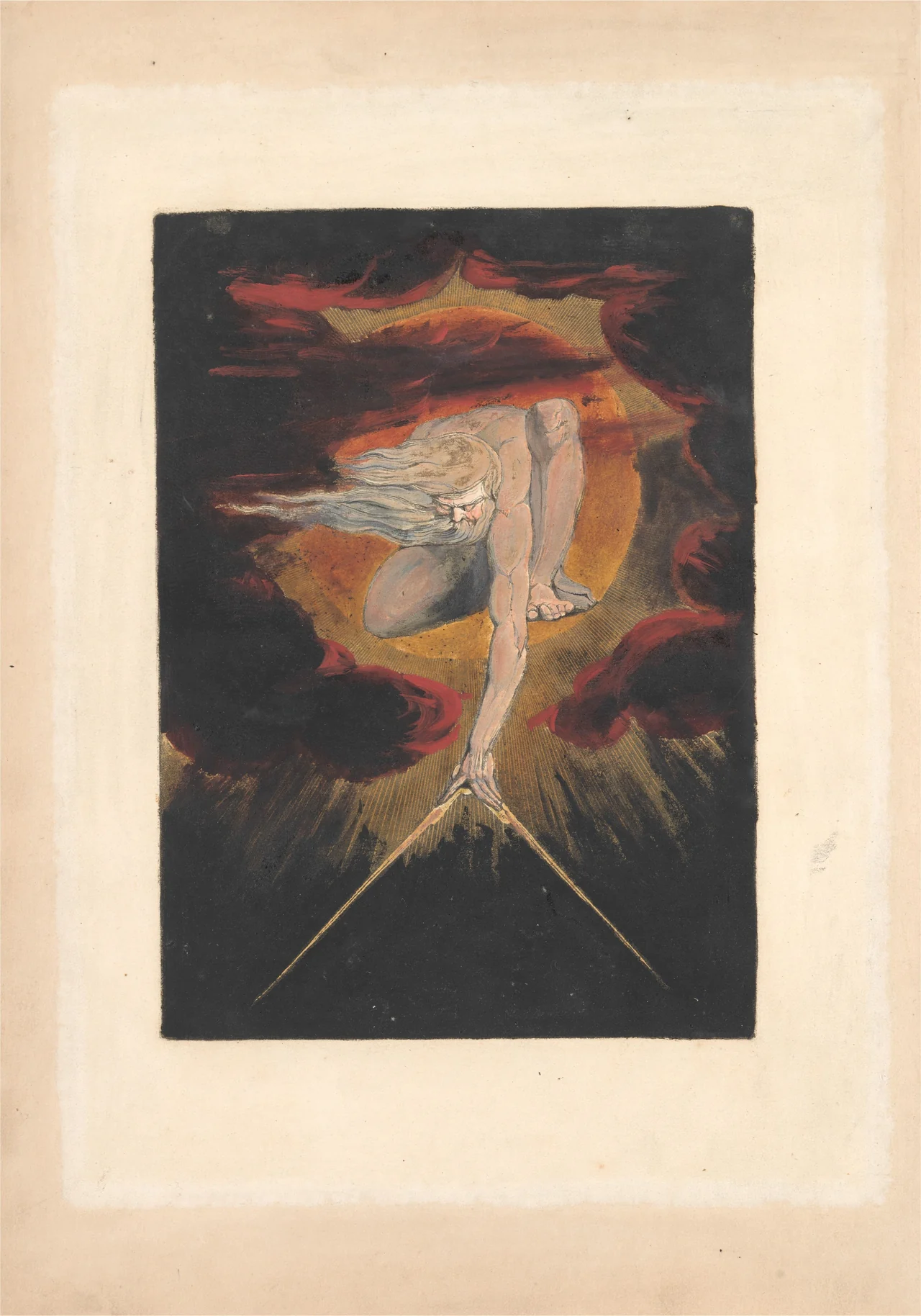
Look first at the difference between the sheet and the image. The broad cream margins surround a dark rectangle. Inside it, red clouds interrupt the glowing circle and the straight rays below. The paper is not a newly painted background extending the scene: it belongs to the physical print as photographed.
Next look at the figure’s hair. Pale strands sweep towards the left, almost horizontally, while the extended arm pulls the eye down. The bent knee and folded body turn inward. Those opposing directions give the small figure a remarkable sense of pressure, as if the space around him were both vast and restrictive.
The darkest areas are not an invitation to invent missing detail. A source file with lifted shadows may seem clearer on a screen while changing the balance between the illuminated body and the surrounding dark. For a faithful reproduction, begin with the supplied image rather than a sharpened, recoloured version whose changes have not been explained.
Looking at the compasses
The long golden points form the clearest geometry in the image. Their open angle gives direction to a scene otherwise full of curling clouds and flowing hair. They are tools for measurement, not rays that happen to cross beneath the figure’s hand.
The Fitzwilliam Museum’s discussion of Blake and Milton connects the design with the passage in Paradise Lost in which golden compasses mark out the universe. That reference helps explain the instrument, but does not make the picture a simple, unambiguous illustration of benevolent creation.
The figure looks down rather than towards us. His shoulders are compressed, his arm extends beyond the circle, and the compasses enter an area with no visible ground. Seen this way, the image can prompt questions about the relationship between making, measuring and imposing limits. Those are ways of reading the visible design, not evidence that Blake intended a modern slogan about science or religion.
If you use the picture on a book cover, consider how the title changes that reading. A cover about architecture, theology or political authority can give the same gesture a different emphasis. Public-domain status does not turn an editorial interpretation into a statement by Blake.
The design and the individual copy
Europe is a historical printed book, not simply a painting dated 1794. The Library of Congress catalogue for Europe identifies its original publication in that year. That is relevant to the early circulation of the design; it does not, by itself, document every later colouring or copy-specific addition.
Blake died in 1827. His ordinary UK author term has long expired under the UK term framework. A recently photographed sheet does not become a newly authored Blake work merely because its image was uploaded this year.
For the United States, old published works and works that remained unpublished follow different statutory routes. Certain qualifying late publications can affect the latter. U.S. copyright duration rules therefore require more than the artist’s death year. This page relies on Yale’s designation for the selected image rather than asserting independently verified publication histories for all copies.
That distinction is useful when comparing a museum sheet with a modern facsimile. A facsimile may reproduce the old design while also adding new commentary, page design or colour work. You can select a historical source without copying those newer contributions.
What Yale’s open image allows
Yale’s public-domain image statement permits use of its qualifying images for any purpose without a permission fee. The image manifest for this object also identifies the individual image’s reuse rights; the conclusion does not rest on open catalogue metadata alone.
The practical difference is substantial. A catalogue entry can be freely reusable as data while the accompanying photograph has other terms. Here, the image itself is within Yale’s stated open-image route. Keeping its accession number and source link makes that route easy to distinguish from an unrelated scan.
The permission does not make Yale a sponsor of a product. Use the collection credit to identify the source, not to imply that the museum approved your edition, colour adjustment or commercial claims. A truthful credit remains useful even where attribution is not a condition of the public-domain dedication.
Choosing a file for a print or publication
Decide whether you want to reproduce the whole sheet or only the printed rectangle. Both can be understandable editorial choices, but they present different objects to the reader. The first shows the historical print as a sheet; the second foregrounds the design. Label a detail or crop rather than silently presenting it as the whole object.
Check the actual downloaded file, not only its thumbnail. The illustration on this page is a reading-size derivative. A wall-sized print needs its own resolution and colour checks against the source. Making a file larger does not recover marks that the original download never contained.
Avoid combining the brightest colours from several impressions and then calling the result a faithful original. That creates a composite. Likewise, replacing the paper with a spotless digital white can remove visible evidence of the sheet’s age and surface. An adaptation can be deliberate and clearly labelled; it should not masquerade as conservation or an untouched museum image.
Keep the copy with the credit
For this example, retain Blake’s name, the work title, the collection credit and B1992.8.4(1). Keep the source record with your download, and describe any crop or material alteration in the place where you publish it. This is a manageable way to preserve both the image’s identity and the basis for reuse.
For other Blake designs, start again with the exact object rather than carrying this image’s permission across by artist name. Our William Blake guide introduces that broader distinction. The useful answer here is specific: this historical impression has a clearly identified open image, while other copies and modern editions deserve their own check.
Editorial record
About this article
- Author
- Publisher
- GeMarkt
- Published
- Reviewed
- Internal source & rights check. Conducted by GeMarkt Research Review. This is an internal editorial check—not independent peer review.
- Source standard
- Rights guide source standardSeparates the underlying work from the source file, records the review date, and links the evidence used for the conclusion.
Found a claim that needs checking? Report a factual error.