GeMarkt Blog · Reference
Is Raphael’s Sistine Madonna—and Its Cherubs—Public Domain?
Separate Raphael’s Dresden painting from its famous cherub detail, nineteenth-century prints and the rights record attached to a modern image.


The short answer
Raphael’s historic Sistine Madonna is beyond the ordinary European author-copyright term, including the two cherubs at its foot. A modern download still needs its own source check: a cropped detail, a newly designed illustration and a photograph of a framed print are not interchangeable.
This guide concerns the 1512–1513 painting in Dresden’s Gemäldegalerie Alte Meister, Gal.-Nr. 93. Checked on 13 October 2026, our selected faithful reproduction carries a Wikimedia Commons PD-Art/Public Domain Mark assessment, not a new open licence issued by the museum. Historical print evidence supports the composition’s long circulation; we have not independently reconstructed its complete authorised first-publication history for the United States.
The cherubs belong to a larger painting
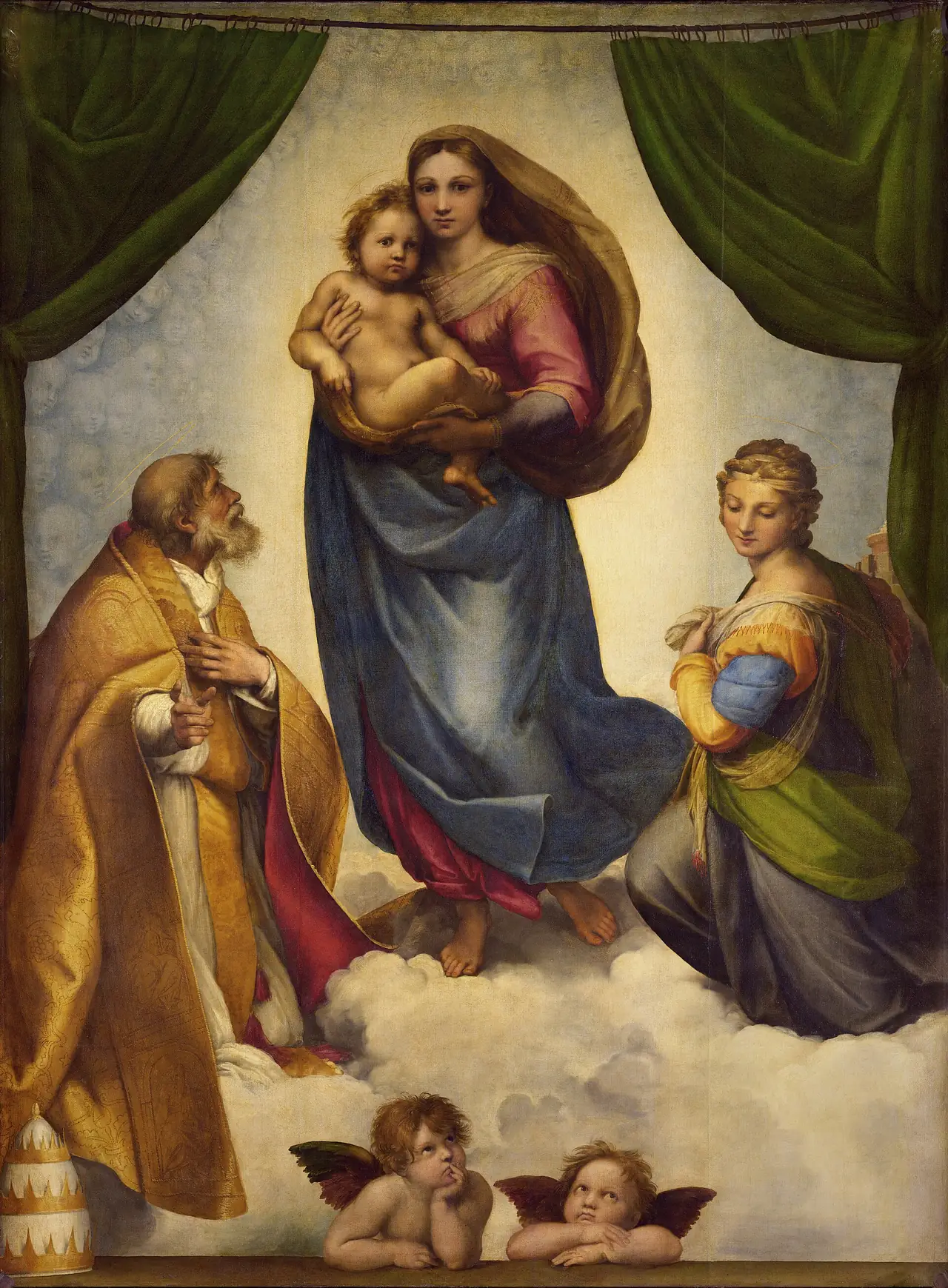
The museum-supplied record on Google Arts & Culture identifies a painting approximately 269.5 cm high and 201 cm wide, intended for the monastery church of San Sisto in Piacenza. It describes the commission from Pope Julius II as almost certain, rather than presenting every circumstance as settled fact.
Mary carries the Christ Child between Saint Sixtus on the left and Saint Barbara on the right. The two winged children occupy the very bottom. They are not a separate panel called Two Angels, although that label can be useful shorthand for a reproduction of the detail. Nor should the word “Sistine” lead you to label this a photograph of the Vatican’s Sistine Chapel.
For matching a file, the surrounding scene is more useful than a search title. Look for the parted green curtains, the saints, the cloud-filled space and the ledge beneath the children. A file showing only their heads and folded arms has deliberately excluded most of Raphael’s composition.
What disappears when you isolate the two figures
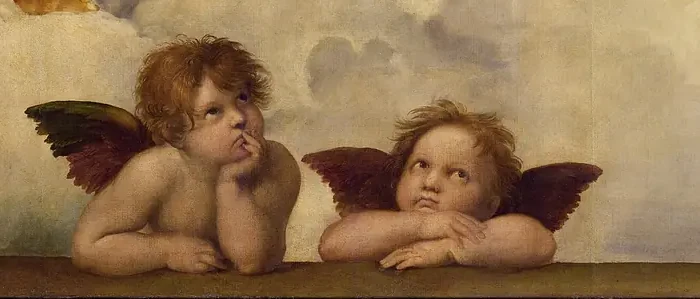
In the complete image, the children seem to occupy our side of a boundary. Their elbows rest on a firm horizontal edge while the principal figures rise above them. Their upward looks connect the bottom strip to the scene overhead; the curtains at the top make that scene feel newly revealed.
Cutting away everything above the children changes those relationships. The upward glance becomes open-ended, available for a joke, a greeting or a decorative caption. That can be an effective design, but it is a different presentation of the painting. Calling the result “the complete Sistine Madonna” would be inaccurate even if the underlying art were free to reproduce.
The Dresden museum’s account dates the first separate copying of the two figures to 1803 and describes their later appearance on decorative objects. Their independent life is therefore not simply a recent internet habit. The history helps explain why someone may recognise the children immediately without recognising the full altarpiece.
For a close-looking article, keep the whole image available beside any detail. For a card or small print, describe the selection honestly. “Detail of the two cherubs from Raphael’s Sistine Madonna” tells the reader much more than “Raphael angels,” without making the caption cumbersome.
Old reproductions and the American publication question
The painting’s date tells us when Raphael made it. It does not, on its own, identify a copyright-law publication event. A church display, a later museum display and a distributed reproduction describe different activities.
There is concrete evidence of nineteenth-century print circulation. The Metropolitan Museum of Art’s record for accession 90.3.11 identifies The Sistine Madonna, an engraving and etching by Moritz Steinla after Raphael, dated 1847 and published in Dresden. This is a dated reproductive print, not merely an exhibition catalogue that names the painting. The Met currently provides no image on that record, so we are not claiming to have visually inspected its impression.
The U.S. Copyright Office’s visual-art guidance distinguishes public display alone from publication. An authorised sale or distribution of an original or copies can also matter; an early printed reproduction is not the only possible evidence.
The Office’s duration circular explains the ninety-five-year maximum term for works already under statutory protection before 1978 and confirms that works published in the United States before 1931 are public domain in 2026. It also explains different treatment for older unpublished works. That is why “painted before 1931” is an inadequate rule.
For this painting, the 1847 record and the museum’s history of separate reproductions are substantial historical evidence. They do not amount to our independently proving the first authorised publication of every feature of the coloured canvas. Commons makes its own public-domain assessment of the supplied file; we retain that attribution instead of turning it into a worldwide commercial clearance certificate.
The painting and the photograph have different histories
Raphael died in 1520. His economic copyright is long past the ordinary author-life-plus-seventy-year term described in EU guidance and UK guidance. The children do not acquire a fresh Raphael copyright when someone selects them from the larger picture.
A later creative work can nevertheless add something separately protectable: an illustrated reinterpretation, a designed advertisement, or an original photograph in which a framed reproduction is part of a room. The answer for Raphael’s painting should not be borrowed to clear those additions.
Germany, where the painting is held, has a particularly relevant distinction. Section 68 of its Copyright Act excludes related-right protection under Parts 2 and 3 for reproductions of public-domain visual art. That is not a declaration that every photograph containing an old artwork lacks copyright. Independently original photographic expression and the conditions attached to a particular supplied file still need attention.
Which image this page uses
Our illustration follows the specific Commons file linked here, which identifies Google Arts & Culture as its source and applies PD-Art/PDM to a faithful reproduction. The institution-supplied Google record credits Gemäldegalerie Alte Meister, SKD, and photographers Hans Peter Klut/Elke Estel. We preserve those credits. We do not describe the file as “SKD CC0,” or imply that the museum approved this article.
The Public Domain Mark records an assessment of copyright status; it is not a licence newly granted by Raphael’s museum. Its explanatory page warns about jurisdictional differences, other rights and the absence of warranties. That qualification belongs with the reusable image, not hidden behind a generic “free art” label.
This page retains the complete supplied view and adds a clearly labelled detail of the two cherubs. Neither is a colour-certified print master, a conservation photograph or evidence that every commercial source offers identical colours. Compare the actual image, not just the work’s name, before relying on another download.
Using the cherubs without misrepresenting the source
Keep three descriptions separate in your own records: the painting, the selected area, and the file supplier. A useful caption might identify Raphael, the full work’s title and date, then state that the illustration is a detail. Add the source and its actual rights designation rather than substituting a more generous-sounding licence.
If you add lettering, remove part of a wing or place the figures against a new background, do not present that arrangement as Raphael’s complete original. Check the file’s conditions and any relevant local rules for your intended use; a high-volume commercial edition deserves its own assessment.
Our Raphael guide gives the wider artist context. The practical conclusion here is narrower: the old painting and its famous detail are available to study and reproduce on a public-domain basis, but identifying the right source—and saying what you have changed—remains part of using them responsibly.
Editorial record
About this article
- Author
- Publisher
- GeMarkt
- Published
- Reviewed
- Internal source & rights check. Conducted by GeMarkt Research Review. This is an internal editorial check—not independent peer review.
- Source standard
- Rights guide source standardSeparates the underlying work from the source file, records the review date, and links the evidence used for the conclusion.
Found a claim that needs checking? Report a factual error.