GeMarkt Blog · Reference
Is Paul Klee’s Senecio Public Domain? Painting and File Checks
Check Klee’s Senecio in Basel, the museum’s image-data statement and the separate U.S. publication question before choosing a reproduction.


The short answer
Klee’s Senecio is beyond the ordinary author-life-plus-seventy-year copyright term in Switzerland, the EU and the UK. Kunstmuseum Basel also labels the image data for its exact painting public domain. Neither fact should be expanded into a promise that every download is cleared for every country.
This guide concerns Senecio (Baldgreis), 1922, 181, Kunstmuseum Basel, inventory 1569, checked on 13 October 2026. We use a museum photograph distributed through Commons. Its source assessment is documented below; the painting’s qualifying first-publication history for the United States has not been independently established here. A business requiring a firm U.S. clearance should resolve that branch before relying on this page.
Which Senecio this guide means
The Basel object record identifies a work 40.3 × 37.4 cm, made with oil over a chalk ground on gauze mounted on cardboard. Its recorded original frame is yellow. The notation 1922, 181 is Klee’s dated work identifier, not the museum’s inventory number.
The museum’s exhibition booklet translates the subtitle as Soon to be Aged and explains the title’s botanical association with Senecio vulgaris. It records the museum’s purchase in 1931. “Senecio,” “Baldgreis” and “Soon to be Aged” can therefore identify the same painting, rather than three different portraits.
Keep the inventory number when comparing downloads. A classroom imitation, a newly drawn face with similar divisions, and a photograph of this object can share a search phrase without sharing authorship, physical history or file rights. A modern decorative adaptation may introduce additional creative material even when Klee’s own copyright has expired locally.
Look at the surface before choosing a file
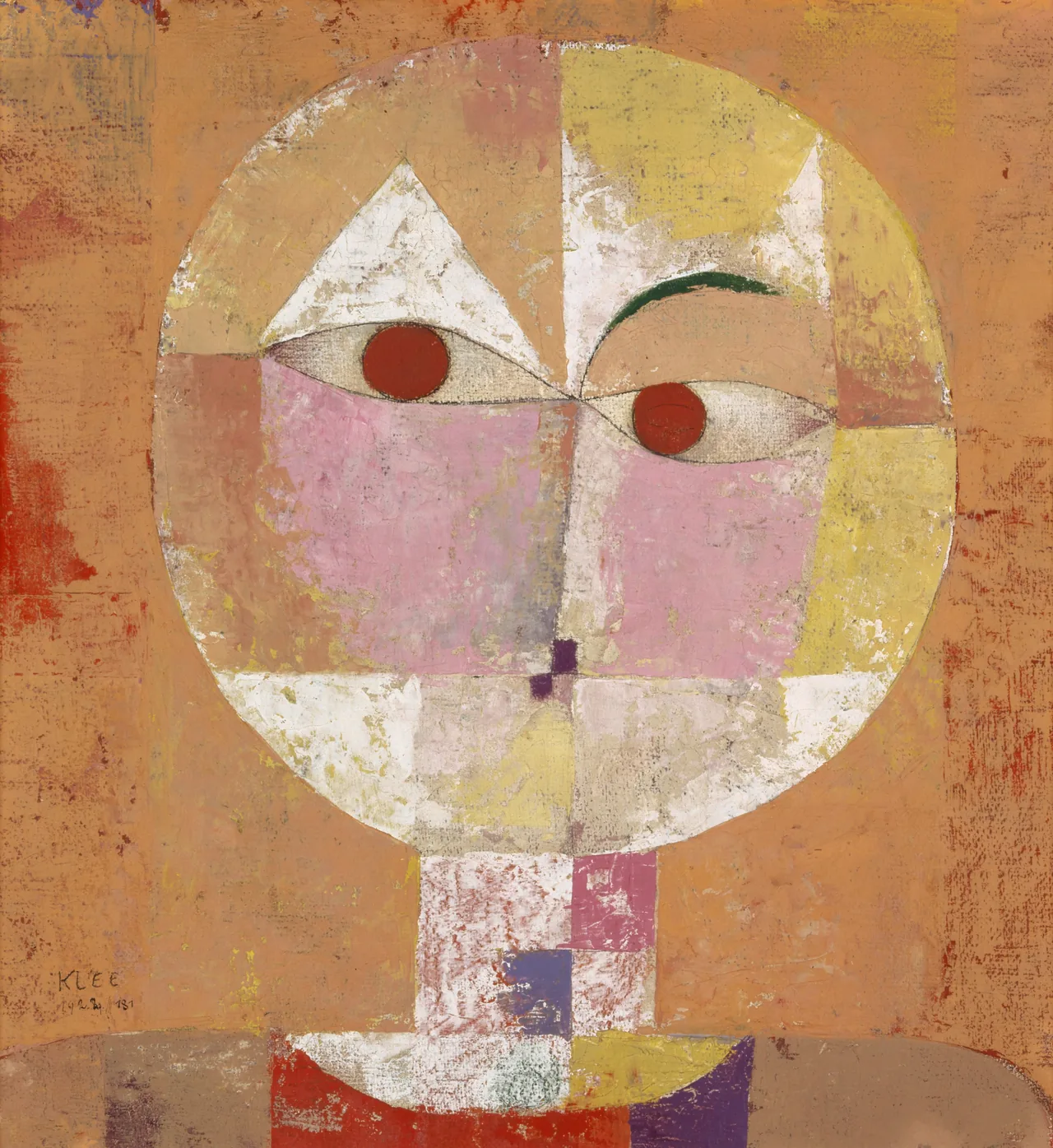
The face is not a smoothly filled vector drawing. Fine scratches, exposed pale areas and uneven patches interrupt the coloured shapes. The left eye sits higher than the right, while one eyebrow becomes a dark arc and the opposite side rises into a pale triangle. These differences make the head feel alert and slightly unsettled, despite its simple outline.
Those are observations of the reproduction, not a diagnosis of the painting’s condition. A photograph alone cannot tell us which marks were deliberate, which developed with age, or which have been affected by conservation. Avoid “repairing” every pale mark just because a cleaner-looking version seems easier to print.
The selected view preserves the supplied painting image, including its lower-left signature and date area. It does not show the original frame recorded by the museum. “Complete supplied painting image” is therefore a more accurate description than “the entire physical object.” Cropping tightly around the face would also remove the small neck, shoulders and much of the surrounding ochre field. If that is your design choice, call the result a detail.
The ordinary term and its territory
Klee died in 1940, as the Zentrum Paul Klee biography records. The Swiss intellectual-property office explains the ordinary seventy-year posthumous term and stresses that national copyright law operates territorially. EU guidance and UK guidance likewise describe the normal life-plus-seventy term for artistic works.
That supports the expired ordinary economic-copyright conclusion in these territories. It does not make the word “worldwide” an appropriate shortcut. A different jurisdiction may apply different rules; a separate photograph or adaptation may also need separate analysis.
Think of the painting and the download as two records that need to meet. The first identifies Klee’s work and the law relevant to your use. The second identifies who made or supplied the reproduction and what statement accompanies it. Keeping both prevents a genuine public-domain painting from being confused with an unrestricted licence to an unrelated image.
What the American publication check still needs
The date painted is not automatically the date published. The U.S. Copyright Office’s visual-art guidance distinguishes display alone from publication; an authorised distribution or offer involving an original or copies can be relevant. A printed reproduction is one possible source of evidence, not the only possible route.
Basel’s bibliography lists early catalogues: Stuttgart 1924, no. 89; Hans Goltz’s Munich exhibition of 1925, no. 14; and the Basel Bauhaus exhibition of 1929, no. 93. These are valuable research leads. This guide has not inspected those original entries and associated sale or distribution records sufficiently to establish which event qualifies under the rules applicable to this painting. A title in a catalogue must not silently become an inspected, authorised illustration.
The Office’s duration circular explains the ninety-five-year maximum term for works already under statutory protection before 1978 and the pre-1931 publication threshold relevant in 2026. Its separate discussion of older unpublished works matters too. Under section 303, some previously unpublished works first published by the end of 2002 can remain protected through 2047.
That is an explanation of why evidence matters, not a finding that Senecio is protected until 2047. Nor does the unresolved branch prove that the painting remains protected in America. It means this research has not independently closed that question. For a U.S.-focused licensing decision, obtain the relevant historical evidence and qualified advice rather than substitute either a creation year or a warning date for a conclusion.
The museum statement and the selected photograph
The current Basel record explicitly marks its image data “Bilddaten gemeinfrei”—image data in the public domain. That specific institutional statement is important. The museum’s general site notice, however, asks for prior written approval for commercial use and publication of website material. We retain the distinction: the object-specific statement is not a blanket release of all website photographs, text and design.
Our selected Commons file identifies the museum as source and Martin P. Bühler in its credit metadata. Commons supplies its own faithful-reproduction public-domain assessment. We have kept that attribution, not relabelled the photograph as a newly granted CC0 licence.
The Public Domain Mark explanation itself warns about territorial differences, other rights and the absence of a warranty. The file assessment and Basel’s image-data statement support the selected reproduction’s source basis; they do not amount to our independently proving the American publication history or obtaining a bespoke museum licence.
Using the image with a clear record
For an article or presentation, retain the artist, title, inventory number, museum, photographer and exact source link together. If a later collaborator replaces the file with a sharper download, repeat the file check. A larger pixel count does not show that its provenance is better.
For a crop, mark the caption “detail” and keep a route to the complete painting. For an altered design, describe the alteration rather than suggesting Klee made your version. Do not add the museum’s logo or imply an endorsed edition simply because the source image came from its collection.
For a commercial project where the remaining country or website-term distinction matters, resolve it before production. This guide supplies a documented starting point, not a substitute for a use-specific clearance. Our Paul Klee artist guide explains why the same work-by-work approach matters across his much larger catalogue.
Editorial record
About this article
- Author
- Publisher
- GeMarkt
- Published
- Reviewed
- Internal source & rights check. Conducted by GeMarkt Research Review. This is an internal editorial check—not independent peer review.
- Source standard
- Rights guide source standardSeparates the underlying work from the source file, records the review date, and links the evidence used for the conclusion.
Found a claim that needs checking? Report a factual error.