GeMarkt Blog · Reference
Is Praying Hands by Albrecht Dürer Public Domain?
Identify Dürer’s 1508 Praying Hands, its connection to the Heller Altarpiece and the separate licence of the ALBERTINA image shown here.


The short answer
The ordinary German and UK author copyright terms on Dürer’s 1508 Praying Hands have expired. The exact digital illustration on this page is available under CC BY-SA 4.0, with attribution and sharing conditions. It is not an unrestricted licence to every photograph, redrawing or devotional product using the same gesture.
This guide, checked 12 October 2026, identifies ALBERTINA inventory 3113. Its independent U.S. publication history is not fully established here. We separate that limitation from the clearly stated licence attached to the particular image we display.
A drawing, not an engraving
The ALBERTINA record identifies Betende Hände, dated 1508, as brushwork in grey and black, with grey wash and white heightening, on blue-prepared paper. The sheet measures 29.1 × 19.7 cm. It is a drawing associated with the Heller Altarpiece, not a plate from one of Dürer’s printed series.
That last point has practical consequences. A search result offering a “Dürer engraving” may show a later engraved reproduction of the drawing. Another file may contain a modern line illustration reduced to a silhouette. Neither should automatically be described as the original 1508 sheet.
The familiar pair of hands can function almost like an emblem, recognisable without a face or setting. That familiarity makes it particularly easy to stop checking. Yet the sheet, a later print after it and a newly drawn icon are different objects with different makers and source histories. Name the version before deciding which rights statement applies.
What the blue ground does
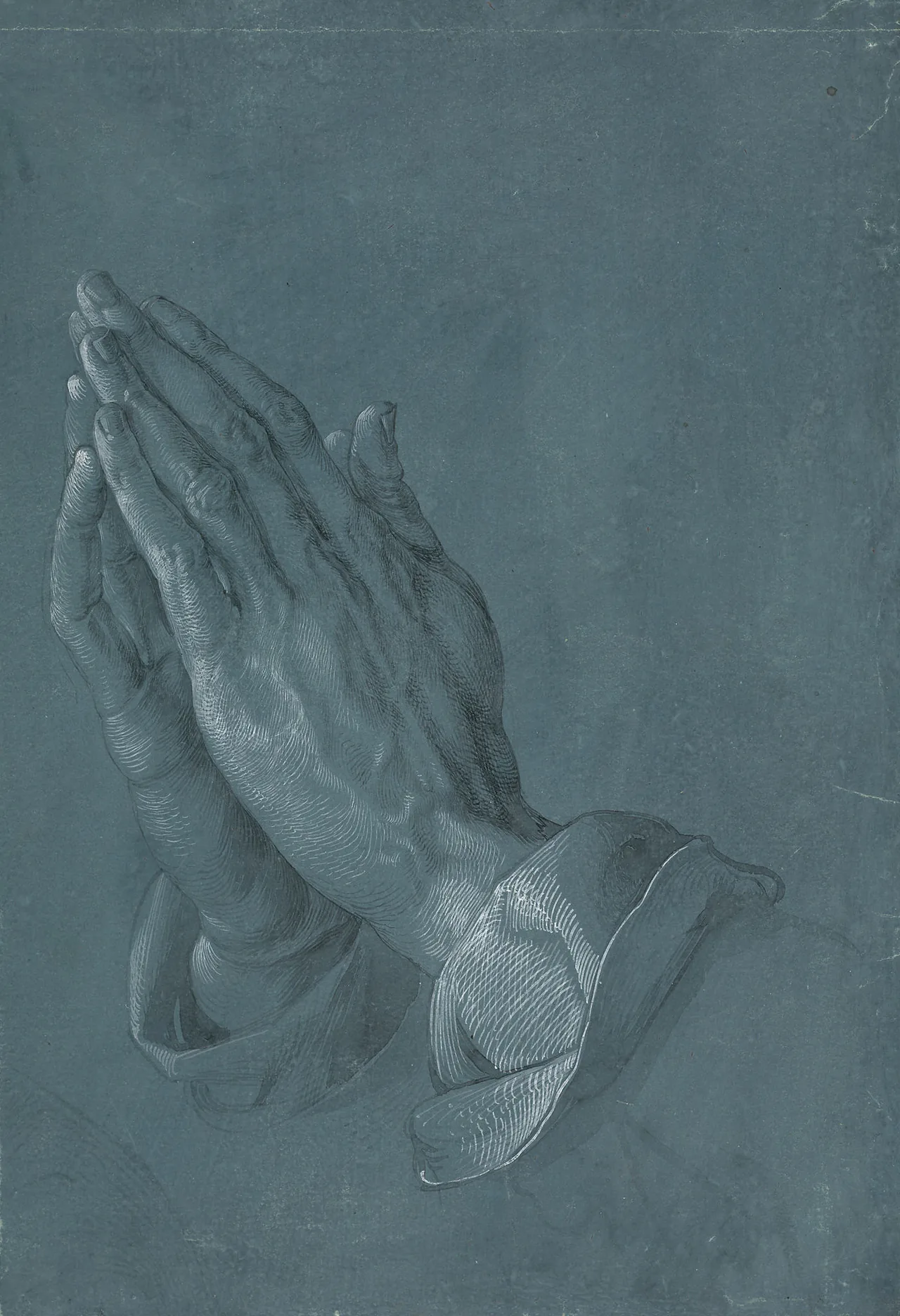
The fingers do not form one flat triangular symbol. Each has a different edge, joint and angle. Fine dark strokes define creases, while short white strokes turn around the flesh. The blue surface supplies a middle tone between them. Brightening the background to white would therefore change the drawing’s structure, not merely clean an empty margin.
The cuffs matter too. One folds across the wrist with a patterned rhythm of light lines; the other recedes into the blue. Together they give the hands weight and a direction. A tight crop that removes them produces a more abstract sign of prayer, but loses some of the drawing’s connection to a clothed body.
Our file keeps the surrounding paper, including visible irregularities in its surface. Those marks need not dominate a reader’s attention, but they remind us that the image represents a particular old sheet. A spotless digital reconstruction should be labelled as an adaptation rather than presented as an untouched view of the object.
How the hands belong to a larger picture
The ALBERTINA connects the drawing to an apostle kneeling beside the empty tomb in the Heller Altarpiece. It also identifies associated studies of the figure’s head, arms and drapery. The head and hands originally shared a larger horizontal sheet; the museum uses that relationship to explain the absence of a date and monogram on this surviving portion.
The museum’s 2019 exhibition account describes Jakob Heller’s 1507 commission and the completed central panel of 1509, later destroyed by fire in 1729. It also stresses the exceptional finish of the surviving studies: these were not merely disposable scraps on the way to a painting.
That is a better historical starting point than attaching an unsupported inspirational anecdote to the image. We do not identify the hands as those of a particular family member on the basis of a circulating story. The object’s documented relationship to a larger religious composition is already rich enough.
It also helps explain why title searches can be misleading. A photograph of a surviving altarpiece copy, a reproduction of one apostle within it and a photograph of the blue drawing may all appear under “Praying Hands.” A caption should tell the reader which of those they are looking at.
Old authorship and new image conditions
Dürer died in 1528, far beyond the ordinary life-plus-seventy author terms described in the German Copyright Act and UK guidance. That conclusion concerns the original drawing in those jurisdictions. It does not assign Dürer’s age to a modern illustrator’s new version.
Nor does it erase a digital supplier’s stated conditions. The ALBERTINA’s general website notice does not offer unrestricted republication of all its images. A visible image and a download button are not, by themselves, a reuse licence.
This page uses a separately released Commons file. Its uploader, Albertina pressoffice, states that it is its own work and applies CC BY-SA 4.0. The file history dates that upload to 2015. We preserve that named source instead of treating the image as anonymous because the drawing is old.

The U.S. publication limit
The year 1508 dates the drawing, not a publication event. U.S. sections 303 and 304 distinguish older published from previously unpublished works, including a 2047 minimum for some qualifying 1978–2002 first publications. This guide has not independently completed that historical publication check.
A bibliography can point toward the answer, but it is not the answer itself. To rely on an old reproduction, identify the edition, inspect the actual illustration, establish that it is this drawing and consider the circumstances of publication. Simply copying a twentieth-century catalogue reference into a rights spreadsheet skips those steps.
The same care applies to the altar. Evidence that a painted composition was publicly displayed does not automatically establish when a separate drawing became published. The drawing and the painting are related, but a rights conclusion cannot move between them just because they share a pair of hands.
Our open-file credit therefore sits beside an explicit research boundary. It is useful evidence about this reproduction, not a substitute for a definitive opinion on a proposed use in every country.
Keeping the image credit attached
Under CC BY-SA 4.0, commercial reuse is allowed subject to credit, a licence link and identification of changes; adaptations carry the same or a compatible licence. The conditions concern the licensed material, not a fictional endorsement by its contributor.
A clear credit names Albrecht Dürer as artist and Albertina pressoffice as image contributor. It also identifies ALBERTINA 3113, so another editor can find the same object. Do not replace that distinction with “Photo: Dürer,” or describe the whole page as a museum publication.
If a designer traces only the outline, removes the blue, adds lettering or turns the image into a decorative pattern, keep a record of the source and the changes. The result may communicate prayer effectively, but it is no longer a straightforward illustration of the full sheet shown here.
Choosing between a document and an adaptation
For an art-history article, the complete drawing is usually the clearest starting point: hands, cuffs, paper and all. For a small icon, fine white lines may disappear and the space above the fingertips may feel generous. That is a layout problem to solve openly, not a reason to quietly substitute someone else’s simplified drawing.
Keep the untouched source file as well as any working crop. Compare the new view with the source at a sensible display size, checking that the fingertips and cuffs have not been clipped accidentally. Avoid promising that a web reproduction is colour-calibrated to the original.
Our Dürer artist guide puts this sheet beside his other work. Here the conclusion remains exact: this is the 1508 ALBERTINA drawing, illustrated through a named open licence, with the independent U.S. publication question left visible rather than guessed away.
Editorial record
About this article
- Author
- Publisher
- GeMarkt
- Published
- Reviewed
- Internal source & rights check. Conducted by GeMarkt Research Review. This is an internal editorial check—not independent peer review.
- Source standard
- Rights guide source standardSeparates the underlying work from the source file, records the review date, and links the evidence used for the conclusion.
Found a claim that needs checking? Report a factual error.