GeMarkt Blog · Reference
Is Ophelia by John Everett Millais Public Domain?
Separate Millais’s Tate painting from Stephenson’s 1866 print, historical publication evidence and the rights in a modern photograph of Ophelia.


The short answer
Millais’s ordinary UK and EU author copyright term has expired. For a usable digital image, still identify the particular painting, print or photograph and follow its own terms. The colour illustration here is a CC BY 3.0 photograph by Sailko. The historical black-and-white illustration is a different object: James Stephenson’s print after Millais, supplied by the Met as public domain under its Open Access policy.
This check is current to 12 October 2026. It does not claim a completed independent U.S. publication review of the painting or every reproduction called Ophelia.
Identify the Tate painting
The work addressed here is John Everett Millais’s Ophelia, 1851–52, Tate N01506, oil on canvas. Tate’s partner record gives dimensions of 76.2 × 111.8 cm and records Henry Tate’s gift in 1894. Tate’s current print description uses the date 1851–2.
The literary subject comes from Shakespeare’s Hamlet. The painting shows the heroine afloat in a stream, her face and hands above the surface, with flowers around her. It is not an illustration made by Shakespeare or a photograph of an actor playing the role.
Tate explains that the river setting was painted beside the Hogsmill in Surrey and that Elizabeth Siddal posed in a bath for the figure. Those different settings matter when reading the result. This is a constructed painted scene, not a single observed drowning recorded on the riverbank.
A title search can also return other artists’ treatments of Ophelia. Before checking rights, compare the maker, date and museum number with the file you actually intend to use. For the wider catalogue, see our Millais artist guide.
What the whole scene preserves
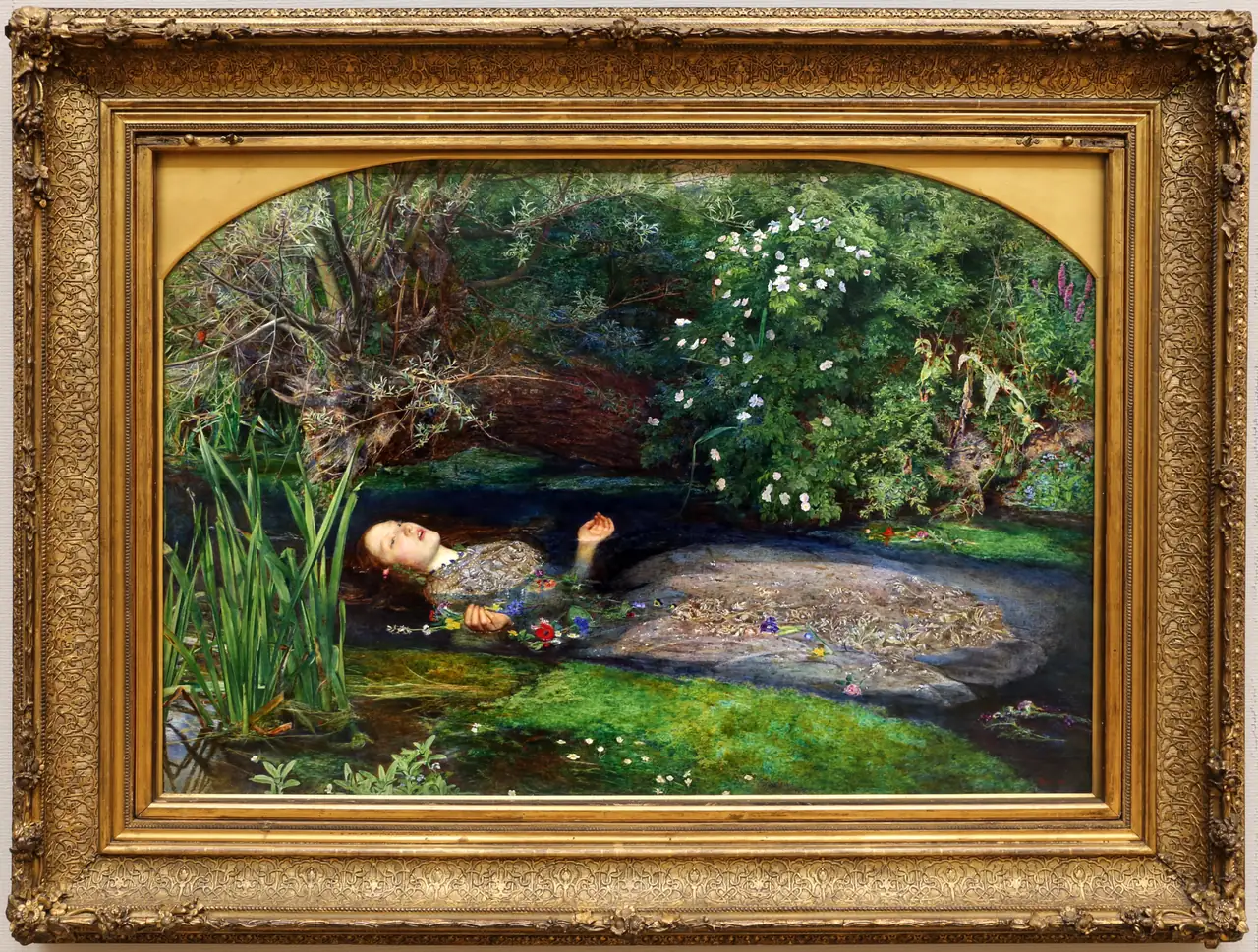
The dress expands across the lower part of the picture, while the bank presses forward behind it. Pale flowers punctuate the darker vegetation. Ophelia’s face is small compared with the surrounding growth, but its light colour pulls attention toward the left side of the stream.
Her hands do not grip the bank. One is turned upward; the other rests nearer the flowers and floating fabric. The image pauses on that unsettling relationship between an apparently still body and a setting full of minute living detail. You do not need to assign an exact botanical name to every leaf to see how densely Millais has built the environment.
A facial crop can suit a discussion of expression, but it removes most of that relationship. A flower-only detail may be useful for looking at colour or technique; it should not be described as the whole painting. The broad view is especially important when an article explains how figure and landscape work together.
Our photograph includes the gilded frame and its curved inner opening. It records the object as encountered in the gallery, not just a flat rectangle of painted canvas. A printed reproduction using this file would reproduce that photographed surround unless it were deliberately removed. Showing it on a product page would not, by itself, promise a physical frame.
The 1866 print is not a monochrome photo
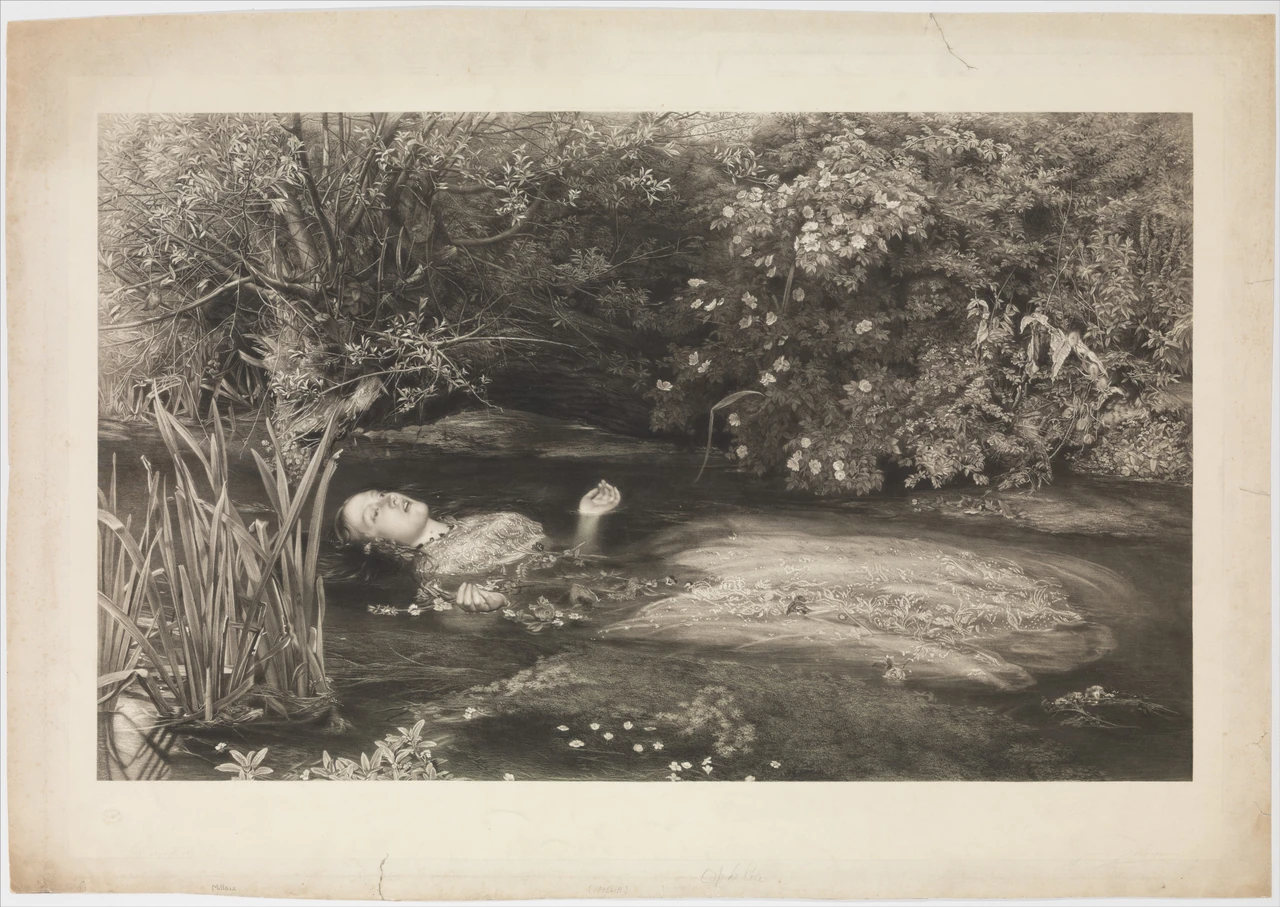
The Met’s record names James Stephenson as engraver, Millais as the artist after whom the print was made, and Henry Graves & Co. and the Printsellers’ Association as publishers. It dates the object 1 March 1866 and describes this impression as a proof, made with mezzotint, etching and stipple on chine collé.
Compare the two illustrations. The printed dress remains intricate, but its pale highlights and dark patterns must work without the painting’s colour. The riverbank likewise becomes a field of light and dark marks. This is a translation into another medium, not merely a digital command that desaturated a colour photograph.
That difference belongs in the credit. “Millais, Ophelia” alone would leave the printmaker invisible and make the object sound like the oil painting. Conversely, crediting Stephenson alone would conceal the composition he reproduced. “James Stephenson, after John Everett Millais” states the relationship directly.
The Met marks its image Public Domain, and its Open Access policy permits unrestricted use of designated images under CC0. That is the provider’s stated status for this exact file. It is not a licence applied to the unrelated colour photograph above.
How far the publication evidence goes
Millais died in 1896; Stephenson died in 1886. Both dates fall outside the ordinary author terms set out in UK and EU guidance. The photograph is separately licensed.
The dated print and named publishers provide more specific historical evidence than the fact that the painting was displayed in 1852. But a proof impression is not, on its own, a complete record of authorised distribution. We have not independently closed the painting’s U.S. publication chain from this object alone.
Under U.S. sections 303 and 304, earlier published and previously unpublished works follow different term rules. The 2026 cutoff concerns publication through 1930, not creation. Some qualifying first publications in 1978–2002 receive a 2047 floor. An exhibition date should not be substituted for publication evidence.
For a project requiring an independent U.S. conclusion, the next useful research is narrow: inspect an issued reproduction or illustrated edition, establish its date and publication circumstances, and confirm that it reproduces this composition. A list of exhibition titles answers a different question.
The photograph and the museum file
The colour file used here identifies Sailko’s own work, photographed 28 February 2017, with a CC BY 3.0 licence. We retained the whole source photograph and reduced it proportionally to 1,280 pixels wide. We did not download a Tate image and assign it that licence.
CC BY 3.0 requires appropriate credit, a licence link and identification of changes. Commercial reuse is permitted under those conditions; the licence does not imply endorsement or clear rights the photographer does not control.
A museum page can supply excellent identification while leaving reuse of its own files to separate terms. The existence of a download button, an art-print shop or a picture in a search result does not settle those terms. If you choose another image, repeat the exact-file check rather than borrowing Sailko’s credit.
Choosing and crediting your version
Use the colour painting photograph when colour, the displayed frame or the painted scene is relevant. Use the Stephenson print when discussing nineteenth-century reproduction or print technique. Neither is a universal replacement for the other.
Save the object number, source page, photographer or printmaker, licence and modification note with the file. Before a large print run, inspect the original pixels and obtain any unresolved territorial advice your project requires. A careful credit preserves the distinction that makes this guide useful: one painted composition can reach us through several different objects and several different rights statements.
Editorial record
About this article
- Author
- Publisher
- GeMarkt
- Published
- Reviewed
- Internal source & rights check. Conducted by GeMarkt Research Review. This is an internal editorial check—not independent peer review.
- Source standard
- Rights guide source standardSeparates the underlying work from the source file, records the review date, and links the evidence used for the conclusion.
Found a claim that needs checking? Report a factual error.