GeMarkt Blog · Reference
Is Morning in a Pine Forest by Ivan Shishkin Public Domain?
Check Shishkin’s 1889 painting, Savitsky’s contribution, publication evidence and the exact Commons reproduction before assuming every forest image is free.


The short answer
The historical painting is beyond the ordinary life-plus-seventy author term, even when Konstantin Savitsky’s contribution is included. The exact reproduction shown here is marked public domain by Wikimedia Commons. That is not a universal clearance of every museum file, book illustration or commercial adaptation of the scene.
This guide identifies the 1889 Tretyakov Gallery painting, inventory 841, rather than every work called Morning in a Pine Forest. Checked 12 October 2026, we report the Commons file’s public-domain assessment, but have not independently completed the painting’s U.S. publication and authorisation history. The date of its first exhibition does not close that question.
The 1889 painting, not a generic bear picture
The Tretyakov Gallery’s object record identifies an oil painting dated 1889, acquired by Pavel Tretyakov that year. Its familiar subject is a group of bears among fallen trunks, surrounded by a much larger forest. The gallery also discusses the collaboration behind the picture, rather than treating the animals as an unexplained addition.
Start with that exact object when collecting files. A preparatory study, a reproduction on packaging, a photograph of the framed painting and a digital reconstruction can all circulate under the same title. They are not interchangeable evidence. The painting’s inventory number is more useful than a filename such as “Russian bears high resolution.”
Nor should a reproduction’s colour be used to identify a supposed second version. Warmer greens, a bluer mist or stronger contrast may reflect photography and processing. Compare the arrangement of trunks and animals first; then check the provider’s object record. Colour differences alone do not establish another painting.
Why the forest needs the bears and the bears need the forest
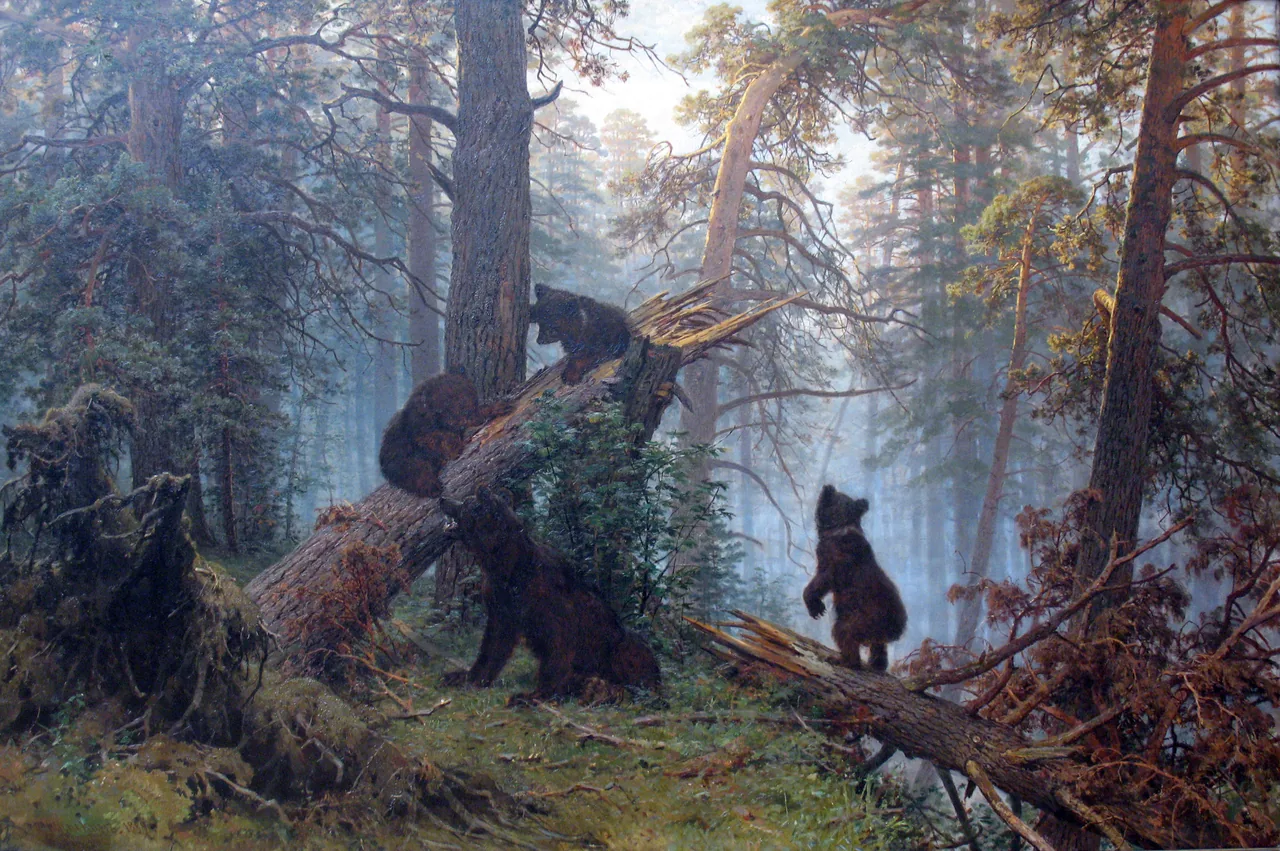
The broken trunk draws a diagonal across the upright trees. Two bears climb along it, while another stands beneath. To the right, the fourth animal rises against an opening in the mist. The animals are dark enough to register quickly, but they occupy only a small part of the painted space.
Look past them and the forest changes character. Close branches, rough bark and the root mass offer hard edges; the distant trees become paler and less distinct. The bright opening is not a blank backdrop. It gives the foreground depth and makes the standing bear’s silhouette legible.
A square crop around the animals would make a cheerful wildlife scene. The full painting asks us to move between the small group and the surrounding height, fallen wood and morning air. That difference matters when you choose an illustration. A detail can explain a bear’s pose, but it cannot stand silently for the complete landscape.
Keep visual interpretation distinct from natural-history claims. The image lets us describe painted actions and spatial relationships; it does not establish how real bears typically behave as a family, or precisely where Shishkin observed these particular animals.
Savitsky’s contribution does not disappear with a signature
The Tretyakov’s account of the painting identifies Konstantin Savitsky as the painter of the bears. It discusses his 1889 letter and the disputed history of his signature. Stories differ about how that signature disappeared from view; the collaboration itself should not disappear from a credit line.
This is also a reason to resist the familiar claim that Shishkin needed help because he could not paint animals. The same museum account points to his animal studies. Collaboration does not, by itself, establish inability. It tells us who contributed to this particular composition.
For a concise caption, “Ivan Shishkin, with bears painted by Konstantin Savitsky” communicates the relevant fact without pretending to resolve every account of their working arrangement. For a rights record, preserve both names and their roles. Removing a signature, changing an attribution or shortening a museum label is not evidence that an actual contributor’s rights never existed.
Which country and which term
Shishkin died in 1898. Savitsky died in 1905, as the Tretyakov’s Savitsky record confirms. In a joint-authorship assessment, the later death matters: calculating from Shishkin alone would leave out a documented contribution.
The EU’s general copyright guidance explains the ordinary seventy-year term after the last surviving author’s death. Even counting seventy years from 1905 puts that ordinary term long behind us. UK guidance also describes a general life-plus-seventy term for artistic works.
That is a bounded term conclusion, not a claim that every country has identical rules. National transitional provisions, moral rights and the status of a particular reproduction remain separate. This page does not give a comprehensive Russian-law or worldwide commercial-use opinion simply because the painting is held in Moscow.
The distinction is useful rather than merely cautious. It allows you to identify an expired historical author term without pretending that a recent photographer, publisher or image supplier has granted permissions that its file page never offered.
Exhibiting a painting is not the same as publishing it
The work appeared at the 1889 exhibition of the Peredvizhniki, according to the Tretyakov’s historical account. That establishes public display. It does not, by itself, establish the distribution of authorised reproductions required for a publication analysis.
The museum also discusses the picture’s later life on confectionery packaging. That is a valuable lead towards dated printed objects, but this guide has not inspected an early wrapper and established its authorisation. A story about mass popularity is not a substitute for that evidence.
U.S. law’s definition of publication expressly distinguishes distribution from display. Its term rules treat older published and previously unpublished works differently. For a substantial U.S. reproduction project, establish the relevant publication history rather than relying only on “1889” or a repository badge.
The specific image used here
The Commons file selected for this article was uploaded by Anagoria in 2012. Its source field names the Tretyakov Gallery, and its rights section presents the image as a faithful reproduction under PD-Art and Public Domain Mark 1.0. We do not describe it as a museum-issued CC0 download or a Creative Commons photographer licence.
There is a small but important metadata trap: the file’s generic lifespan notice uses Shishkin’s death year, while its creator information includes Savitsky. Our assessment retains the later contributor instead of repeating the simplified date. The 2012 upload date also tells us when this file arrived online, not when the painting was first published.
The Public Domain Mark’s own notice cautions that restrictions can vary by jurisdiction and that its assessment carries no warranty. The mark is evidence to record, not a promise of museum endorsement. Our displayed file preserves the supplied composition and has only been proportionally reduced. It is not offered as a colour-calibrated printing master.
A sensible reuse record
Keep four things together: the 1889 object, both contributing artists, the exact source file, and the country-specific reasoning for your use. A modern chocolate wrapper needs its own assessment because packaging may add logos, lettering and other design elements. The painting’s status does not automatically clear the wrapper as a whole.
Credit the collection as the painting’s location, not as a sponsor of your product or article. Label any crop as a detail, retain an untouched source copy, and keep the provider’s rights statement with the downloaded file. These small steps make later corrections much easier.
For other Shishkin landscapes and their different source records, see the artist rights guide. The practical conclusion here is specific: a traceable Commons reproduction with a stated public-domain assessment, an expired ordinary joint-author term, and a U.S. publication question that is not disguised as completed legal clearance.
Editorial record
About this article
- Author
- Publisher
- GeMarkt
- Published
- Reviewed
- Internal source & rights check. Conducted by GeMarkt Research Review. This is an internal editorial check—not independent peer review.
- Source standard
- Rights guide source standardSeparates the underlying work from the source file, records the review date, and links the evidence used for the conclusion.
Found a claim that needs checking? Report a factual error.