GeMarkt Blog · Practical guide
Is Ivan Shishkin’s Art Public Domain? Forests, Fields and Image Sources
Explore Shishkin’s pines, rye fields and woodland studies through twelve museum records, two genuine images and careful work, country and file checks.
Rights check · reviewed
The short answer
Shishkin’s ordinary EU/UK artist term has elapsed. The two selected Google Art Project reproductions of Mast-Tree Grove and Rye carry Commons PD-Art/Public Domain Mark, not museum CC0 releases. Independent U.S. publication histories remain unresolved. Morning in a Pine Forest also includes bears painted by Konstantin Savitsky.
| What is being checked | Result | Why |
|---|---|---|
| European Union — ordinary artist term | Ordinary artist term has elapsed | Shishkin died in 1898; the ordinary life-plus-70 term has elapsed. This limited conclusion does not resolve every national exception, moral right, later first publication, adaptation or separately authored image. |
| United Kingdom — ordinary artistic-work term | Ordinary artist term has elapsed | Older unpublished works and separate photographs require their own assessment. This is not a catalogue-wide file permission. |
| United States — all twelve research objects | Independent publication histories unresolved | Museum and Commons file designations are attributed. No independent original-publication chain is established here, including for the displayed paintings. A date of painting, exhibition or museum acquisition is not automatically publication. |
| Russia and other local conditions | No universal local commercial clearance | A file designation does not by itself settle separate local museum, contractual or other non-copyright conditions. No museum permission for every commercial use in Russia is asserted. |
| Morning in a Pine Forest — contributors | Ordinary terms elapsed for both named painters | Tretyakov identifies the landscape with Shishkin and the bears with Konstantin Savitsky (1844–1905). Their ordinary EU/UK terms have elapsed; U.S. publication, exact file conditions and disputed signature-removal accounts remain separate. |
| Selected digital files | Two exact Commons PD-Art / PDM reproductions | Mast-Tree Grove, Russian Museum, and Rye, Tretyakov 837, are exact Google Art Project files. PDM is not CC0, nor a museum-issued permission for all commercial uses. Source files, metadata and deterministic resized masters are preserved. |
| Other works and files | Ten display HOLDs | No display files were acquired for the other ten references, including Morning in a Pine Forest. The 1866 Road through Rye and 1878 Rye remain separate; Goutweed at Pargolovo retains the museum’s 1884/1885? uncertainty. |
Twelve exact research objects, two selected historical images and ten display HOLDs. Official museum dates and dimensions take priority over conflicting Commons metadata. Morning in a Pine Forest has a real co-contributor, not a fictional sole-author simplification.
This is a documented research summary, not legal advice. Copyright and moral-rights rules can vary by country and by the history of a particular work.

What we’ll look at
What makes a Shishkin landscape distinctive, and which exact image can you reuse?
Short answer: Shishkin’s ordinary EU/UK artist term has elapsed, but each painting and reproduction still needs identifying. The two historical images shown here carry Wikimedia Commons’ PD-Art/Public Domain Mark designations. They are not museum CC0 releases or proof that every Shishkin download is unrestricted. Independent U.S. publication histories remain unresolved here.
Shishkin’s forests are worth looking at slowly. A first glance finds an imposing stand of trees; a second discovers different bark, exposed roots, young growth and changes in the ground. His landscapes can feel dense without treating the woodland as an undifferentiated green wall.
More than a forest painter
Ivan Shishkin lived from 1832 to 1898. The Russian Museum’s account places him among the founding members of the travelling-exhibition association commonly called the Peredvizhniki. He also worked in engraving and spent time studying in Germany and Switzerland.
“Forest painter” is a useful introduction, not a complete description. His subjects include open fields, winter ground, coastal air and modest studies. Compare the scale of Before the Thunderstorm with the close vegetation of Goutweed at Pargolovo. One invites you to read a broad weather change; the other asks you to give low-growing plants sustained attention.
That alternation between the extensive and the particular is a good way into his work. Try looking once for the largest dark shape, then again for the smallest clearly observed part. The two readings should belong to the same place.
Mast-Tree Grove
The opening painting is Mast-Tree Grove, 1898, a late major work in the State Russian Museum. It draws on studies around Yelabuga and the ship-timber groves of Afanasov. The painting itself is 165 × 252 cm, considerably larger than its appearance on a phone suggests.
The trunks extend beyond the upper edge. Instead of fitting whole trees neatly into the picture, Shishkin makes you feel their continuation outside it. A shallow stream opens the foreground; smaller trees and a slight wooden fence offer another measure of the great pines’ scale.
Look at the intervals between trunks as carefully as at the trunks themselves. Some reveal sunlit ground, others close into shadow. The rhythm makes the forest navigable. There is not one uniform green: warm light on bark and ground sits beside darker foliage and cool patches of water.
The reproduction preserves the supplied warm colour. Turning the scene colder or uniformly greener might satisfy an expectation of what a forest should look like, but it would change this particular image.
Rye and open space
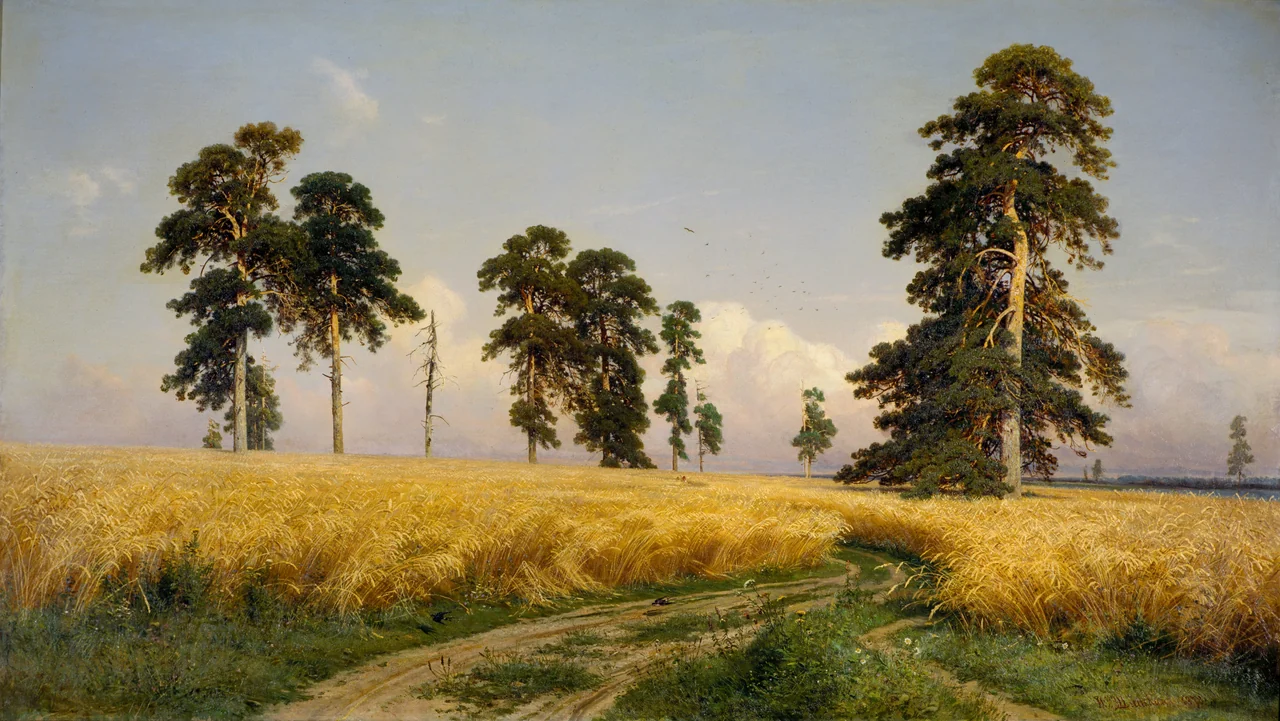

In Rye, painted in 1878, the trees no longer form an enclosing grove. Their spacing matters. An immense pine on the right anchors the foreground while other trees mark the distance across a golden field.
The track gives the eye a route through the crop. Follow its bends and notice how the low horizon leaves room for the sky. This is cultivated ground rather than untouched wilderness: the field and path belong to the picture’s identity as much as the trees do.
Tretyakov gives the canvas dimensions as 107.5 × 188 cm. Its broad format supports the sense of movement across open land. Cropping it to a narrow upright shape would do more than remove spare sky; it would change the relationship between the path, scattered pines and distant field.
The bears have a second painter
Morning in a Pine Forest is dated 1889, and the bears were painted by Konstantin Savitsky. Tretyakov’s account of the painting’s history uses correspondence and recollections to explain that collaboration. Calling every visible element solely Shishkin’s work leaves out an actual contributor.
It does not follow that Shishkin was incapable of painting animals. The museum discusses other animal subjects in his practice. Collaboration is a fact about this particular picture, not a simple verdict on one artist’s limitations.
The familiar story about Savitsky’s signature being removed has competing accounts. It should not be repeated as though every part of the episode were settled. For an image caption, the useful minimum is clear: Shishkin painted the landscape, with the bears by Savitsky. For a rights check, remember both authors rather than stopping at the better-known surname.
Twelve landscapes to identify
The first two entries have selected images here. The other ten are research references whose exact display files remain on hold; that does not mean the old paintings have been found to be copyrighted.
| Work | Date | Institution or distinguishing detail |
|---|---|---|
| Mast-Tree Grove | 1898 | Russian Museum; image shown |
| Rye | 1878 | Tretyakov, 837; image shown |
| Morning in a Pine Forest | 1889 | Tretyakov; bears by Konstantin Savitsky |
| Path in a Forest | 1880 | Russian Museum |
| Oaks | 1887 | Russian Museum; 147 × 108 cm |
| Winter | 1890 | Russian Museum |
| Before the Thunderstorm | 1884 | Russian Museum |
| A Stream in a Birch Forest | 1883 | Russian Museum; not the earlier related composition |
| Goutweed at Pargolovo | 1884/1885? | Russian Museum retains uncertainty |
| By the Gulf of Finland, Udrias near Narva | 1889 | Russian Museum |
| Road through Rye | 1866 | Tretyakov, Ж-1434; not the 1878 painting |
| Along the Seashore, Study | 1889 | Tretyakov, 852 |
Country and file checks
The ordinary EU and UK life-plus-70 terms have elapsed for Shishkin and for Savitsky, who died in 1905. That does not settle every later photograph, adaptation, unpublished-work exception or local museum condition.
The U.S. Copyright Office distinguishes publication-based terms from rules for older unpublished works. A pre-1931 publication can matter in 2026; an 1889 painting date alone does not establish it. This guide does not independently establish U.S. publication histories for the twelve works, including the two illustrated paintings.
Both displayed files are Google Art Project reproductions hosted on Commons and marked PD-Art/Public Domain Mark. That designation is not a CC0 licence from the Russian Museum or Tretyakov. Use the exact Mast-Tree Grove file page and the linked Rye page, not a generic “free Shishkin” claim. Commercial projects in a particular country still need to consider separate local and contractual conditions.

Choosing a forest reproduction
A useful reproduction should retain the distinction between shadow and solid black. Check the foliage and ground at the intended viewing size: excessive sharpening can turn twigs into harsh outlines, while compression can blur different leaves into one texture.
Keep the original proportions in mind too. Mast-Tree Grove builds height through its trunks; Rye needs room to move sideways. Choose the composition for the space before forcing either into a standard crop. The reward is not simply more visible detail, but a clearer sense of how Shishkin makes a landscape hold together.
Sources and review method
We checked the artist chronology against museum records, treated each named jurisdiction separately, and recorded the provider policy for the image set. These sources support the legal framework and artist dates used above; the source file for any individual image still needs its own record.
- Mast-Tree Grove, 1898 — State Russian Museum. Exact work, dimensions and Yelabuga studies; authoritative artist dates 1832–1898 override Commons birth-year error.
- Mast-Tree Grove, Google Art Project file — Wikimedia Commons. Exact file provenance, native resolution and PD-Art / Public Domain Mark; not a museum CC0 licence.
- Rye, 837 — State Tretyakov Gallery. 1878 painting, official 107.5 × 188 cm dimensions and distinction from the earlier field study.
- Rye, Google Art Project file — Wikimedia Commons. Exact file and PD-Art / Public Domain Mark; rounded Commons dimensions not substituted for the museum’s measurement.
- The history of Morning in a Pine Forest — State Tretyakov Gallery, Lavrus. 1889 collaboration and Savitsky’s bears; competing signature-removal accounts, not a settled anecdote.
- Savitsky, Konstantin Apollonovich — State Tretyakov Gallery. Institutional artist dates 1844–1905 used only for the limited ordinary-term comparison.
- Goutweed at Pargolovo — State Russian Museum. Retains uncertain 1884/1885? dating and exact support.
- Copyright in the EU — European Union, Your Europe. Ordinary artist term and last surviving joint author; not a universal file licence or every national exception.
- How long copyright lasts — UK Intellectual Property Office. Ordinary artistic-work duration, with older-work and unpublished-work qualifications kept separate.
- Duration of Copyright, Circular 15A — U.S. Copyright Office. Publication-based terms and conditional older-unpublished rules; neither creation nor exhibition alone establishes publication.
Editorial record
About this article
- Author
- Publisher
- GeMarkt
- Published
- Reviewed
- Internal source & rights check. Conducted by GeMarkt Research Review. This is an internal editorial check—not independent peer review.
- Source standard
- Rights guide source standardSeparates the underlying work from the source file, records the review date, and links the evidence used for the conclusion.
Found a claim that needs checking? Report a factual error.