GeMarkt Blog · Reference
Is Merian’s Metamorphosis Insectorum Surinamensium Public Domain?
Merian’s 1705 published plates are public domain. Identify the edition, engraver and hand-coloured copy before reusing an image or a modern translation.

The short answer
Yes: the original illustrations published in Maria Sibylla Merian’s 1705 Metamorphosis insectorum Surinamensium are public domain in the United States and under ordinary EU and UK author terms. That does not include every recent translation, newly written commentary or modern illustration sold under a similar title.
This guide, checked on 12 October 2026, uses plates 7 and 1 from Universitätsbibliothek Basel’s copy, UBH AN I 14. Its e-rara record applies a Public Domain Mark. We are looking at particular coloured pages from a particular historical edition, not claiming that all Merian-related image files have identical terms.
The 1705 book, not every book called Merian
The Basel library record identifies the Amsterdam publication associated with Gerard Valck, dated 1705, containing sixty plates and text in Dutch and Latin. Its persistent identifier is 10.3931/e-rara-5285.
That information separates this book from Merian’s European insect publications, her preparatory drawings and later editions of the Suriname work. It also separates it from a modern English book that uses a translated or shortened version of the title.
Start with the title page, then find the actual plate number. A digitisation may count a facing text page, a blank leaf or a cover as an image. Its “page 20” is not automatically plate 20. In our selected illustration, the printed 7 sits near the lower-right corner; the engraver’s credit appears along the bottom.
The Merian artist guide places these pages within her wider career. Here, the narrower question is what can be concluded about this published edition and these supplied scans.
An image of relationships
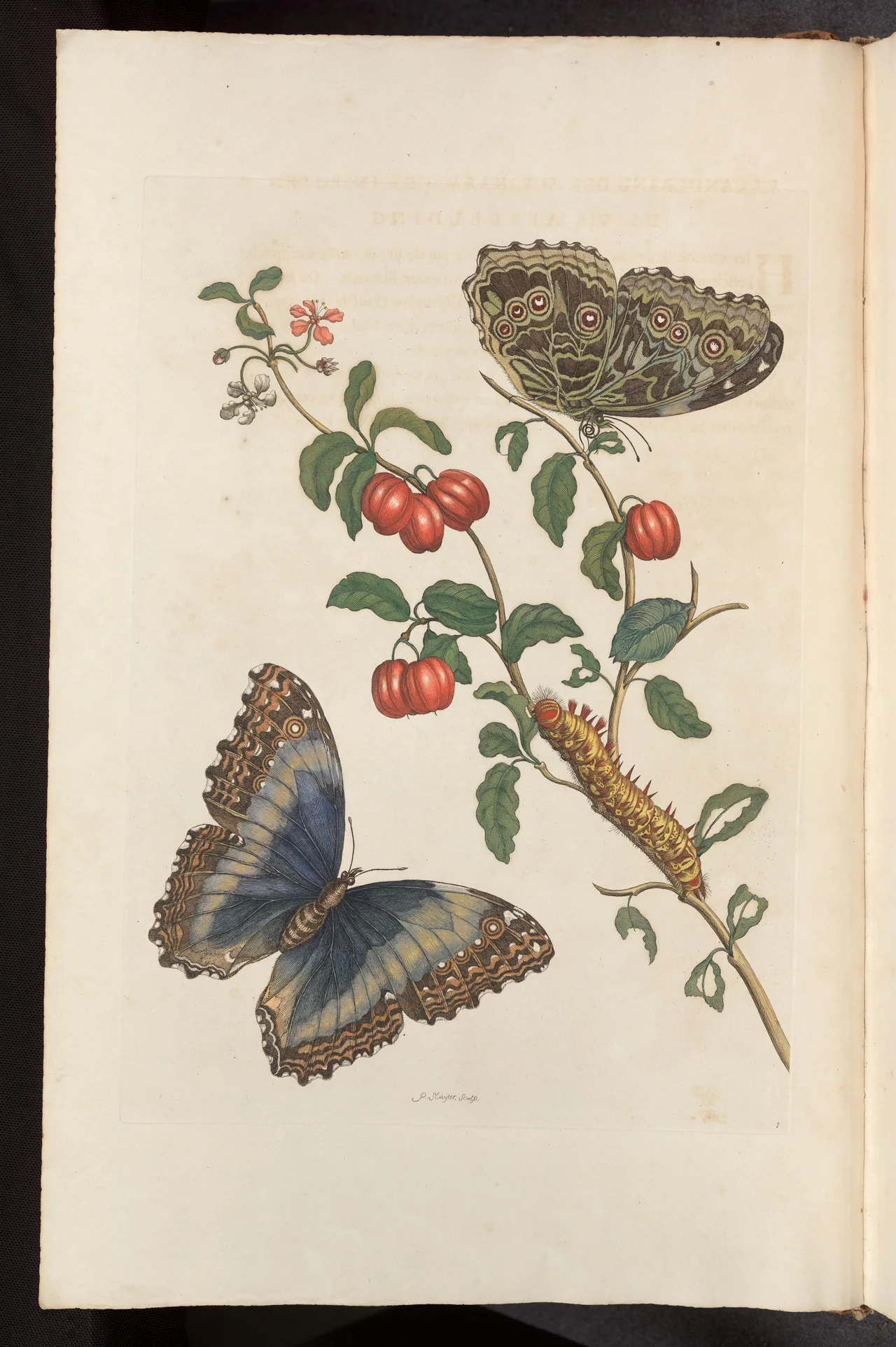
The branching stem makes a diagonal path through the composition. Red fruit punctuates the green leaves; the caterpillar follows the lower branch. Above, one butterfly presents patterned folded wings, while the open-winged insect below introduces a much larger area of blue.
Those contrasting views encourage the eye to travel rather than settle on one decorative motif. A thumbnail might look like a butterfly picture, but the full sheet also gives the plant and the caterpillar substantial space. Remove either and the relationship between different forms of life becomes harder to read.
This is not a photograph of several creatures happening to occupy one branch at one instant. It is a composed illustration. The visible arrangement can be discussed without treating every association as a current scientific conclusion or inventing a modern species name from an attractive online caption.
If you use the picture to teach biology, check contemporary scientific references as well as the historical text. Public-domain status tells you about reuse, not whether an eighteenth-century observation remains scientifically accepted.
The engravers and the coloured copy
On plate 7, the printed signature identifies Pieter Sluyter as engraver. Plate 1, shown below, bears Joseph Mulder’s name. Keeping these credits acknowledges how Merian’s designs became reproducible printed pages. The book did not emerge from a single uninterrupted act of painting.
The Getty’s Merian and Daughters exhibition explains that the 1705 publication was sold in different forms, including a deluxe hand-coloured transfer-print version. It also describes the assistance of Merian’s daughters and an Indigenous woman who travelled back to Amsterdam with them. The work’s production and knowledge have a wider history than the name on the title page alone suggests.
That account does not establish who applied the colour to every leaf in the Basel copy. We therefore describe the selected coloured copy without assigning its colouring to a named hand. Differences in colour between surviving copies should not be erased by calling one web image the single definitive original.
What the old publication means for copyright
Here there is an identified 1705 issued book, rather than a painting whose early publication remains unknown. The original published material is far beyond any ordinary U.S. published-work term; U.S. copyright duration provisions distinguish that history from older material that remained unpublished.
Merian died in 1717. The historical printed contributors also belong to that early publication, not to a recent illustrated remake. Ordinary EU and UK author terms have elapsed for this original material. The library’s public-domain designation provides an additional, explicitly attributed finding for its digitised copy.
A new translation is a different matter. If you want English text for a modern article, write your own sourced account or obtain permission for a current translation where required. The age of a Dutch or Latin passage does not automatically make someone else’s recent wording available to copy.
What Basel says about its files
The e-rara record marks the book Public Domain Mark and makes it available for free download. It asks for source information, including the author, holding institution and persistent identifier, and requests notification or a copy of a publication using the material.
This is not an assertion that the library has issued a CC BY licence or a CC0 dedication. The mark is a description of public-domain status. Use the wording that actually appears on the record instead of substituting a more familiar licence label.
A useful credit names Merian, the book, 1705, the plate, its engraved credit and Basel’s shelfmark. It should link to the record, not merely the image address. The source page is what lets another reader verify that the botanical illustration belongs to the book and copy you describe.
1719 is a different edition
Getty records a reissue in 1719 with twelve additional plates, after Merian’s death. Its displayed examples from that edition are valuable, but they should not quietly be described as leaves from the sixty-plate 1705 publication. Nor should each later addition be assigned personally to Merian without checking its authorship.
The distinction matters even when both old editions are out of copyright. It affects captions, attribution and interpretation. If an article discusses an added plate, its date and edition must follow that plate; borrowing the better-known first-publication date makes the identification less accurate.
A modern facsimile introduces another layer. Its new introduction, cover design or annotations can have their own rights. Choosing an old library scan is often the clearer route when all you need is the historical illustration, not the complete modern editorial package.
Keep the life cycle visible
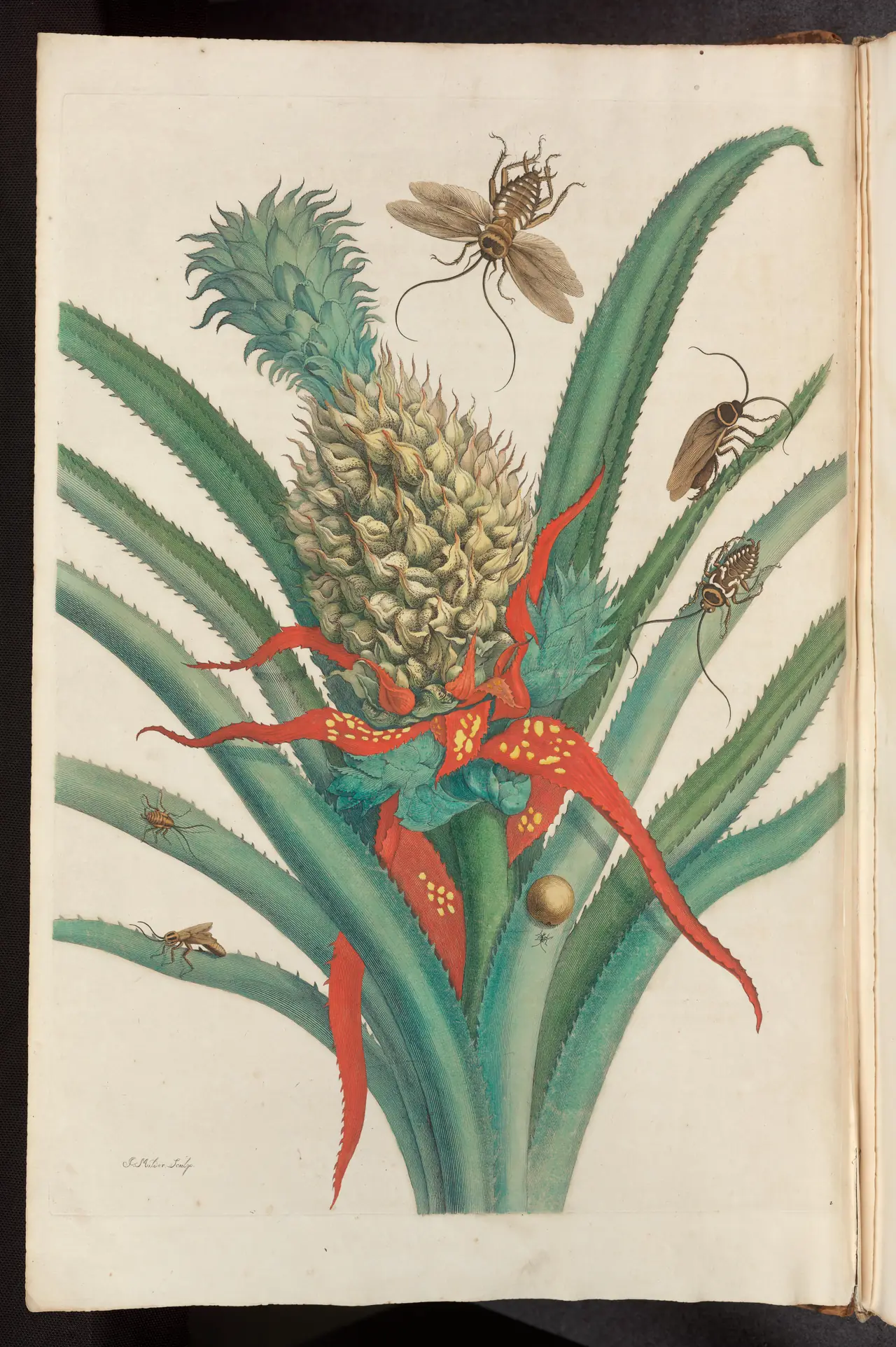
Here the pineapple dominates, yet small insects occupy the gaps around it. A narrow crop could preserve the fruit while removing much of what makes this an insect-book illustration. Before trimming, decide whether your purpose is to reproduce the plate, discuss one detail or create a decorative adaptation.
For a faithful illustration, preserve the complete supplied leaf and legible credits. For a detail, say which area has been selected. Keep the unedited source separately, and do not let automated image enhancement invent wing markings or alter engraved letters.
The 1705 plates offer a clear public-domain starting point. Matching the edition, plate and scan keeps that practical freedom connected to the historical work, instead of turning a carefully observed page into an anonymous “vintage nature” image with an untraceable source.
Editorial record
About this article
- Author
- Publisher
- GeMarkt
- Published
- Reviewed
- Internal source & rights check. Conducted by GeMarkt Research Review. This is an internal editorial check—not independent peer review.
- Source standard
- Rights guide source standardSeparates the underlying work from the source file, records the review date, and links the evidence used for the conclusion.
Found a claim that needs checking? Report a factual error.