GeMarkt Blog · Reference
Is Little Dancer Aged Fourteen by Edgar Degas Public Domain?
Separate Degas’s original wax dancer, later bronze casts and their photographs, with two museum images and a practical guide to checking reuse.

The short answer
There are openly reusable museum photographs of Degas’s Little Dancer, but “public domain” must refer to a particular object and image. The National Gallery of Art releases the photograph of its original wax figure shown here under CC0. The Met also supplies an open image of its later bronze cast. Neither statement licenses every photograph, cast or contemporary replica carrying the title.
Checked 12 October 2026, these are institution-designated public-domain images. Degas’s ordinary UK author term has expired. This guide does not independently establish the complete U.S. publication history of the sculptural composition; the 1881 exhibition alone cannot settle that question.
One dancer, more than one object
The familiar pose survives in objects made at different times, from different materials. A caption saying only “Degas, 1881” hides an important part of their identity.
| Object discussed here | What its record identifies |
|---|---|
| NGA 1999.80.28 | Original wax and mixed-media figure, 1878–1881 |
| Met 29.100.370 | Bronze cast by A. A. Hébrard, 1922, after the model of 1881; modern tutu |
| Either museum photograph | A particular photographic view, released through that institution’s open-image policy |
The NGA record lists wax, clay, an internal metal support, human hair and real textiles among the original’s materials. Its height without the base is just under one metre. It is not the bronze familiar from many other collections.
For a reader, that distinction explains why two reputable images can differ. For someone reproducing the work, it identifies which object a file actually documents. The title connects them; the accession number separates them.
Looking at the original wax
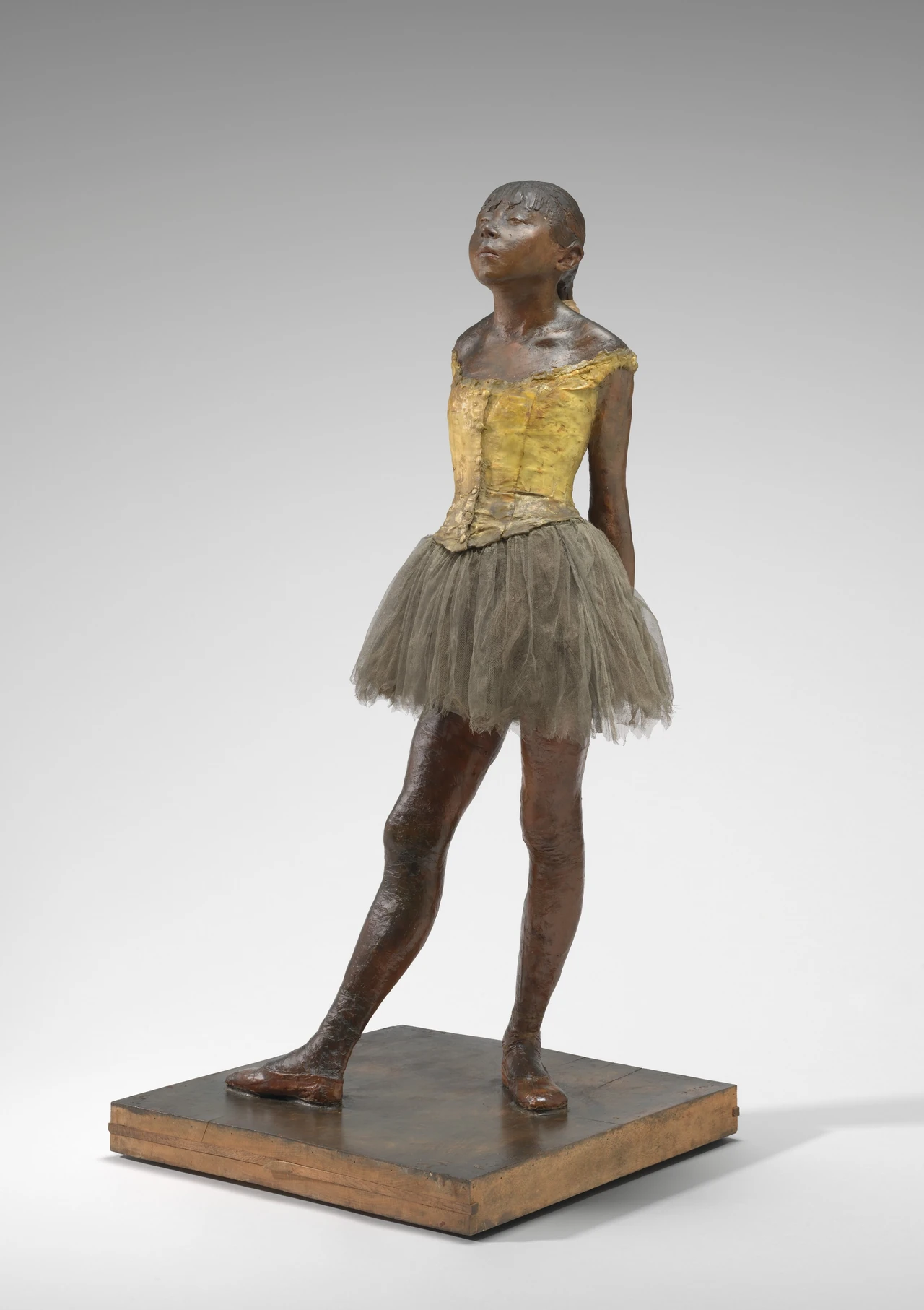
Begin with the feet rather than the face. One leg reaches outward while the other supports the upright body. The hands disappear behind the back, and the chin lifts. The figure is still, yet the arrangement does not feel relaxed: it holds a position.
The skirt and body behave differently in the light. The fabric hangs in uneven, translucent folds, while highlights catch the textured wax at the knees, shoulders and cheeks. The yellow bodice creates another surface between them. A monochrome thumbnail can conceal these material differences and make the figure resemble a single bronze casting.
The grey background and floor shadow belong to this photograph, not to a setting designed by Degas. Keeping that distinction in mind helps when comparing images made from other angles or against different backgrounds. Apparent changes in warmth, balance or expression may come from lighting rather than from a different sculpture.
Nor is this a time capsule of every detail seen in 1881. The NGA’s study of the original state says that no images of the wax from Degas’s lifetime have been found. Written responses and later photographs therefore matter to its reconstruction. A current museum photograph records the object as photographed, not a verified view of its first exhibition.
What changes in the bronze
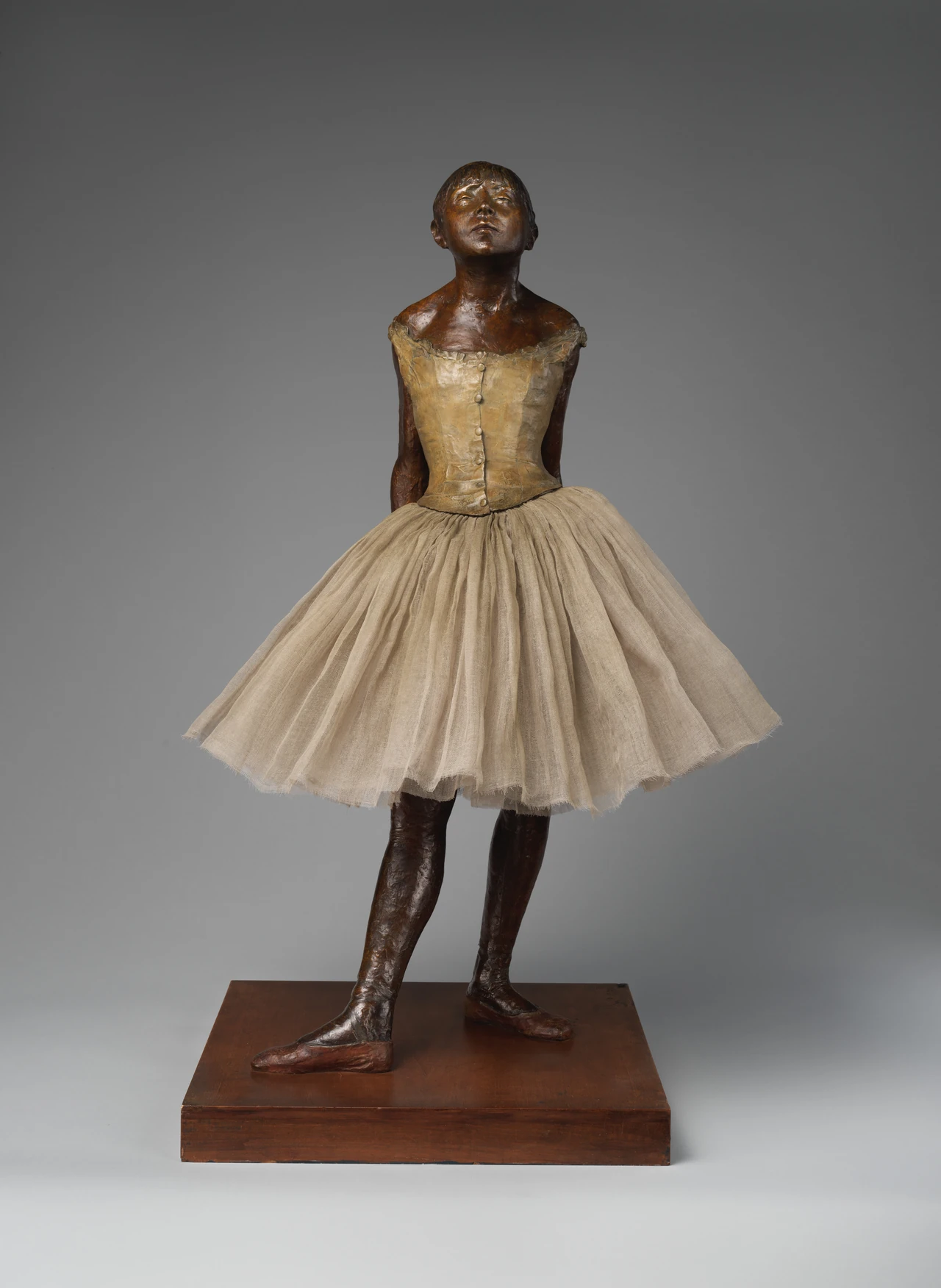
The pose is recognisable, but the material and presentation are different. In this view the pale skirt spreads broadly, and the legs carry sharper highlights. Do not read every difference between the photographs as a change made by the foundry: angle, lighting and textiles also influence what we see.
The Met’s object record identifies both the bronze’s 1922 casting and its modern tutu. Its conservation account explains that Degas’s heirs arranged bronze reproductions after his death. It also documents successive replacement skirts, including a new tutu made in 2018.
That history is useful beyond copyright. A new skirt does not make the entire sculpture a new Degas artwork. Equally, “cast after Degas” does not mean this is an anonymous modern souvenir. Preserve the foundry, cast date and collection identification instead of collapsing all these objects into either “the original” or “a copy.”
Why 1881 is not a complete copyright answer
Degas died in 1917. Under the ordinary UK rule for artistic works, his author term has expired. That conclusion concerns his historical work, not a photographer’s recent composition or every later creative addition.
The United States distinguishes publication from public display. Its statutory definition does not treat exhibition alone as publication. Different duration provisions cover old published and previously unpublished works, including a special rule for certain late publications. Therefore, a casting or exhibition date is not a substitute for examining the relevant publication evidence.
Here the museums’ designations support the selected image routes. They are not presented as this guide’s independent legal finding for all casts, all countries or every reproduction history. If a proposed use depends on manufacturing replicas or distributing them internationally, an object-specific review is more appropriate than extending an image label beyond its scope.
The photograph has its own source
A sculpture can be photographed from countless positions. Lighting, perspective and background shape the resulting image. Finding an old sculpture in a picture does not, by itself, give you permission to copy that picture.
For the original wax, the NGA’s open-access terms release qualifying images under CC0, including commercial reuse. The object page expressly identifies its media as public domain. The terms also limit the museum’s assurances to rights it holds; they are not a warranty against every possible third-party claim.
For the bronze photograph, the Met’s image policy covers its designated public-domain images under CC0. That is an image policy, not merely permission to copy catalogue data. Both routes are materially different from taking a visitor’s photograph from social media without checking its licence.
Choosing an image or making an object
For an illustrated article, first decide whether the subject is Degas’s wax experiment or the later bronze tradition. Then select the corresponding museum image. If the text discusses the skirt, use a view that actually shows it and identify a modern replacement where the record does so.
For a print, inspect the source dimensions rather than enlarging a small website preview. The pictures on this page are reading-size derivatives. They are useful for comparison, not a promise of print quality at every size. Preserve the feet and base unless a clearly labelled detail is your intention.
For a three-dimensional reproduction, the task is different. An openly released photograph is not a ready-made, licensed 3D scan. A scan supplier may have separate terms, and a modern model may contain additional work. Do not describe a newly manufactured object as an historical Hébrard cast or suggest museum approval because its reference photograph was openly available.
A credit that identifies the dancer
A useful credit names Degas, the specific collection, its accession number and the material or cast date. Add the image source and its open-access link. That tells the next reader whether they are looking at wax, bronze or a later interpretation.
The practical answer is thus a qualified yes for the two identified museum images, not a licence attached to the word “dancer.” For wider context, continue with our Degas artist guide and public-domain checklist. This is source-led general information, not individual legal advice.
Editorial record
About this article
- Author
- Publisher
- GeMarkt
- Published
- Reviewed
- Internal source & rights check. Conducted by GeMarkt Research Review. This is an internal editorial check—not independent peer review.
- Source standard
- Rights guide source standardSeparates the underlying work from the source file, records the review date, and links the evidence used for the conclusion.
Found a claim that needs checking? Report a factual error.