GeMarkt Blog · Reference
Is Redouté’s Les Roses Public Domain?
The historical Les Roses plates are public domain, but editions and files differ. Check an exact Met rose engraving, its contributors and its CC0 image.

The short answer
Yes: the original published illustrations in Redouté’s Les Roses, issued in 1817–1824, are public-domain historical content in the United States and under ordinary EU and UK author terms. A modern edition’s introduction, translation, layout or newly created illustrations may have separate protection.
The specific example checked here on 12 October 2026 is the Met’s ‘Empress Josephine’ or Frankfort Rose (Rosa turbinata), accession 2018.587.1. Its institutional image is available through the museum’s Open Access programme under CC0. That gives us a defined file to discuss, rather than an assurance about every “Redouté rose” sold or shared online.
Which Les Roses image is this?
The Met object record identifies a colour stipple engraving, dated 1817–24, measuring 34.9 × 25.2 cm. It belongs to Les Roses, with text by Claude-Antoine Thory. The image is a print, not Redouté’s original watercolour and not a photograph of a living rose.
The sheet carries two names below the plant: Rosa Turbinata and Rosier de Francfort. The Met supplies the additional familiar name “Empress Josephine”. Different titles can therefore describe this one object. The accession number is the useful anchor when the wording changes.
The museum record does not assign this loose sheet a volume and plate number. This guide does not invent either. Its identification rests on the named rose, date range, collection record and visible printed inscriptions. To cite a page in a bound volume, use that volume’s own title page and sequence.
Look at the whole printed rose
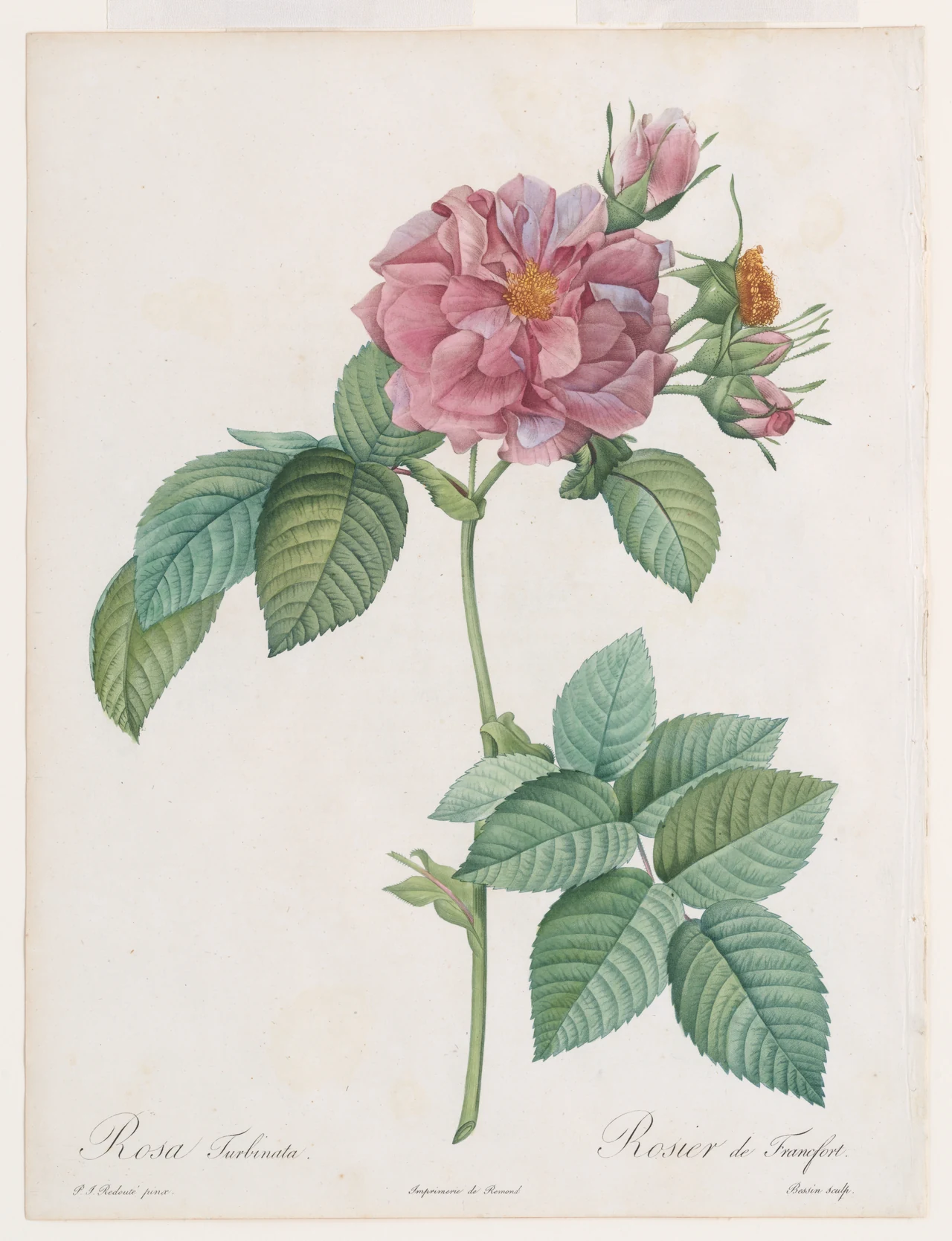
The large flower faces towards us but does not sit perfectly square to the page. Folded pink petals surround its yellow centre; a smaller bloom at the right exposes more of its interior. Above and beside them, buds show stages that the central flower has already passed through.
The leaves matter as much as the attractive blossom. Their serrated edges and visible veins give the stem structure, while their cooler colour balances the pink. The long lower stem leaves room for the names at the bottom. Removing all that space makes a compact floral motif, but it changes the logic of the original sheet.
A close crop can be beautiful without being a faithful full-page reproduction. Label it as a detail or adaptation. In a comparison or a botanical discussion, retaining the leaves, buds and inscriptions makes it easier for readers to understand which illustration they are seeing.
A book made by more than one person
The Biodiversity Heritage Library’s account dates the first publication to three volumes, 1817–1824, and identifies Thory as the writer. It also distinguishes the later 1828–1835 third edition. A search returning that later set has not necessarily found the identical impression reproduced here.
The selected sheet itself credits Redouté at the lower left, Bessin as engraver at the lower right, and Imprimerie de Rémond in the centre. Those names are visible evidence of collaborative manufacture. This guide preserves the printed “Bessin” credit without expanding it into a biographical identification the object record does not establish.
The rose was designed, translated into a printable plate, printed and made available to readers. A credit that says only “watercolour by Redouté” collapses those stages. “Colour stipple engraving after Redouté, from Les Roses” is a more useful description of this object.
The Redouté artist guide also shows material from Les Liliacées. That is a different publication: an iris or crown imperial should not be relabelled as a plate from Les Roses simply because both look at home in a botanical collection.
Why this is a publication question
The book’s nineteenth-century issue is evidence of historical publication. It is not merely the date of a private drawing or a later exhibition. Its original published plates are far beyond the maximum ordinary 95-year term for older published material explained by the U.S. Copyright Office.
For the EU and UK, Redouté’s death in 1840, the historical printed contributors and the age of this published edition place the original material beyond ordinary author-term protection. The general EU duration rule and UK guidance should not be confused with the rights in a newly written book about it. The Met separately designates this particular print public domain.
That conclusion is not a claim that every country has identical rules or that every modern reproduction is unrestricted. It is a bounded answer for the original issued material and the territories discussed, supported by the identified historical object and an open institutional file.
The Met file and the historical print
The museum labels the object Public Domain. Its Open Access policy makes designated images available under Creative Commons Zero, allowing copying and adaptation, including commercial reuse, without an image-permission fee.
Use the image supplied from that object record, not an unrelated shop’s photograph of a framed reproduction. CC0 for the Met file does not turn a retailer’s room photograph, packaging design or description into public-domain material.
The historic sheet and the digital file answer different questions. The first tells you what the object is and when it was issued. The second tells you the source and terms for the pixels being downloaded. Keeping both records avoids the common mistake of saving a picture while losing the very page that explained its status.
Attribution is still useful even when a CC0 permission does not require it. Naming Redouté, the publication, the Met and the accession helps the next reader find the same image and distinguish it from another rose.
Later editions are not interchangeable
A modern facsimile may reproduce the old plate alongside a new essay. A gift-book edition might remove the margins, change the order or supply contemporary plant names. A designer might recolour the flower and place it on a dark background. Each can be a different product even when the historical rose at its centre is out of copyright.
Do not take the entire modern package merely because one ingredient is public domain. Start from the open historical source when you want that ingredient. If you specifically need a publisher’s new commentary, obtain permission or rely on a legally applicable exception for that text.
Colour variation also deserves care. Two scans can make the same petals appear warmer or cooler. That is not proof that one is a different species or that either file accurately represents every surviving impression. Describe the selected copy and avoid promising a colour match to an unseen original.
Choose a file that suits your use
For an educational page, the full sheet explains the relationship between flower, foliage and printed identification. For a decorative arrangement, a detail may work better, provided its description makes the change clear. Neither choice requires pretending the image is a newly discovered original painting.
Before a large print, inspect the leaves and small lettering at the intended size. Increasing the pixel dimensions of a small preview does not recover the fine marks in the source. Keep the untouched download, its accession, the source URL and the CC0 record with any edited version.
The historical rose is available to reuse; the exact source still matters. Choosing this named Met engraving gives you both an identifiable published work and a clear institutional file policy, without borrowing the unverified claims of whichever website happens to rank first in an image search.
Editorial record
About this article
- Author
- Publisher
- GeMarkt
- Published
- Reviewed
- Internal source & rights check. Conducted by GeMarkt Research Review. This is an internal editorial check—not independent peer review.
- Source standard
- Rights guide source standardSeparates the underlying work from the source file, records the review date, and links the evidence used for the conclusion.
Found a claim that needs checking? Report a factual error.