GeMarkt Blog · Reference
Is Lady with an Ermine by Leonardo da Vinci Public Domain?
Identify Leonardo’s Kraków portrait, use the museum’s exact CC0 image, and distinguish the old painting from later reproductions and its publication history.

The short answer
Leonardo’s ordinary economic copyright has long expired, and the National Museum in Kraków currently labels the exact image selected here “CC0 – Public domain”. That makes this institutional source a much clearer starting point than an unattributed download of Lady with an Ermine.
The answer concerns MNK XII-209, the portrait dated about 1490 in Kraków’s Czartoryski Museum. It was checked on 12 October 2026. The museum’s file-level release is distinct from an independent reconstruction of the painting’s historical U.S. publication record; we do not claim to have completed that reconstruction or issued worldwide legal clearance.
Match the Kraków panel
The museum’s digital catalogue identifies the sitter as Cecilia Gallerani, the artist as Leonardo da Vinci, and the date as about 1490. The figure holds a pale animal against a dark background. Her head and the animal both turn towards the right side of the image.
The museum’s digital catalogue record supplies the inventory number MNK XII-209 and dimensions 53.4 × 39.3 cm. It identifies a walnut support and an oil-and-tempera technique. Those object measurements are not the dimensions of the surrounding frame or the downloadable image.
Match the accession, composition and institution together. A later engraving after Leonardo, a photographic detail of Cecilia’s face and a modern painting inspired by the pose are not interchangeable versions of the same digital object. Their source pages should say what each actually is.
Our Leonardo guide discusses his work more broadly. This page follows one portrait and one institutional image, so its conclusion should not be transferred to every reproduction of every Leonardo painting.
A portrait that turns outwards
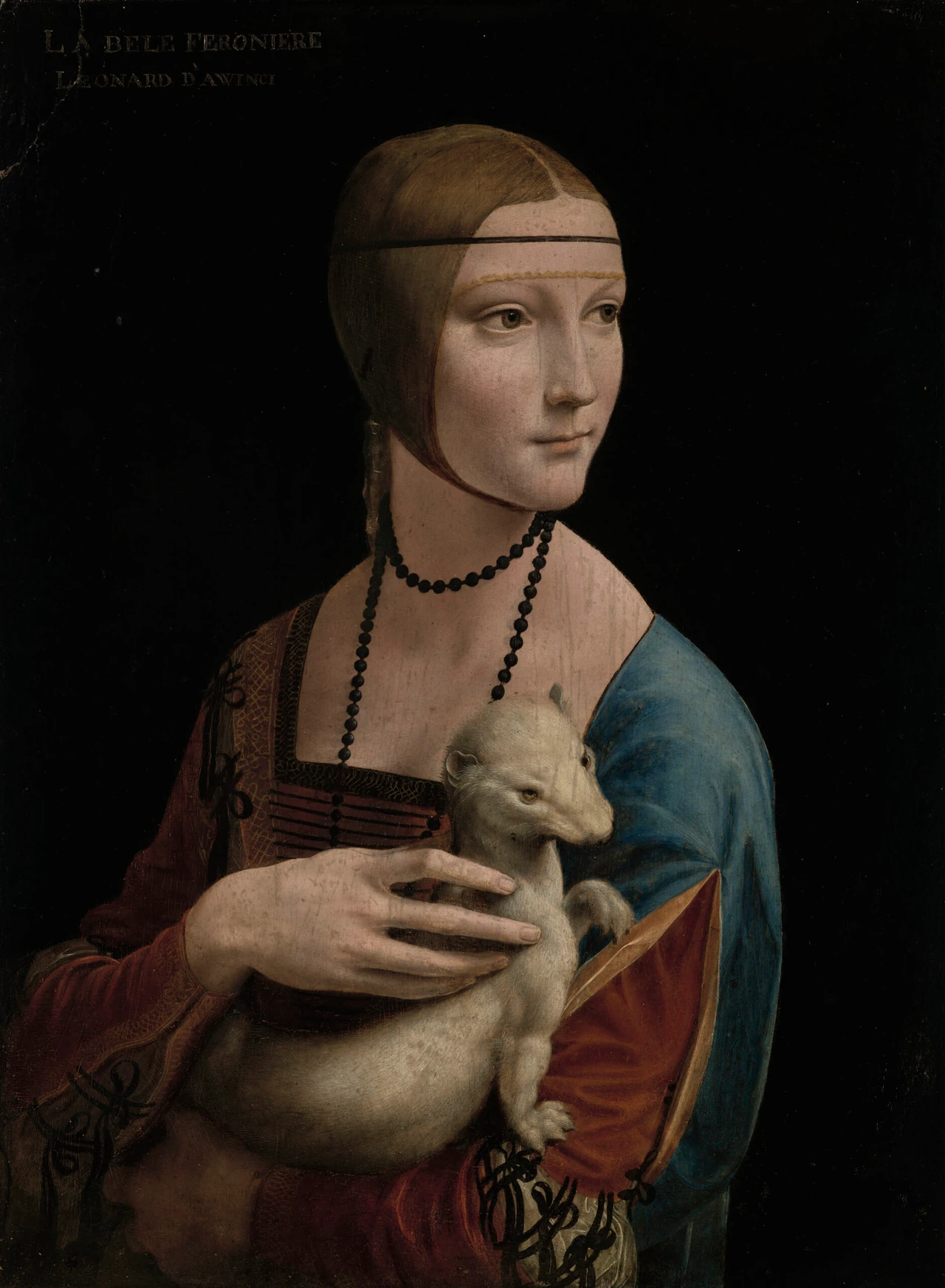
Cecilia’s body and face do not point in exactly the same direction. The turn creates a sense of attention to something beyond the picture. Her fingers stretch across the animal, while its small forepaw makes a much shorter gesture below. The long human hand and compact animal body establish different rhythms within the same narrow space.
The dark ground helps the pale face and fur register first. The blue sleeve then gives the lower-right area weight. A crop that keeps only the face can work as a clearly labelled detail, but it removes the visual conversation between the sitter and what she holds.
The animal’s head repeats Cecilia’s direction of attention without exactly repeating her expression. Her fingers extend almost horizontally; its neck rises between them. These connections make a practical test for a crop: can a viewer still understand what the hand touches and where both heads are looking?
The museum identifies the black background as nineteenth-century repainting. That does not supply the missing information needed to replace it. An invented room would be a reconstruction, not something recovered from these pixels, and should not be passed off as the museum’s photograph.
What has expired and what is separate
Leonardo died in 1519. The ordinary life-plus-seventy author terms described by the EU and UK have elapsed. No fresh term in Leonardo’s authorship begins because a reproduction appears in a recent catalogue.
That does not make the catalogue’s writing, page design or another photographer’s creative contribution yours to copy. The original painting and the material surrounding it are separate subjects of enquiry. Likewise, permission to reproduce an image is not permission to claim that the museum recommends your shop or has authenticated your print.
A useful label is therefore more specific than “copyright-free Leonardo”. Identify the old work, then identify the file. In this case there is a particularly helpful answer to the second question: the supplying museum has attached an explicit open designation to its own collection page.
The museum’s exact CC0 image
The institutional page’s copyright field reads CC0 – Public domain. Our illustration uses its supplied portrait, not a search-engine thumbnail or a different photograph with a borrowed licence label.
CC0 is designed to waive copyright and related rights to the extent the person applying it can do so. It permits reuse without attribution as a copyright condition, but does not warrant every possible right or endorsement. Giving a clear collection credit remains useful even where it is not required by that instrument.
A sensible credit names Leonardo da Vinci; Lady with an Ermine; about 1490; National Museum in Kraków, Czartoryski Museum; MNK XII-209; CC0. A link back to the exact page lets another reader verify which work and image you mean.
Save the source and the checked terms with the downloaded file. If you later replace the image with a paid agency photograph, the old CC0 note does not automatically accompany that replacement. Follow the provenance of the pixels you actually use.
A 1903 print is evidence, not a shortcut
The museum separately catalogues a 1903 print after Leonardo by Franciszek Siedlecki, accession MNK XV-R.-3722, made using mezzotint and etching. The print’s own record is a useful historical lead, but it is not a second accession number for the painting or the source of our colour illustration.
For U.S. analysis, the Copyright Office distinguishes public display from publication; authorised sale or distribution can be relevant. The existence of a dated reproductive print invites investigation of its issuance and authorisation. It does not let this guide silently certify those facts.
The U.S. duration rules include different treatment of older published and previously unpublished works. We have not closed that historical branch independently. The museum’s present CC0 image statement is reported on its own terms, not disguised as evidence of when Leonardo’s painting was first legally published.
How to present the portrait accurately
Keep the slender vertical format when presenting the full work. A tight square tends to remove the lower animal and much of the hand, while an automatic face-centred crop can leave the ermine looking like an unexplained fragment. If the design needs that shape, say “detail” and choose the crop deliberately.
Do not erase the visible inscription, darken away surface marks or manufacture extra fur merely to make a reproduction look cleaner. These changes can alter the historical appearance represented by the source. A useful editorial image should help a reader recognise the painting, not conceal what the source actually shows.
For a physical print, test the file at the intended size. Small skin tones and dark transitions can merge differently on paper than on a bright screen. Inspect a sample rather than treating a large pixel count as a promise of colour accuracy.
Before you reuse it
Start with the museum’s identified image, preserve its source record, and separate your own design changes from the historical work. If you crop or add typography, describe the result honestly without suggesting museum approval.
For this file, follow the identified CC0 release and its limits. A different file or a project needing an independent jurisdiction-specific rights opinion deserves its own check; the title alone is not the permission.
Editorial record
About this article
- Author
- Publisher
- GeMarkt
- Published
- Reviewed
- Internal source & rights check. Conducted by GeMarkt Research Review. This is an internal editorial check—not independent peer review.
- Source standard
- Rights guide source standardSeparates the underlying work from the source file, records the review date, and links the evidence used for the conclusion.
Found a claim that needs checking? Report a factual error.