Is Leonardo da Vinci's art public domain? A collector's guide
Leonardo died in 1519, before modern copyright existed. Learn why digital files still matter and how the 1911 Mona Lisa theft and a $450 million sale shaped his fame.
From the guide to the collection
Explore the da Vinci collection → · Shop all art → · Free da Vinci wallpapers — the complete paintings at 4K ↓
From the studioda Vinci prints — 250+ restored works, curated and annotated →
Fewer than twenty paintings
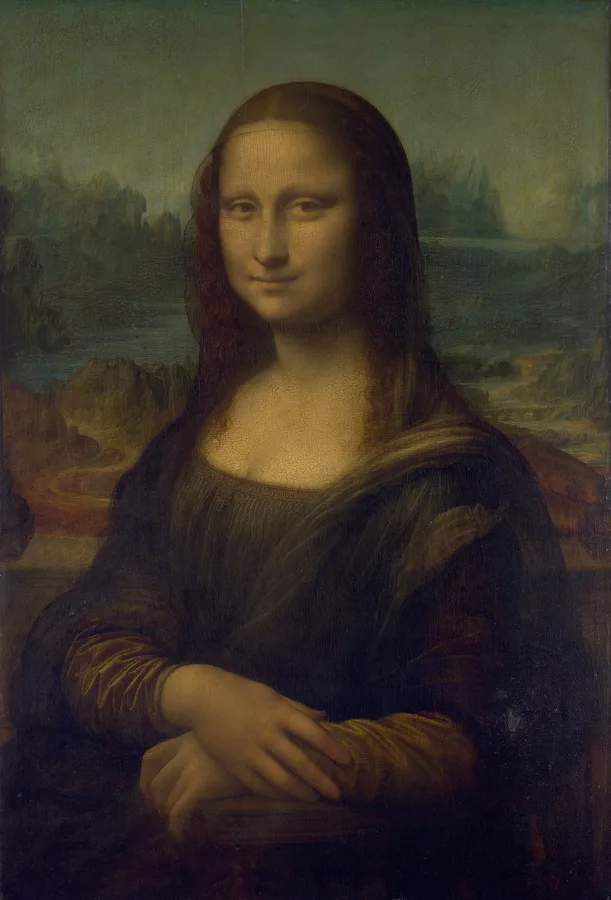
Leonardo da Vinci was born on 15 April 1452 in the Tuscan hill town of Vinci and died on 2 May 1519 at Clos Lucé, a manor beside the royal château of Amboise in France. He had lived there since late 1516 as the guest of King Francis I, and he did not arrive empty-handed: in his luggage were the Mona Lisa, the Saint John the Baptist, and The Virgin and Child with Saint Anne — panels he kept beside him to the end, which is why the most famous Italian painting on earth hangs in Paris rather than Florence.
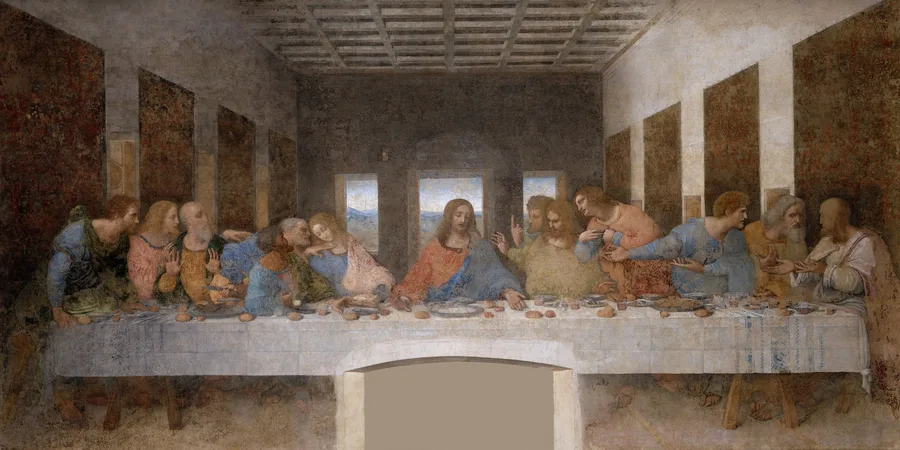
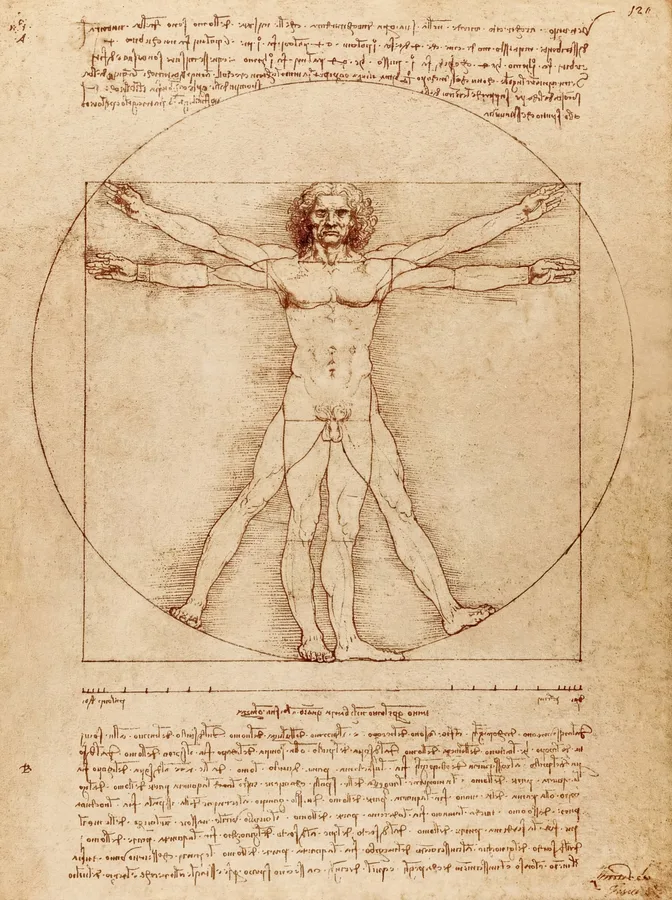
For a figure of his stature, the surviving catalogue is startlingly small. Fewer than twenty paintings are generally attributed to him; the Leonardo scholar Martin Kemp puts the ceiling at about twenty, and only a handful are beyond dispute. He experimented, revised, abandoned. The Last Supper began decaying within his own lifetime because he painted it on a dry wall rather than in true fresco — a visitor noted as early as 1517 that it was already failing. Against this scarcity stand the notebooks: roughly seven thousand pages survive, written in his mirror hand, covering anatomy, water, flight, and the geometry that produced the Vitruvian Man of about 1490, a sheet that is half drawing and half text.
A theft and an auction
Two modern stories explain the shape of his fame.
On 21 August 1911, Vincenzo Peruggia, a former Louvre workman who had helped build protective cases for the museum’s paintings, walked out of the closed galleries with the Mona Lisa under his smock. The painting was already admired; it was not yet the most famous picture in the world. Two years of headlines, a wall left conspicuously bare, and a recovery in Florence in December 1913 — Peruggia was caught when he offered the panel to the art dealer Alfredo Geri — completed the transformation. Peruggia claimed he was repatriating a work Napoleon had looted. In fact, Leonardo himself had carried it to France, and the French crown had acquired it honestly.
The second story is recent. On 15 November 2017, Salvator Mundi, a rediscovered and heavily restored painting attributed to Leonardo, sold at Christie’s in New York for 450.3 million dollars — the highest price ever paid for a work of art at auction. Whatever one makes of the attribution debate, the number tells you what the market believes a Leonardo is worth.
Is Leonardo’s art public domain?
Yes — and in the purest way any artist’s work can be.
The world’s first copyright statute, Britain’s Statute of Anne, came into force in 1710. Leonardo had been dead for 191 years by then. His work did not “enter” the public domain, because there was never a copyright to expire: he predates the entire system. Everything he made has been free to copy since the day he made it.
The modern rules only confirm this. Most of the world protects works for the life of the author plus seventy years; for a man who died in 1519, that clock — if you insist on running it at all — stopped in 1589. The United States measures older works by publication date instead, placing works published more than ninety-five years ago in the public domain; nothing in Leonardo’s catalogue comes anywhere near the line. Under both major systems, in every country, the answer is the same.
One honest caveat belongs here. Copyright terms vary by country and are occasionally revised, and this page is general information, not legal advice. For Leonardo the conclusion is not in doubt anywhere, but the principle matters when you look at artists who died within living memory.
The oldest master, the newest question
Because nothing about the paintings is contested, the interesting question for a collector is entirely modern: not the painting, but the file.
A five-hundred-year-old panel being public domain does not mean every digital image of it is free. Museums and image libraries sometimes assert rights, or attach contractual terms, to their photographs of public-domain works. In the United States, a federal court addressed this directly in Bridgeman Art Library v. Corel (1999), holding that a faithful photographic copy of a public-domain painting lacks the originality copyright requires — the photograph adds nothing new, so no new right arises. The decision came from a district court rather than the Supreme Court, but it has been widely followed, and it became the legal backbone of the open-access movement that has since led many museums to release their collections freely. Outside the US the picture is less uniform, and some institutions still press claims over their images.
That is why the provenance of a file matters as much as the status of the artwork. The restorations we sell are our own work, and we verify the rights status of every individual piece before it is listed — the artwork and the source both. With Leonardo, the artwork half of that check is the easiest in the catalogue; the file half is where the care goes.
Leonardo in our collection
Our da Vinci collection holds over 250 restored works — the paintings, but above all the drawings and notebook pages, because that is where most of Leonardo actually survives. The Mona Lisa is here with the amber of three centuries of varnish eased back, so the blue-green of the valley behind her can breathe again. The Vitruvian Man — kept in the dark in Venice and exhibited only rarely — is restored with the mirror writing above and below the figure fully legible, because the sheet deserves to be read as well as looked at. The red-chalk Self-Portrait of about 1512, in person a field of brown foxing, comes back as the textured drawing it is. And the Saint John the Baptist, the painting he kept beside him until the end, holds its single slow fade out of the dark.
Every piece comes in the same four formats: rolled poster, stretched canvas, framed canvas, and framed paper print. The rolled poster suits collectors who already have a framer they trust; the framed options arrive ready to hang.
No artist’s work belongs to everyone more securely than Leonardo’s — it was free for five hundred years before “free” needed a legal definition. Browse the da Vinci collection: twelve works chosen and annotated by the studio, and a door to the other 250-plus behind them.
Editorial record
About this article
- Publisher
- GeMarkt
- Published
Found a claim that needs checking? Report a factual error.