GeMarkt Blog · Reference
Are Haeckel’s Kunstformen der Natur Plates Public Domain?
The original Haeckel plates are out of copyright in the US and ordinary life-plus-70 systems. Check the edition, lithographer and exact library scan.

The short answer
Yes: the historical illustrations issued in Ernst Haeckel’s Kunstformen der Natur in 1899–1904 are out of copyright in the United States and under the ordinary EU and UK life-plus-70 rules. That answer concerns the original published plates, not every modern book, translation or digitally altered design carrying the title.
The examples here are plates 8 and 1 from ETH-Bibliothek Zürich’s copy, Rar 10308, supplied through e-rara with a Public Domain Mark. The records were checked on 12 October 2026. For a different scan or edition, retain the same distinction: identify the old illustration first, then check the file you actually intend to use.
Start with the published book
The ETH library record describes a two-volume work published in Leipzig and Vienna by the Bibliographisches Institut, 1899–1904. These are publication dates for an illustrated book, not a guess based on when an artist might have drawn a jellyfish.
Our main image is labelled Tafel 8 — Desmonema. The bottom caption places it within Discomedusae. The second example is Tafel 1 — Circogonia, with Phaeodaria printed below. A scan counter in a digital viewer is not necessarily the printed plate number: covers, text leaves and blank pages are counted too.
For a reliable reference, retain the plate title, number and library shelfmark together. “Haeckel sea life” is a useful search phrase, but it cannot distinguish an original plate from a later collage that combines organisms taken from several pages.
The Haeckel artist guide covers the wider body of work. This article concerns this particular publication and these identifiable examples.
Read the jellyfish plate before cropping it
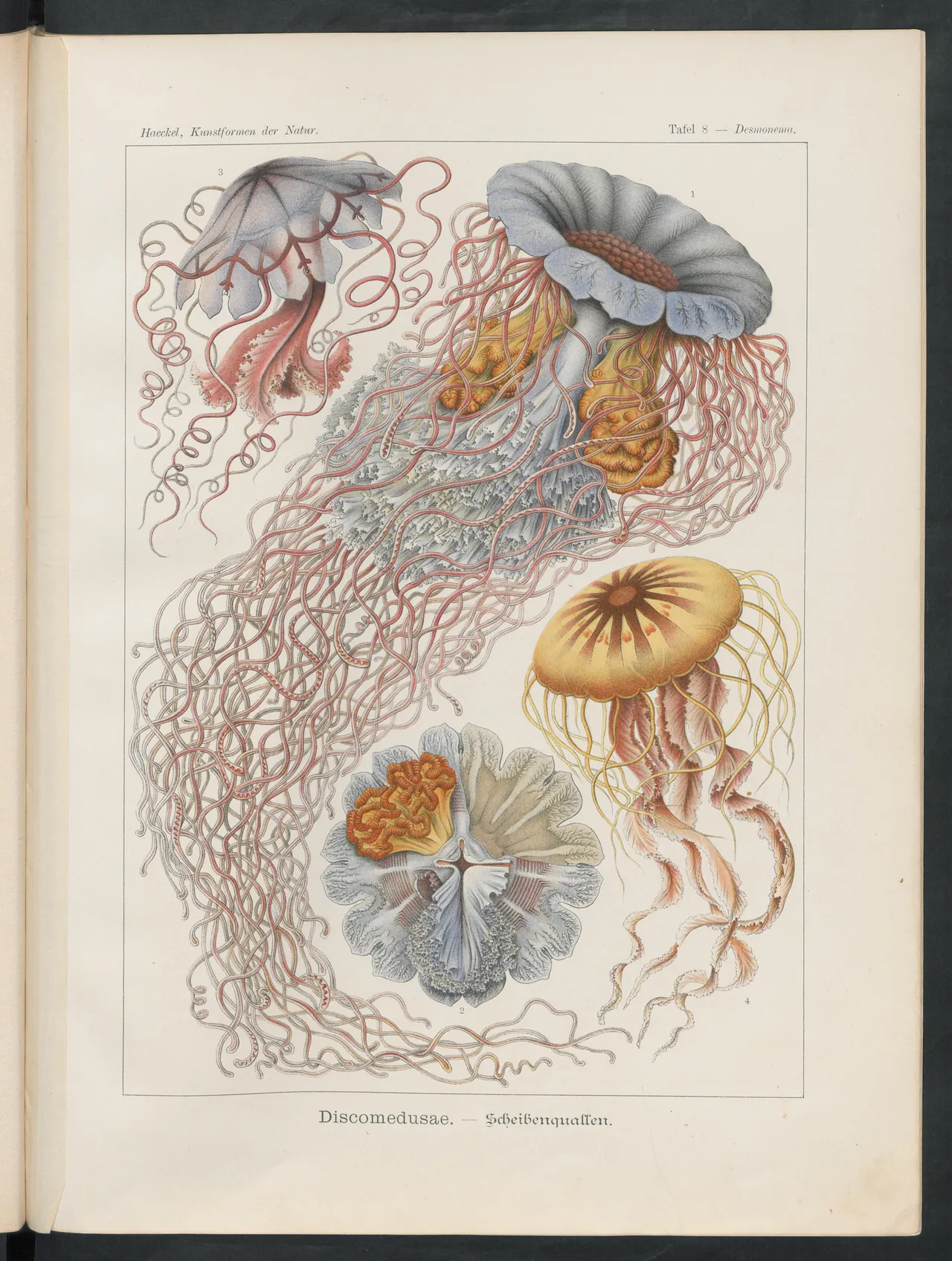
The two large forms at the top send their tentacles through most of the page. A smaller yellow form occupies the right-hand side; another view opens towards us near the bottom. The composition is crowded with fine lines, yet each body remains distinct.
Look at the numbers beside the figures. They connect the illustrations to explanations rather than merely decorating a poster. Removing them may be acceptable for a clearly described decorative adaptation, but it makes the result less useful as a reproduction of the historical scientific plate.
The paper surrounding the image also does work. It separates the curling tentacles from the edge of the sheet and leaves space for the title and classification. A tight square crop may remove the longest lines while making the jellyfish look abruptly cut off. Test the whole composition before deciding that its margins are wasted space.
These observations concern what is visible in this copy. They do not certify that every historical classification or anatomical interpretation remains accepted by scientists today.
Haeckel was not the only contributor
The book’s digitised historical text credits Adolf Giltsch for its skilled visual execution. Treating the plates simply as pictures “painted by Haeckel” loses the printmaker’s contribution. Haeckel’s authorship, the translation of drawings into printable images and the later scanning of a bound copy are different stages.
Haeckel died in 1919. The University of Jena’s primary bibliography records his obituary for Giltsch in 1911. Neither contributor creates a surviving ordinary life-plus-70 term in 2026. The EU and UK explain that ordinary author-based duration.
A practical credit can therefore name Haeckel, acknowledge Giltsch’s printmaking role, identify the plate and give the holding library. That is more informative than naming a modern download website as though it had created the organism design.
What the publication dates establish
For these plates, there is an issued historical book to identify. That makes the U.S. analysis different from a painting known only to have existed or been exhibited before 1931. The old published illustrations are well beyond the maximum ordinary 95-year published-work term described in the U.S. Copyright Office’s duration guidance.
This conclusion is about the historical edition’s content. A recent introduction, translated commentary or newly drawn diagram is not made equally old by being bound next to it. Nor does a library’s recent digitisation date restart the publication date of the original plate.
There is no reason to replace these distinct dates with one misleading label. “Published 1899–1904; digitised copy supplied by ETH” explains the relationship far better than either “copyright 1904” or “created online in 2017”.
The library scan has its own record
ETH’s title record applies the Public Domain Mark and permits free download. It asks users reproducing the material to provide the source, author, location and persistent identifier, and to notify the holding institution or provide a copy of the resulting publication.
The mark describes the material as free of known copyright restrictions; it is not the same instrument as a CC0 dedication. It also does not mean that a different archive’s download conditions have been checked. Keep the ETH record with the image obtained from ETH.
The illustrations here preserve the supplied page rather than reconstructing the animals against a new background. That lets you see the plate number, the printed lettering and the particular book’s paper. A cleaner-looking file elsewhere might be useful, but it needs its own source history.
Do not mistake a new edition for the old one
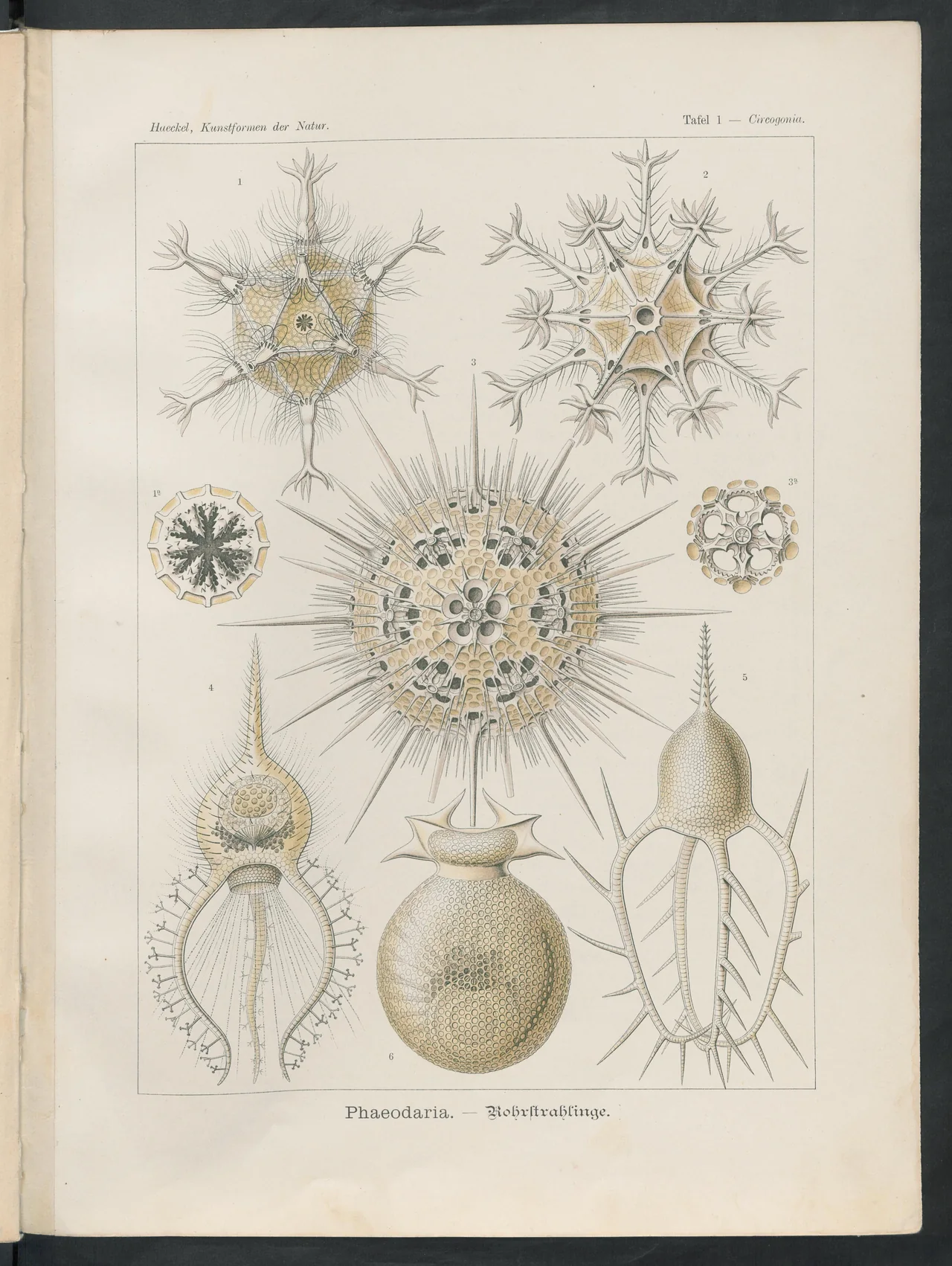
On this sheet, the central form is surrounded by smaller organisms and enlarged details. Their different sizes help the page remain legible; they should not automatically be interpreted as a shared scale. A contemporary designer might isolate one form, replace the paper tone and arrange a repeat pattern. That result is an adaptation, not an untouched historical plate.
When choosing a file, compare its edges and labels with the library image. Are the figure numbers still present? Has the background been replaced? Have spines or tentacles disappeared? Has a publisher added new names or a new key? These visible differences tell you what you are acquiring, even before any legal question arises.
Using the plates without losing their meaning
For an article or classroom handout, show the relevant plate beside the discussion and link its original record. For a decorative print, decide whether you want the entire historical sheet or an explicitly identified detail. Do not advertise a cropped detail as a complete facsimile.
Keep an untouched source file before making changes. Record the plate number, book dates, shelfmark, source link and rights statement. A thumbnail suitable for a web page is not necessarily adequate for a large physical print; check fine tentacles and lettering at the intended output size.
The useful answer is therefore quite direct: the original published plates can be reused as public-domain historical content, and this particular library source makes its status clear. Preserve the evidence and describe any adaptation honestly. Neither public-domain status nor visual beauty turns a historical scientific illustration into a current identification guide or an endorsement by the holding library.
Editorial record
About this article
- Author
- Publisher
- GeMarkt
- Published
- Reviewed
- Internal source & rights check. Conducted by GeMarkt Research Review. This is an internal editorial check—not independent peer review.
- Source standard
- Rights guide source standardSeparates the underlying work from the source file, records the review date, and links the evidence used for the conclusion.
Found a claim that needs checking? Report a factual error.