GeMarkt Blog · Reference
Is Interior with Young Woman Seen from the Back Public Domain?
Identify Hammershøi’s Randers interior, distinguish its 1904 date from publication and check the source of the exact reproduction shown here.


The short answer
Hammershøi’s original painting is out of its ordinary Danish and UK author copyright terms. The particular reproduction shown here is marked public domain on Wikimedia Commons, but this guide does not independently close its U.S. publication history. A familiar artist, an old date and a downloadable museum picture are not interchangeable evidence.
Checked 12 October 2026, this answer concerns the painting in Randers Kunstmuseum, not another Hammershøi interior with a woman facing away. We identify the object first, then distinguish its copyright term from the assessment attached to the selected file.
The Randers painting rather than any quiet room
Randers Kunstmuseum titles the painting Interiør med ung kvinde set fra ryggen and dates it 1904. It is oil on canvas, 60.5 × 50.5 cm. The museum identifies the figure as Hammershøi’s wife, Ida, in their home at Strandgade 30, Copenhagen.
The Ny Carlsberg Foundation record gives the same dimensions and placement, while noting a dating of circa 1903–04. Its acquisition and placement dates belong to the work’s later history, not to the moment when it was painted. Both date forms can therefore appear in responsible captions without identifying two different pictures.
The useful visual identifiers are the dark dress, the blue-and-white covered vessel on the left, the cabinet and the cropped framed picture above. “Woman from behind” alone is not specific enough. Before adopting a source file, compare those details and the holding institution rather than relying on the English title’s spelling.
What the turned back does
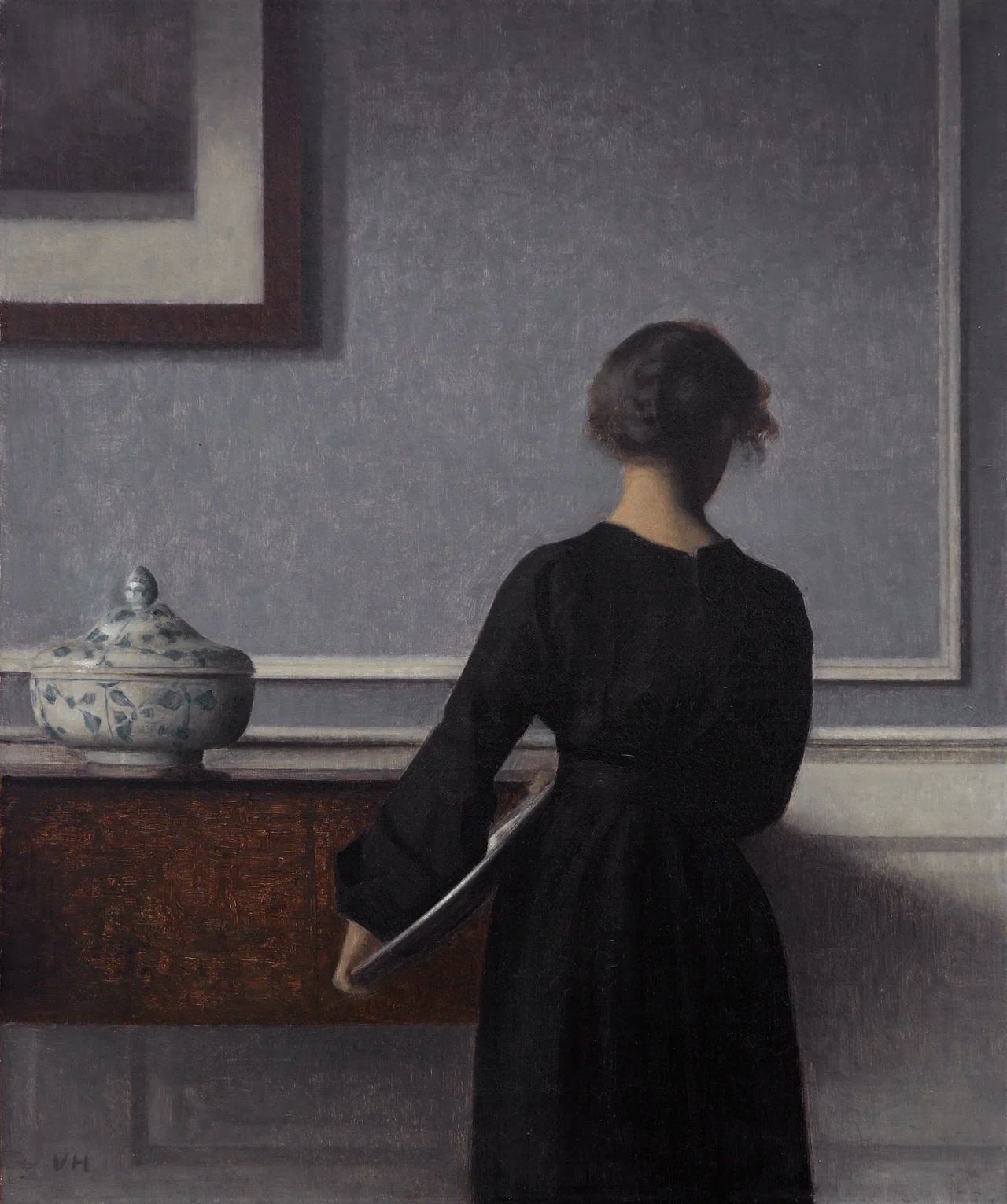
Ida is close enough for us to see the line of her neck and the shape of her hair, but her face remains inaccessible. The painting does not supply the expression that a conventional portrait would use to invite a story. Her position creates intimacy without giving the viewer complete access.
Follow the outline of the dress. The narrow waist, bent arm and widening skirt form a sequence of curves against the straight mouldings. A pale edge running diagonally near her arm catches attention without fully explaining what she is doing. It is possible to look closely while leaving the action unresolved.
That restraint matters in a caption. “A woman pauses beside a cabinet” describes what the picture makes available. “A lonely wife waits for her absent husband” invents a situation and an emotion. The second may sound more dramatic, but the turned back is not evidence for it. A useful reproduction allows ambiguity to remain visible.
The room is not colourless
The walls are grey, but the image is not black and white. Brown appears in the cabinet, blue in the porcelain and warm colour in the exposed skin. These small differences are easier to see once the dark dress stops dominating the first impression.
The covered vessel is particularly important. Its rounded body and lid make a second cluster of curves beside the figure. It is light where her dress is dark, and patterned where the room is sparse. Removing it in a narrow crop leaves the woman against an almost abstract wall and changes the balance of the composition.
The framed picture in the upper left is already cut by the painting’s boundary. Its rectangular bands answer the wall mouldings, while its darkness echoes the dress. The composition is built from these relationships rather than from an inventory of expensive objects. A reproduction does not need a more dramatic colour palette to make them work.
For this reason, be cautious with versions advertised as brightened or modernised. Raising every dark area can weaken the figure; neutralising every warm note can erase the differences between skin, wood and wall. If you want a deliberately monochrome adaptation, label it as one rather than presenting it as the museum’s colour record.
Denmark, the UK and the original painting
Hammershøi died in 1916. Denmark’s ordinary economic author term runs for 70 years after the death year, so that calculation for his own authorship has expired. The Danish Copyright Act, section 63, supplies the term; the ordinary UK framework also no longer protects this painting through his author term.
The Danish statute additionally distinguishes a photograph from the depicted work. Its section 70(4) excludes the special photographic-image protection where the main subject is a visual artwork whose protection has expired. That is relevant to faithful reproductions, but is not a reason to ignore original additions, contracts or the rules of a different country.
An old painting can also appear inside a contemporary museum-room photograph. Lighting, visitors, surrounding objects and a photographer’s composition may introduce a different question from a flat reproduction of the canvas. Decide which image you are actually using before treating these situations as equivalent.
Why 1904 does not settle the U.S. question
Painting, purchasing and exhibiting an object are different events from publishing reproductions of it. A collection record can reliably establish the first three while leaving the fourth unclear. Neither the 1904 date nor the later foundation acquisition should be silently relabelled “first publication”.
For U.S. purposes, older published works and previously unpublished works can follow different rules, including special treatment for certain later publications. See the Copyright Office’s duration provisions. This is why the independent publication check remains separate from the Danish author-term calculation.
The selected Commons page asserts publication or registration before 1931. An exact early reproduction and its relevant authorisation have not been independently established for this guide. A rights record for another Hammershøi interior cannot fill that gap, even if its subject and date are similar. The practical result is a bounded country-and-file answer, not a new worldwide clearance certificate.
What the selected image record does and does not say
The Commons file page describes the image as a faithful reproduction and applies a Public Domain Mark assessment. Its current high-resolution upload dates from 2013; the source notes point to an older Danish government art page and another historical web reference. These are file-history details, not proof of the painting’s first publication.
We use that specific reproduction, with its assessment clearly attributed to Commons. We do not describe it as a newly granted Randers commercial licence, or suggest that every photograph on the museum’s website carries the same terms. The museum record establishes the painting’s identity; the file page records the basis on which this particular reproduction is supplied.
Keeping these references together helps prevent a common mistake: replacing a small open image with a larger, unrelated photograph while retaining the old credit. A better-looking file may have a different maker, crop or permission. Its extra pixels do not transfer the first file’s terms to it.
Using the picture without inventing a story
For a reading illustration, preserve enough of the room to explain how the figure relates to it. A detail of the neck or porcelain can support a specific observation, but should be named as a detail. The whole image remains important when the subject is the painting’s balance rather than one motif.
For a printed reproduction, compare the selected file’s tonal detail at the intended size before ordering. A dark picture can look attractive as a small screen image yet lose the distinctions within the dress when enlarged or printed. That is a production check, separate from whether the historical artwork may be reused.
Credit Hammershøi, identify the Randers painting and keep the actual file source attached. Our Hammershøi artist guide covers other interiors with different records. The best answer for this one preserves its specificity: a particular woman, room, canvas and reproduction, rather than a generic promise about all quiet interiors.
Editorial record
About this article
- Author
- Publisher
- GeMarkt
- Published
- Reviewed
- Internal source & rights check. Conducted by GeMarkt Research Review. This is an internal editorial check—not independent peer review.
- Source standard
- Rights guide source standardSeparates the underlying work from the source file, records the review date, and links the evidence used for the conclusion.
Found a claim that needs checking? Report a factual error.