GeMarkt Blog · Practical guide
Is Vilhelm Hammershøi’s Art Public Domain? Rooms, Light and Image Sources
Compare Hammershøi’s moonlit and sunlit rooms through exact Met and SMK images, with twelve object records and separate checks for country, publication and file.
Rights check · reviewed
The short answer
The Met supplies Moonlight, Strandgade 30 under CC0; SMK designates Interior in Strandgade, Sunlight on the Floor with the Public Domain Mark. Hammershøi’s ordinary EU/UK author term has elapsed, but this guide does not independently establish U.S. publication histories or clear every reproduction.
| What is being checked | Result | Why |
|---|---|---|
| European Union — ordinary author term | Ordinary named-artist term has elapsed | Hammershøi died in 1916; the ordinary life-plus-70 author term has elapsed. National exceptions, moral rights, later first-publication rights and other contributors remain separate. |
| United Kingdom — ordinary artistic-work term | Ordinary artist term has elapsed | This is the ordinary artistic-work term, not clearance of specific older unpublished material or another contributor’s work. |
| United States — independent publication history | Publication remains work-specific | This guide does not independently establish U.S. publication histories for either displayed painting or the remaining research objects. The exact providers’ designations are attributed; creation and death dates do not replace that evidence. |
| Selected digital files | One Met CC0 and one SMK PDM image | Met 2012.203, Moonlight, Strandgade 30 (1900–1906), and SMK KMS3696, Interior in Strandgade, Sunlight on the Floor (1901), are exact preserved sources. SMK’s source is its official proportional 1600px IIIF derivative, not a claimed original-size scan. |
| Other works and files | Ten records remain display HOLDs | The other SMK records have institutional PDM designations, but no local source image was acquired and reviewed for this guide. HOLD is not a declaration that the underlying painting is protected. The matrix is not twelve independently cleared U.S. publication chains. |
Twelve exact painting records; two displayed museum files and ten display HOLDs. Similar translated room titles are distinguished by date and accession. SMK’s Public Domain Mark is not CC0; no worldwide or catalogue-wide permission is claimed.
This is a documented research summary, not legal advice. Copyright and moral-rights rules can vary by country and by the history of a particular work.

What we’ll look at
Which Hammershøi room and which reproduction are you looking at?
Short answer: The two Hammershøi paintings illustrated here have openly designated museum files: Moonlight, Strandgade 30 from the Met under CC0, and Interior in Strandgade, Sunlight on the Floor from SMK under the Public Domain Mark. His ordinary EU and UK author term has elapsed. This guide does not independently establish the paintings’ U.S. publication histories or clear every Hammershøi reproduction.
With this artist, identifying the picture can be half the work. Search for “Hammershøi interior” and you meet pale doors, empty floors and women facing away. Similar subjects—and translated titles that sound almost interchangeable—can conceal quite different paintings. Start with the room, then confirm its date and museum accession number.
The room is the subject
Vilhelm Hammershøi lived from 1864 to 1916. He made the Copenhagen homes he shared with his wife, Ida, into recurring subjects. SMK’s account of the sunlit interior explains that the apartments served as both home and studio. Strandgade 30 supplied many of the rooms now associated with his work.
These interiors do not require a hidden story to hold your attention. A door can interrupt a wall; a window can turn daylight into a grid; a person can block your view without making eye contact. The paintings ask you to notice the distances between things.
They also reward looking past the idea that grey means colourless. A warm floor, a cooler wall and the almost-white edge of a door may sit very close in tone while remaining distinct. If a reproduction turns everything into flat beige, you lose much of what makes the room convincing.
Moonlight without a figure
The opening image is the Met’s Moonlight, Strandgade 30, accession 2012.203. The museum dates it 1900–1906, not to one certain year. It is an oil painting measuring 41 by 51.1 centimetres: an intimate object rather than a room-sized canvas.
Look first at the window on the left. Its bars reappear as light and shadow on the floor. The closed door on the right offers another rectangle, but one that you cannot see through. Between them, the wall seems spacious precisely because so little occupies it.
The colours are subdued without being neutral. Lavender-grey passages sit beside browner floorboards; white woodwork catches small changes in illumination. The brightest shapes do not form one continuous spotlight. They are interrupted, broken and softened, which makes the air feel different from a brightly photographed rental apartment.
No person tells you how to interpret the room. That absence can feel peaceful, expectant or unsettling, depending on the viewer. It is not evidence that the artist was describing a particular tragedy or diagnosis. The painting gives us a carefully arranged interior; it does not hand over its occupants’ private thoughts.
Keeping the full width matters. A square crop would squeeze the interval between window and door. Those apparently uneventful stretches of floor and wall are part of the subject, not spare space awaiting decoration.
Sunlight and a turned back
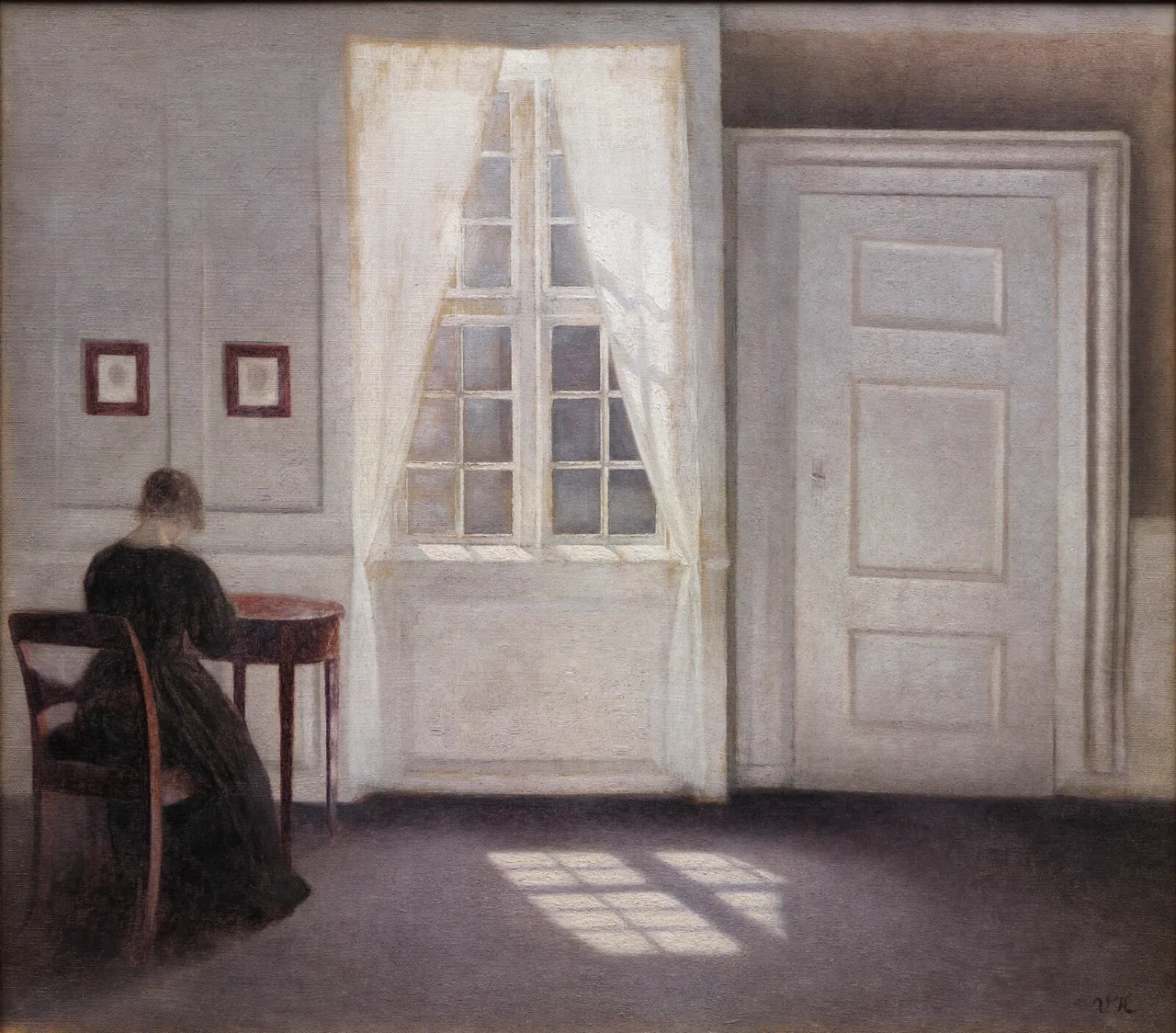
Vilhelm Hammershøi, Interior in Strandgade, Sunlight on the Floor, 1901. SMK — National Gallery of Denmark, KMS3696. Exact museum record and Public Domain Mark.
Here the windows are softened by light curtains, and there is someone in the room. SMK identifies the seated woman as Ida. Her turned back prevents the picture from becoming a conventional portrait built around a face and expression.
Compare her dark shape with the bright opening beside her. The figure anchors one side of the painting, while the diagonal light reaches into the open floor. A round table interrupts the many straight lines. The few pictures on the wall stay small enough not to become pictures within the picture that demand separate attention.
You can recognise furniture and architecture while remaining unsure what Ida holds or thinks. Leaving that question open is more faithful to the visible evidence than inventing a letter, an argument or a specific emotion. The private activity matters partly because we cannot fully join it.
The painting measures 46.5 by 52 centimetres. Its proportions are close to square, but not square. Compare that shape with the wider Moonlight: the two should not be stretched to fit identical openings in a frame simply because both are called interiors.
Twelve specific paintings
These records extend the view beyond two familiar rooms. Only the two images above are supplied in this guide; the remaining ten are linked research examples, not a package of reviewed downloads. English titles follow the collections’ records, which may change their translations over time.
| Painting | Date | Exact record |
|---|---|---|
| Moonlight, Strandgade 30 | 1900–1906 | Met 2012.203 |
| Interior in Strandgade, Sunlight on the Floor | 1901 | SMK KMS3696 |
| A Room in the Artist’s Home in Strandgade, Copenhagen, with the Artist’s Wife | 1902 | SMK KMS3697 |
| Evening in the Drawing Room | 1904 | SMK KMS6658 |
| Interior. Artificial Light | 1909 | SMK KMS8677 |
| Ida Hammershøi, the Artist’s Wife, with a Teacup | 1907 | SMK KMS3352 |
| Self-Portrait. The Cottage Spurveskjul at Sorgenfri, North of Copenhagen | 1911 | SMK KMS3351 |
| Self-Portrait | 1890 | SMK KMS6692 |
| A Wing of Christiansborg Palace | 1907 | SMK KMS2052 |
| View of Christiansborg Palace. Late Autumn | 1890–1892 | SMK KMS6750 |
| From Christianshavn’s Canal, Copenhagen | 1905 | SMK KMS8415 |
| Near Fortunen, Jægersborg Deer Park, North of Copenhagen | 1901 | SMK KMS6990 |
An accession number prevents an important mistake: treating the 1901 and 1902 Strandgade pictures as different names for the same object. It also makes city views and portraits discoverable without forcing everything into the category of an empty room.
What public domain means here
Hammershøi’s ordinary life-plus-70 term has elapsed under the general EU and UK rules. That statement concerns the artist’s ordinary term, not every later contribution, unpublished-material exception or right attached to a new photograph.
In the United States, publication matters. The Copyright Office’s 2026 circular identifies the pre-January 1, 1931 U.S. publication cutoff. “Painted in 1901” is not proof of publication in 1901. The museum designations used here are attributed to the providers; this guide has not independently closed that historical chain for the twelve paintings.
The two file labels also mean different things. CC0 is a dedication or waiver tool; the Public Domain Mark identifies material believed free of known copyright restrictions. SMK’s PDM is not a CC0 licence, and neither label implies that a museum endorses a product made from its image.
Keep the light in the file
Choose an exact museum file rather than copying the first attractive thumbnail. Our Met image and SMK’s official 1600-pixel image derivative retain the complete supplied composition. They have not been brightened, extended or filled with generated detail.
For a print, inspect the pale curtain, floorboard edges and darkest doorway at your intended size. Heavy sharpening can outline gentle transitions; automatic contrast can turn a quiet room into a stark black-and-white design. Neither change recovers missing information.
Hammershøi’s appeal lies partly in those small distinctions. A good reproduction leaves room for them—and a good source record tells you exactly which room you are looking at.
Sources and review method
We checked the artist chronology against museum records, treated each named jurisdiction separately, and recorded the provider policy for the image set. These sources support the legal framework and artist dates used above; the source file for any individual image still needs its own record.
- Moonlight, Strandgade 30, 2012.203 — The Metropolitan Museum of Art. Exact 1900–1906 oil painting, dimensions, credit and CC0 source; broad date preserved.
- Interior in Strandgade, Sunlight on the Floor, KMS3696 — SMK — National Gallery of Denmark. 1901, dimensions, Ida’s identity, home/studio context and exact PDM link.
- KMS3696 official object metadata — SMK — National Gallery of Denmark. Accession, translated titles, physical dimensions, PDM and official IIIF image source.
- Public Domain Mark 1.0 — Creative Commons. Designation of known public-domain material, distinguished from a waiver.
- CC0 1.0 Universal — Creative Commons. Dedication or waiver tool; does not imply provider endorsement.
- Copyright in the EU — European Union, Your Europe. Ordinary life-plus-70 term; not worldwide clearance or every national exception.
- How long copyright lasts — UK Intellectual Property Office. Ordinary artistic-work term, with older-material and other-contributor questions kept separate.
- Duration of Copyright, Circular 15A, April 2026 — U.S. Copyright Office. Publication cutoff, renewal and conditional older-unpublished rules; creation date is not publication evidence.
Editorial record
About this article
- Author
- Publisher
- GeMarkt
- Published
- Reviewed
- Internal source & rights check. Conducted by GeMarkt Research Review. This is an internal editorial check—not independent peer review.
- Source standard
- Rights guide source standardSeparates the underlying work from the source file, records the review date, and links the evidence used for the conclusion.
Found a claim that needs checking? Report a factual error.