GeMarkt Blog · Reference
Is Impression, Sunrise by Claude Monet Public Domain?
Check the exact Marmottan painting, the limits of its 1874 exhibition history and a specific public-domain-labelled image before reusing Monet’s harbour scene.


The short answer
Monet’s ordinary economic copyright term has expired in the EU and UK, but “public domain” does not clear every photograph of Impression, Sunrise. The particular reproduction shown here has a Public Domain Mark on Wikimedia Commons; that page also lacks a completed U.S.-specific public-domain tag. We preserve that limitation rather than turning the label into worldwide permission.
This check, current to 12 October 2026, concerns the 1872 painting in the Musée Marmottan Monet, inventory 4014. It does not establish an independent U.S. publication history for the canvas. If that is essential to a commercial project, it remains a separate clearance question.
Which Impression, Sunrise?
The Marmottan’s object record identifies Impression, soleil levant, an oil painting of Le Havre. It dates the work to 1872, lists its current unframed dimensions as 50 × 65 cm, and records its donation in 1940. Those identifiers are more reliable than matching a download by its English title alone.
The museum connects the view to the Hôtel de l’Amirauté and describes the port’s working infrastructure. This is not an untouched stretch of sea: masts, cranes and industrial structures sit behind the small boats. The painting’s fame can make that distinction easy to miss.
Older catalogue information can differ. The museum-supplied Google Arts & Culture entry gives 48 × 63 cm. We follow the current museum notice without claiming to have resolved that measurement discrepancy. Neither measurement tells you the pixel dimensions of a downloadable image.
For the wider artist-level position, see our Monet public-domain guide. An answer about this harbour scene should not be applied automatically to every work, reproduction or modern publication bearing Monet’s name.
What the full picture shows
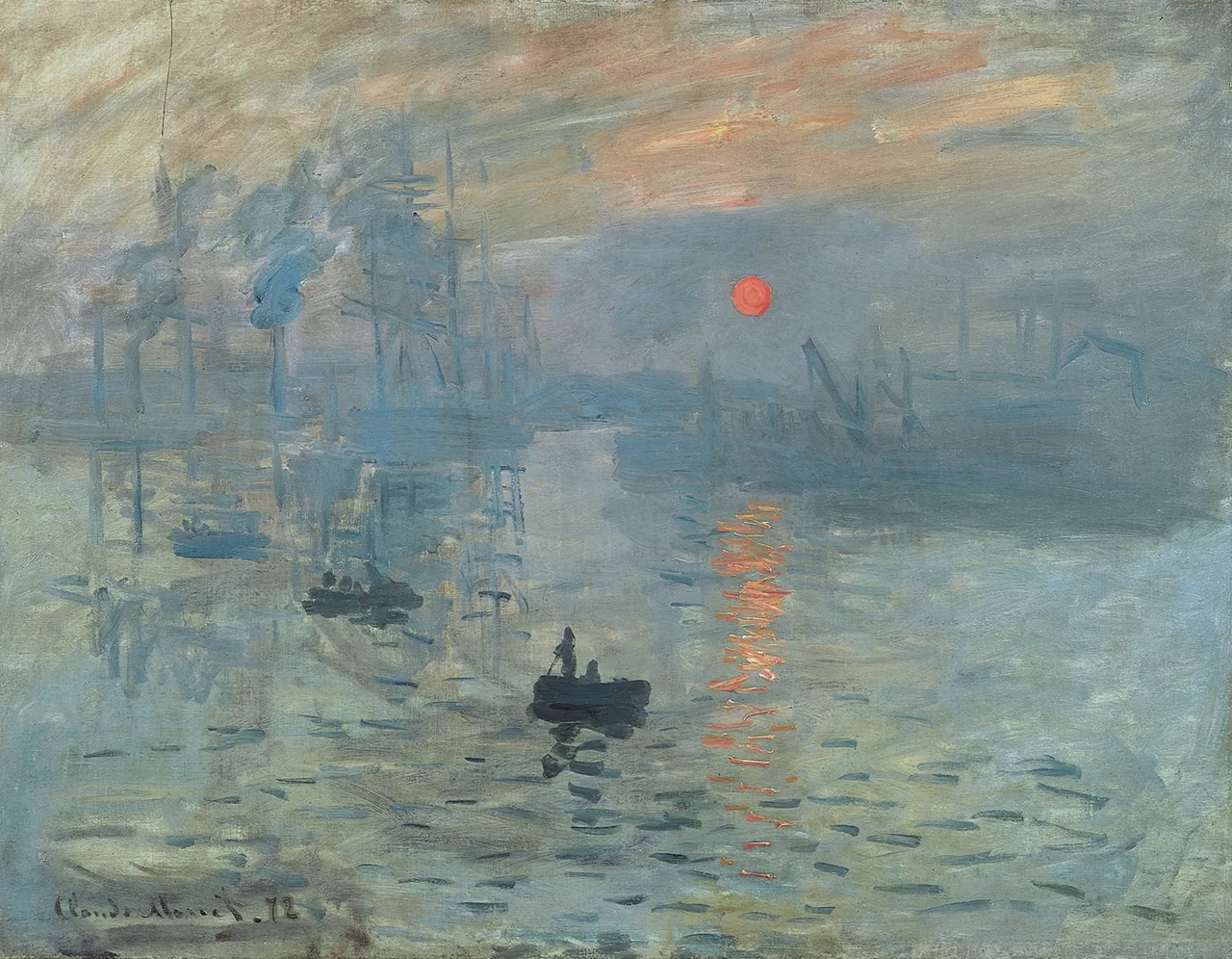
The orange sun is small. Its reflection is not a smooth stripe but a chain of separated strokes. Across the foreground, darker marks pull sideways through the water. The nearest boat interrupts that horizontal movement and gives the eye something solid to hold before it moves back into the haze.
The effect would be very different if the image were sharpened into crisp outlines. The distant structures are visible without becoming equally definite. You can follow their verticals, yet their edges keep dissolving into the surrounding blue and grey. That uneven clarity is part of what the picture presents, not simply a problem for a modern editor to repair.
A phone-shaped crop centred on the sun would remove much of the harbour and squeeze the distance between the boats and reflection. It might make a striking detail, but it would not show the whole painting. Label such a result as a detail, and retain access to the full composition when discussing Monet’s choices.
Monet’s copyright and the country question
Monet died in 1926, as recorded in the Marmottan’s collection overview. The ordinary author terms described by the EU and UK have elapsed. That supports a bounded answer about his original painting, not a claim that every possible right everywhere has disappeared.
A museum’s downloadable photograph, a photographer’s room view and a publisher’s illustrated page are different things. They can contain material beyond the underlying canvas. Nor does the end of the painter’s term imply an endorsement of a product or a right to use an institution’s logo.
Keep the question concrete: are you reproducing this painting, using a particular supplied image, or copying someone’s designed product? Those activities may look similar in a search result but do not share one automatically transferable permission statement.
What the 1874 exhibition does not prove
Marmottan documents the painting’s appearance in the 1874 exhibition at Nadar’s former premises, and the contemporary response to its title. That is important evidence about how the picture became associated with Impressionism. It is not, by itself, proof of the first qualifying publication of its image.
The U.S. Copyright Office distinguishes public display from publication. An authorised sale or distribution can matter; exhibition alone does not establish publication. This guide has not reconstructed which historical events qualify for this particular canvas.
U.S. duration provisions distinguish older published works from previously unpublished works. 1872 is a creation date, not a completed U.S. copyright calculation. A dated review naming a painting is also not automatically a reproduction of it.
This is a limit on the research claim, not an assertion that Monet’s painting is currently protected in the United States. If independent U.S. clearance is necessary, investigate its publication record directly rather than citing this article’s illustration as proof.
The exact image used here
Our illustration comes from this specific Commons file, whose source field identifies a Wartburg reproduction. The page applies Public Domain Mark 1.0, but explicitly calls for a U.S. public-domain tag. Its origin-country designation and that unresolved field must be read together.
The Public Domain Mark describes a copyright-status assessment; it is not a fresh licence from the Marmottan. We do not present this file as a museum CC0 release or as the RMN-credited photograph on the museum’s partner page.
If you obtain a different file through the Marmottan’s image service, assess that supply arrangement separately. A licence or status label belongs with the image it actually describes. Attaching the Commons credit to a different photograph would break the evidence chain.
Choosing a file without changing the painting
Before printing, inspect the actual downloaded pixels at the intended output size. The signature, pale water strokes and thin harbour structures are useful places to notice lost detail. A large file size alone does not guarantee a faithful or sufficiently detailed reproduction.
Compare the whole image, not just the brightest orange. Increasing saturation until the sun looks dramatic can also alter the surrounding water and sky. If a file needs extensive reconstruction to survive enlargement, a smaller reproduction may be a more honest choice.
Save the source page alongside your image, together with the date checked. Add your own output instructions separately. “Crop to a square” is a design decision; it is not a historical description of the painting or evidence that the supplied file carries broader rights.
A useful reuse decision
For an illustrated discussion, identify Monet, the title, date and collection, then state which exact reproduction you selected. For a commercial product, decide the intended territories and resolve the file’s remaining status questions before production.
The practical answer is therefore yes to expired ordinary author rights in the jurisdictions identified above; not an unqualified yes to any image found online. The painting, the historical publication evidence and the chosen digital file each need to remain visible in that decision.
Editorial record
About this article
- Author
- Publisher
- GeMarkt
- Published
- Reviewed
- Internal source & rights check. Conducted by GeMarkt Research Review. This is an internal editorial check—not independent peer review.
- Source standard
- Rights guide source standardSeparates the underlying work from the source file, records the review date, and links the evidence used for the conclusion.
Found a claim that needs checking? Report a factual error.