GeMarkt Blog · Reference
Is Girl with a Pearl Earring Public Domain?
Yes for Vermeer’s historical painting, but check the image you download. A guide to Mauritshuis 670, file permissions and the U.S. publication question.


The short answer
Yes: Vermeer’s historical Girl with a Pearl Earring is a public-domain artwork under the ordinary life-plus-70 author term. That does not make every photograph, film still or online download an unrestricted file. This guide concerns the painting of about 1665, Mauritshuis inventory 670, and the separately identified Commons reproduction shown above.
For the United States, Commons records a public-domain assessment. This guide does not independently establish the painting’s early authorised publication history. Keep that distinction if your project needs documented U.S. clearance rather than a provider’s assessment. The museum’s own download conditions also deserve a separate look: its current pages do not all describe commercial use in the same way.
Which girl and which picture
The Mauritshuis record identifies an oil on canvas, 44.5 × 39 cm. It calls the picture a tronie: a study of a character or type, rather than a conventional portrait identifying a named sitter. The young figure turns towards us in a blue-and-yellow head covering. The title describes the conspicuous earring, not a documented biography.
That matters when looking for an image. A photograph of an actor recreating this pose is a different work. So is an illustrator’s modern version with a telephone, sunglasses or newly invented clothes. Recognising the famous silhouette does not tell you who made the file or what rights attach to it.
For the painting’s story, see our Girl with a Pearl Earring article. Here the practical question is narrower: which image can you reproduce, on what basis, without confusing Vermeer’s painting with something made centuries later?
What the image needs to preserve
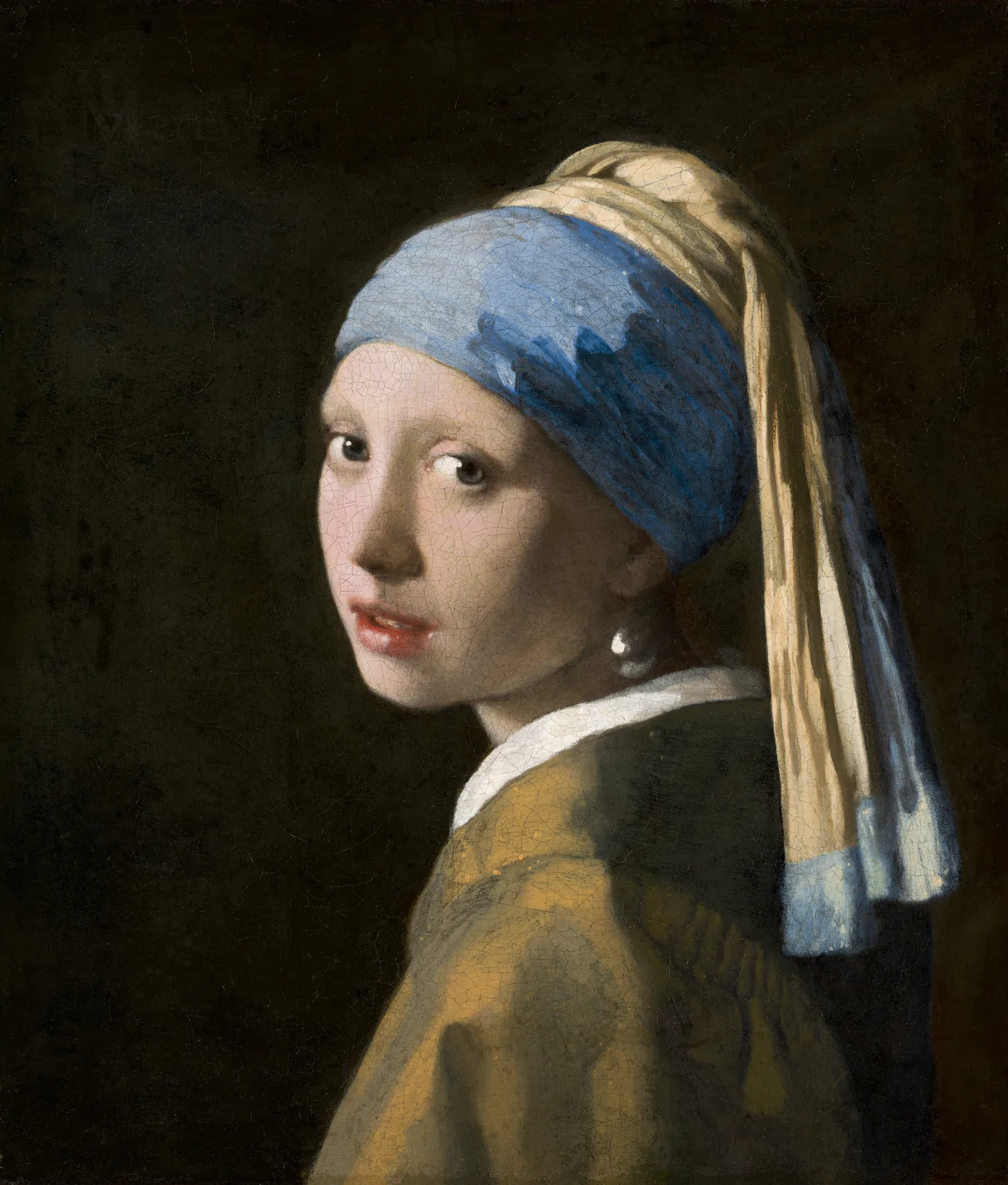
Look at the full reproduction before looking for a larger download. The shoulder turns away while the head turns back. A strip of white collar interrupts the warm fabric below the face. The earring sits between that bright collar and the shadow beside the jaw. Its effect depends on those neighbouring tones, not simply on being a white object.
The dark area around the figure is also part of the composition. It gives the turn room to register. A tight square crop that removes the hanging fabric and shoulder produces a useful face detail, but it is not a complete reproduction. Label it accordingly instead of selling or publishing it as the whole painting.
Be cautious with versions that make every shadow perfectly black or turn the skin completely smooth. In the image here, fine cracks remain visible and the transitions across the cheek are gradual. Those characteristics should not be mistaken for defects that a quick filter must erase. An attractive thumbnail and a reliable study image are not always the same thing.
Vermeer’s copyright and the US question
Vermeer died in 1675. His ordinary economic copyright term is long past under the EU life-plus-70 framework. That conclusion is about his painting, not a new photographer’s creative contribution or the text accompanying a modern exhibition.
U.S. analysis asks different questions about old works, including publication. The Copyright Office’s duration guide distinguishes older published works from works that remained unpublished. In 2026, a qualifying publication before 1931 is a relevant boundary; “painted in 1665” is not itself a publication record.
Commons states that the work was published or registered before that boundary. Its file page does not supply the historical evidence needed to independently reconstruct that conclusion here. This is a limit on our proof, not a claim that Vermeer’s heirs currently control the image. A publisher requiring a formal clearance opinion should examine that history with its adviser, including whether an authorised sale, distribution or reproduction qualifies under the applicable rules.
The file used here
Our image comes from the specific Commons file whose source is Google Arts & Culture. It is labelled PD-Art / Public Domain Mark 1.0, as a faithful reproduction of a two-dimensional public-domain artwork. That is not the same as a photographer releasing an image under CC0.
The Public Domain Mark communicates a rights assessment; it is not a universal warranty or a new licence overriding rights that might exist elsewhere. The Commons record itself notes that treatment of faithful reproductions can differ between jurisdictions.
Keep the file page alongside the download. A search-result preview loses the source, assessment and version history. If someone later asks where the image came from, a saved record answers a different and more useful question than “it was all over the internet”. Do not apply this file’s status to another upload merely because both show the same face.
Why the museum download needs a separate check
The museum’s image-request page says collection images may be downloaded royalty-free and discusses merchandise. Its FAQ, and the painting’s download panel, describe non-commercial use and ask commercial users to contact the museum. Those statements are not identical.
If you want the museum’s supplied file for a commercial project, ask which conditions apply to that particular download. “Royalty-free” alone does not answer every permission question. This article uses the separately recorded Commons image; it does not silently turn the museum’s download panel into unrestricted permission.
The same distinction applies to scientific images. An ordinary view of the painting, a specially illuminated examination image, an annotated research diagram and a museum promotional photograph may sit on one website. They need not share one rights statement. Choose the actual item you intend to reproduce, not the institution’s name in the abstract.
Using the image in a new design
Start with the intended result. A classroom slide benefits from the whole painting and a short caption. A discussion of the earring may need a labelled detail as well. A book cover requires enough space for its title without pretending that added lettering belongs to Vermeer.
Do not stretch the face to fill a standard rectangle. Either preserve the original proportions, use a clearly identified crop, or place the image within a larger design. If you add a background, change colours or reconstruct missing areas, describe the result as an adaptation. Do not present invented pixels as newly revealed original paint.
Nor should a product imply museum approval simply because the museum houses the painting. Naming the collection is useful attribution; reproducing its logo or claiming an official collaboration is a different matter. The public-domain artwork does not establish that relationship.
Keep the credit with the picture
A clear credit can be brief: Johannes Vermeer, Girl with a Pearl Earring, c. 1665. Mauritshuis, The Hague, inventory 670. Image: Google Arts & Culture via the linked Commons file, PD-Art / Public Domain Mark. Add “detail” if you crop it.
For later reuse, retain the downloaded file, its source page and the date you checked it. Record any changes you make. That small record keeps the historical painting, the chosen reproduction and your new design from becoming one vague claim of ownership. It is much more useful than either “copyright-free everywhere” or “ask permission for every Vermeer”.
Editorial record
About this article
- Author
- Publisher
- GeMarkt
- Published
- Reviewed
- Internal source & rights check. Conducted by GeMarkt Research Review. This is an internal editorial check—not independent peer review.
- Source standard
- Rights guide source standardSeparates the underlying work from the source file, records the review date, and links the evidence used for the conclusion.
Found a claim that needs checking? Report a factual error.