GeMarkt Blog · Reference
Is Flaming June by Frederic Leighton Public Domain?
Identify the Ponce painting, Leighton’s earlier studies, the documented Graphic reproduction and the separate rights in a photograph of Flaming June.


The short answer
The ordinary UK and EU author term for Leighton’s Flaming June has expired. There is also documented nineteenth-century reproduction evidence, but an old painting does not make every modern image of it free to use. Our illustration is an independently photographed file that Daderot released under CC0, not a download licensed to us by the museum.
This check is current to 12 October 2026. It concerns the finished 1895 painting at the Museo de Arte de Ponce, 63.0406. The historical publication evidence is described below without claiming that we inspected every original issue or resolved every U.S. legal circumstance.
The painting in Ponce
The museum’s object record identifies an oil on canvas measuring 119.1 × 119.1 cm, credited to the Museo de Arte de Ponce, The Luis A. Ferré Foundation. That square painting, with its sleeping figure in orange, is the object most people mean when they search for Flaming June.
Its present location is important. Photographs taken during an exhibition in London do not make it a painting owned by the Royal Academy. Our selected photograph was made while the work was shown there; the collection credit remains Ponce. The name of the venue in a file title can otherwise lead to a misleading caption.
Ponce presents the work in relation to Aestheticism: attention to visual experience rather than a compulsory moral narrative. You can look at its colour and arrangement without assigning the sleeping woman a named mythological identity. The painting’s fame does not supply evidence for every story attached to it online.
See our Leighton artist guide for the wider artist context. This page separates the finished painting, its preparatory material, old reproductions and the present photograph.
Why the square matters
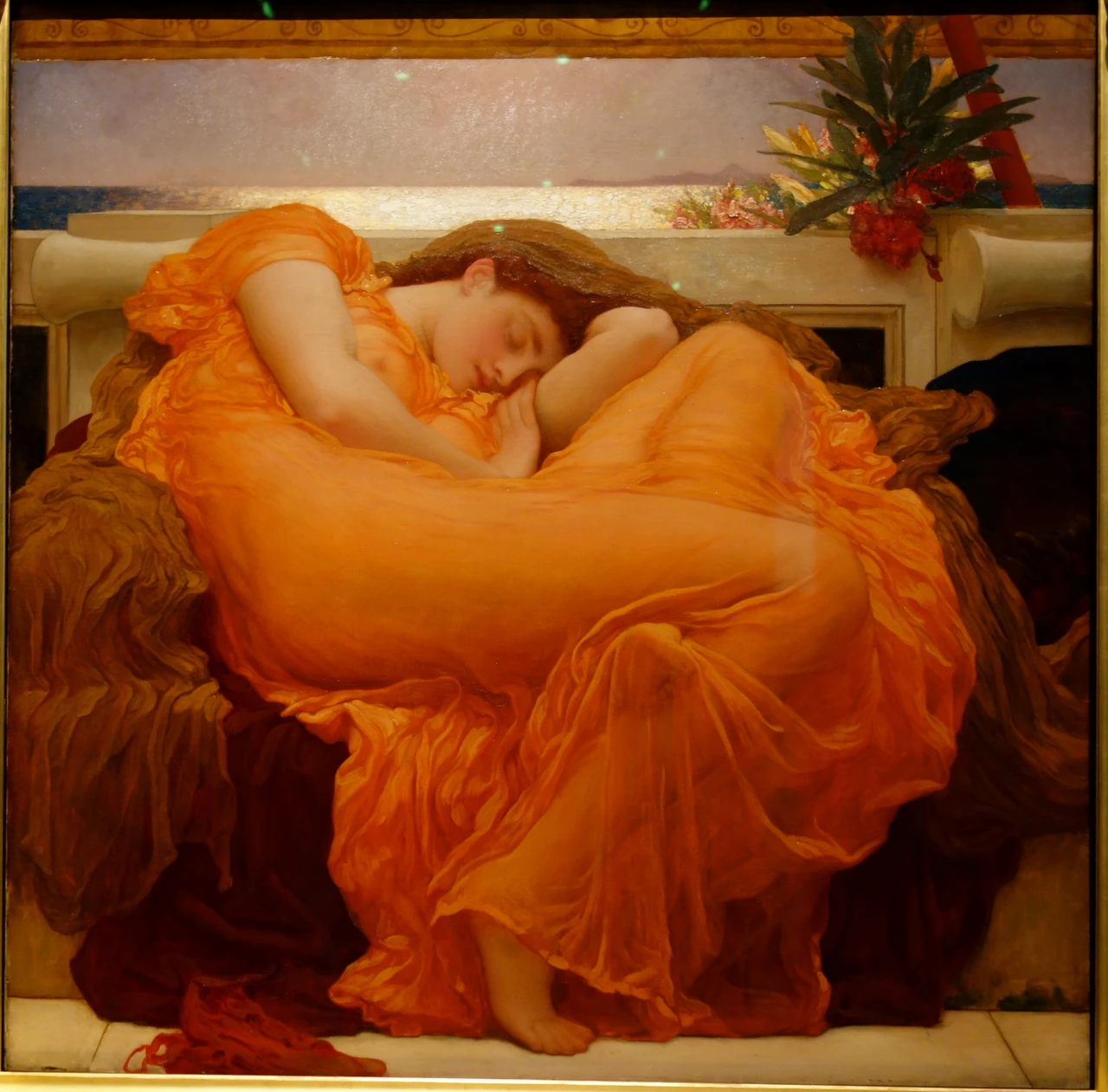
The knee rises toward the bowed head; the arm closes the space between them. Cloth follows that folded shape and then drops toward the bottom edge. The resulting movement feels circular inside a square boundary. It is not simply a standing portrait turned sideways.
Above the figure, horizontal bands of pale architecture and water interrupt the orange mass. A darker plant occupies the upper right. These quieter areas give the eye somewhere to go after it encounters the dress. At the bottom, the visible foot helps the body remain understandable beneath the fabric.
This is why a tall, narrow crop can misrepresent the picture. It may preserve the sleeping face while losing the shape formed by the legs and drapery. A very tight crop also changes the balance between the figure and the space above her. If you need such a detail for a cover or screen, show it as a detail rather than implying that Leighton painted a vertical composition.
The tiny green light marks visible in this particular photograph are photographic reflections, not symbols painted by Leighton. We have left them intact. This file is useful for discussing the composition and its rights, but should not be advertised as a colour-calibrated, reflection-free museum scan.
The study is another object
Leighton House describes a small colour sketch, approximately 11 × 11 cm, alongside preparatory drawings. Its account notes differences from the finished painting, including an island omitted from the final horizon and changes to the awning.
Those are not merely two resolutions of the same image. A sketch records a stage in making the painting; a photograph records a particular physical object. If an image shows a different arrangement, check whether it depicts that study before concluding that someone has digitally altered the famous canvas.
The same caution applies to a modern copy. A recent artist might repeat the orange dress but alter a hand, invent texture or simplify the background. An attribution to Leighton should describe the source composition, not conceal the identity of a new painter. Keep any copyist, photographer or digital editor separate in the record.
A reproduction, not just an exhibition
For copyright research, the strongest useful detail in Leighton House’s account is its description of The Graphic’s Christmas 1896 reproduction. The museum says the newspaper’s owner, William Luson Thomas, bought the painting and that the image circulated with that edition. This is evidence of a reproduced picture reaching readers, not just the public seeing a canvas in an exhibition.
The account also dates the studio unveiling to April 1895. Keep these events apart: 1895 is the painting and exhibition date; 1896 is the reproduction date reported by this museum source. A short caption that collapses them into “published in 1895” would overstate what we checked.
We have not independently inspected the original newspaper issue and the relevant rights agreement. The museum account gives a substantial early-publication lead, with a named publisher and circulation context, but it is not presented here as a completed legal opinion on the entire publication chain.
An old printed version may also differ in colour from the oil painting. If you reproduce that print, identify it as the historical reproduction rather than as a newly photographed view of the canvas. Its margins, lettering or colour interpretation may be part of the object you are actually showing.
What the country check establishes
Leighton died in 1896, well outside the ordinary UK and EU life-plus-seventy author terms. This explains the bounded conclusion about his painting; it does not assign the same status to every modern photograph.
For the United States, an established nineteenth-century publication would put the composition beyond the ordinary published-work term. Sections 303 and 304 distinguish published and previously unpublished works. A painting’s creation date alone is insufficient, and some qualifying first publications in 1978–2002 receive protection through 2047. Our historical lead is explicit; independent verification of that chain remains incomplete.
The CC0 photograph used here
The exact Commons file page identifies Daderot’s own photograph and an explicit CC0 dedication. Its camera metadata records 31 May 2024, and the source file is 3,300 × 3,252 pixels. The heading’s 1895 date describes the painting, not when a digital camera photographed it.
CC0 waives the contributor’s rights to the extent permitted by law. It is not a warranty clearing rights the contributor does not own. The Commons page separately carries a public-domain assessment for the older work and a note requesting a U.S. tag; that note should not be hidden behind the CC0 label.
Our source is this photograph. No Ponce image-licensing permission was requested or invented. A different file from the museum, an agency or a commercial print seller needs its own check.
Choosing between an illustration and a production file
For a reading page, the photograph supplies a clear, traceable view. For a reproduction sold for its colour and detail, inspect reflections, perspective and painted edges before choosing a source. Permission and production quality are separate questions: a usable licence does not turn a gallery photograph into a perfect printing master.
Keep a credit naming Frederic Leighton, Flaming June, 1895, Museo de Arte de Ponce, 63.0406, followed by photograph Daderot, CC0, its linked source and your changes. If you later replace this with another file, revisit that record instead of carrying the old licence forward unchanged.
Editorial record
About this article
- Author
- Publisher
- GeMarkt
- Published
- Reviewed
- Internal source & rights check. Conducted by GeMarkt Research Review. This is an internal editorial check—not independent peer review.
- Source standard
- Rights guide source standardSeparates the underlying work from the source file, records the review date, and links the evidence used for the conclusion.
Found a claim that needs checking? Report a factual error.