GeMarkt Blog · Reference
Are Gustave Doré’s Divine Comedy Illustrations Public Domain?
Check Doré’s nineteenth-century Dante illustrations by edition, engraver and scan, without confusing them with modern translations or newly edited books.


The short answer
Doré’s historically published nineteenth-century Divine Comedy illustrations are public-domain material, but that does not make every modern Dante book or digital file free to copy. Identify the illustration, its printed edition and the source of the scan separately.
The example here is a complete page from the 1870 German edition of Inferno, held by the National Library of Poland and supplied through a documented Commons file. It is not a scan taken from a recent publisher’s edition. The historical publication dates support the U.S. term assessment; the exact digital file has its own public-domain designation. This guide was checked on 12 October 2026.
Start with the volume, not an image search
Dante’s poem has three parts: Inferno, Purgatorio and Paradiso. Doré’s illustrations reached readers through books, then through later editions, separate prints and reproductions. A title such as “Doré’s Dante” is too broad to identify a particular leaf.
The Bibliothèque nationale de France catalogues the illustrated Inferno of 1861, published by L. Hachette in Paris, with French translation by Pier-Angelo Fiorentino alongside the Italian. The National Institute of Informatics catalogue records Hachette’s Le purgatoire; Le paradis in 1868. These are book-publication records, not dates inferred from a drawing’s style.
The distinction helps when matching an image to a scene. A number printed under an illustration may be a plate number within that edition, not Dante’s canto number. The example below is plate 41 recto in an 1870 volume, but it depicts the Geryon episode associated with Inferno XVII. Recording both avoids a surprisingly easy caption error.
Geryon on an 1870 book page
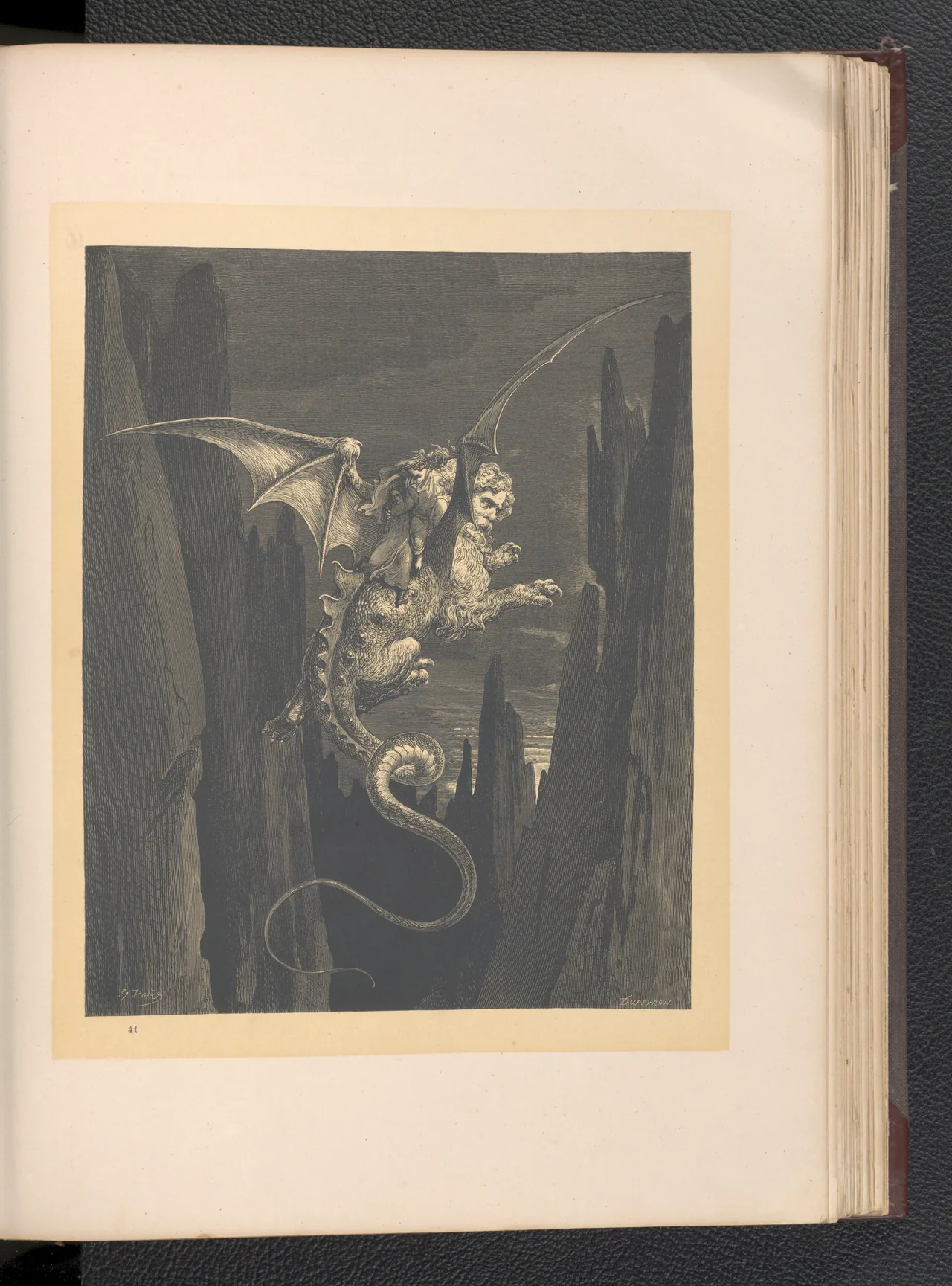
The travellers are small enough to make the monster feel enormous. Geryon’s wings spread across the gap, while his tail bends down into the darker space. Behind them, the rock rises in repeated vertical bands. The two human figures give the scene a scale that the cliffs alone would not provide.
Look closely at the change from pale sky to heavy shadow. The image does not depend on coloured paint. Fine lines, dense black areas and untouched paper produce the sense of distance and weight. At a small size, those marks merge into tone; enlarged, the printed structure becomes easier to see.
For a printed reproduction, check a sample at its intended size before enlarging the page across a wall. A file can be legally reusable yet visually unsuitable: compressed lines can close up, and the paper’s existing marks can become more conspicuous as the image grows.
The page itself also matters. Its warm paper, lower plate number and edges remain visible here. We have not turned it into an apparently spotless original drawing. If a designer later removes the margins, that should be described as an image extraction, not as another historical state of Doré’s composition.
Doré did not make every part alone
Doré supplied designs, but an illustrated book also involved engravers, printers, translators and publishers. Crediting him alone can hide the work that made the pictures printable.
For a different Inferno scene, the BnF’s individual print record explicitly names Doré and Héliodore Pisan, identifies a wood engraving published in 1861, and locates it after page 134. It concerns Canto XXVI, verses 46–48. That is evidence for Pisan’s role on that recorded plate—not permission to attach his name to every Dante illustration. The Geryon page shown here instead bears G. Doré at lower left and a signature reading Dupeyron at lower right. That visible credit belongs in its description, even though the exact contributor attribution and printing technique have not been independently established for this edition.
Later versions can change technique as well as publisher. The Metropolitan Museum’s Geryon record, accession 1976.631.1, describes a 1890 lithograph by Bonnet Dupeyron after Doré. It is not the 1870 book impression above. The shared scene does not make them the same physical object.
These differences are useful rather than pedantic. “A print after Doré in an 1870 edition” tells a reader what they are seeing. “Doré original” could misleadingly suggest a drawing made by his own hand.
What publication establishes
The U.S. analysis rests on the nineteenth-century published illustrations, including the dated book represented by this scan. Those publication dates are well beyond the maximum term described in the Copyright Office’s duration guide. A recently discovered unpublished sketch would require its own analysis; an 1861 or 1870 printing is not evidence that every drawing associated with the project was published then.
Doré died in 1883. The ordinary author term summarised by EU guidance and UK guidance has long elapsed for his contribution. Other credited contributors and particular national rules still belong in an exact-edition review. Dante’s much earlier death is not a substitute for checking Doré, an engraver or a later translator.
Neither conclusion relies on an exhibition date, the present age of a museum or the fact that an image appears online. Those facts do not tell you when reproductions were first distributed or what a current file provider permits.
The scan used here
The exact Commons file identifies the National Library of Poland’s copy, 392.174, and its 1870 Berlin publisher, W. Moeser. Its institutional upload record links to the Polona volume and marks the supplied image with the Public Domain Mark.
The library’s reuse explanation expressly distinguishes public-domain material, which can be reused commercially, from protected works made available under more limited permission. We use the former source record here; we do not treat everything visible in Polona as unrestricted.
The displayed file retains the complete supplied page and has only been proportionally reduced. That source choice matters: another website may offer a contrast-adjusted extraction, while a modern book may add retouching, colour or layout. Do not replace the file silently and assume its documentation follows the substitute.
What a modern edition can still own
A new translation is not made public domain by being printed beside Doré. Nor are a contemporary introduction, newly commissioned illustrations or original editorial additions necessarily free. The Copyright Office explains that qualifying new authorship in a derivative work can be protected without extending ownership over the pre-existing public-domain material.
For example, making your own caption for the historical Geryon image differs from scanning a recent annotated spread complete with its translated verse, notes and page design. Start from the old illustration’s documented source rather than copying more recent material simply because it surrounds an old picture.
A useful record for one plate
Keep the designer, scene, volume title, publisher, year, plate or page number, holding library, exact file page and rights statement together. Where an engraver is named, include that person too; where attribution remains unresolved, say so instead of borrowing a credit from a neighbouring plate.
For this example, that record leads back to the 1870 Die Hölle leaf, not an unspecified “free Dante image.” The Doré artist guide introduces his wider output. For reuse, however, the individual book page remains the most useful starting point.
Editorial record
About this article
- Author
- Publisher
- GeMarkt
- Published
- Reviewed
- Internal source & rights check. Conducted by GeMarkt Research Review. This is an internal editorial check—not independent peer review.
- Source standard
- Rights guide source standardSeparates the underlying work from the source file, records the review date, and links the evidence used for the conclusion.
Found a claim that needs checking? Report a factual error.