GeMarkt Blog · Reference
Is the Arnolfini Portrait by Jan van Eyck Public Domain?
Separate Van Eyck’s 1434 painting from a modern photograph, National Gallery image terms and an early reproduction. Our colour photograph is CC BY-SA 4.0.


The short answer
Van Eyck’s ordinary economic copyright has long expired, but the colour photograph used on this page is licensed CC BY-SA 4.0, not supplied as an unrestricted public-domain file. You can reuse that photograph under its licence, including for commercial purposes, while preserving its attribution and other applicable conditions.
This guide concerns the 1434 painting in London’s National Gallery, accession NG186, and the exact photograph credited below. The check is current to 12 October 2026. It does not declare every museum image, crop, modern reconstruction or publication of the portrait free to use in every country.
The painting is NG186
The National Gallery’s object record identifies Jan van Eyck’s The Arnolfini Portrait, 1434, oil on wood, probably oak, measuring 82.2 × 60 cm. The accession is NG186. The familiar English title is useful, but the inventory number is the firmer identifier when comparing image records.
The scene contains two standing figures, a bed, a window, a hanging chandelier and a convex mirror on the rear wall. A small dog occupies the foreground. These are not incidental identification clues: their arrangement allows a full-view reproduction to be distinguished from a detail or a later copy.
The Gallery qualifies the sitters’ identification rather than treating every traditional name as settled. Its account also explains why the woman’s gathered dress is not proof of pregnancy. Be equally cautious with a caption: “wedding photograph in paint” is an interpretation, not an adequate factual description of what is securely known.
Our story of the Arnolfini Portrait explores those interpretive questions. This page has a different purpose: to identify the work and make the image-use decision intelligible.
Why the complete room matters
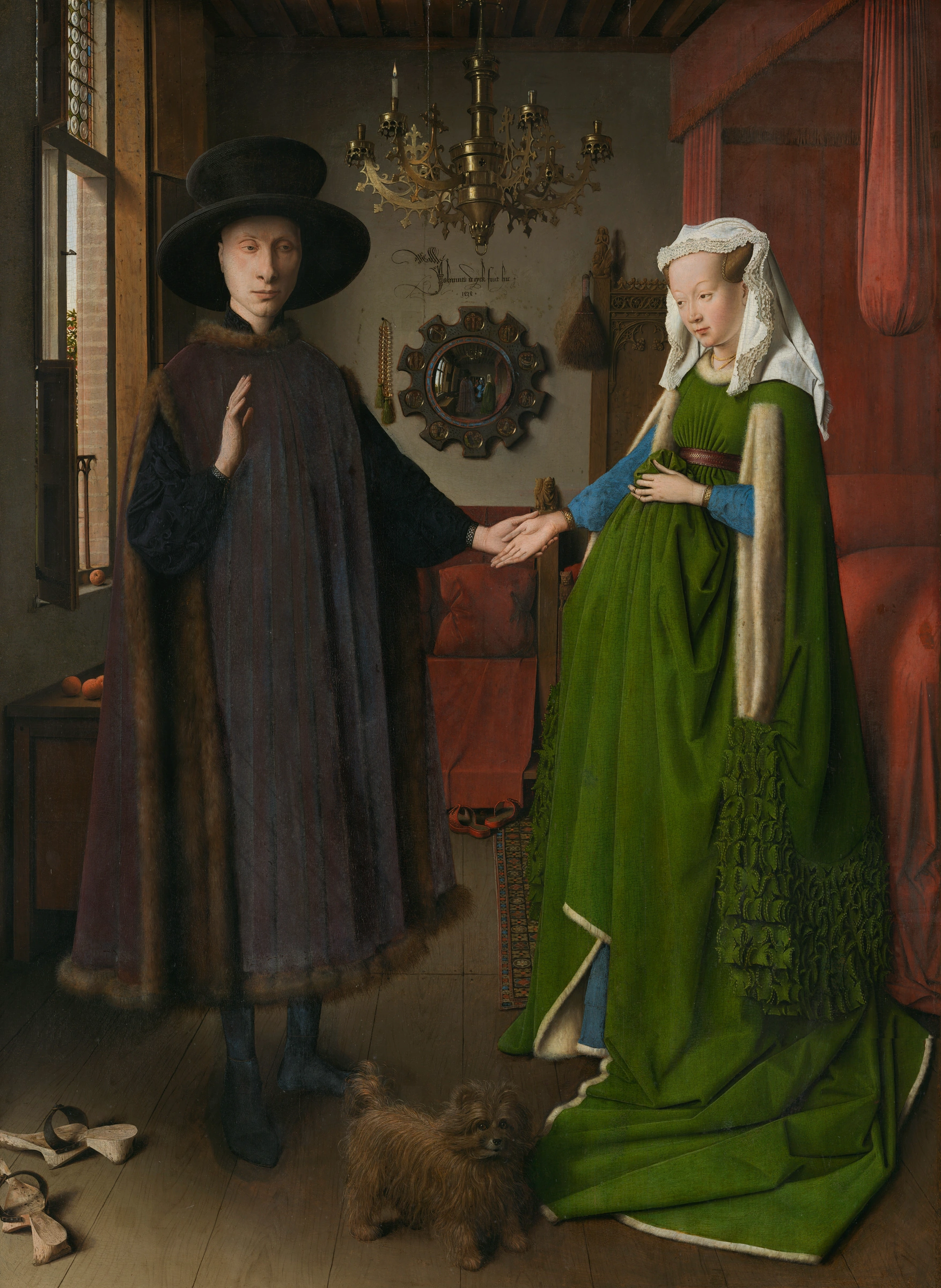
The mirror is near the centre, but the scene does not simply revolve around it. Light enters from the left. The red bed fills the right, and the woman’s green dress extends down into the foreground. Those large areas establish the setting before the tiny reflected figures can be examined.
The two hands meet beneath the mirror. Higher up, the chandelier and inscription create another cluster of details. Lower down, shoes and the dog interrupt the floor. A full reproduction lets a reader move between those levels; a square crop can remove much of the evidence that makes the room interesting.
A mirror detail is valuable when the text discusses reflection, but it needs a label and a link back to the full painting. Enlarging a few blurred pixels cannot recover lettering, faces or brushwork that the photograph did not capture. Do not present generated detail as something Van Eyck painted.
Old painting, new photograph
Van Eyck died in 1441. His ordinary author term has elapsed under the UK and EU duration rules. That is a conclusion about his original artistic work, not the text, layout and photography of a newly published book.
Our selected Commons record identifies Gennadii Saus i Segura as the photographer and the image as his own work. The preserved upload licence and structured record support CC BY-SA 4.0. We retain that attribution-based licence even though the current page also displays a public-domain assessment of the underlying painting.
Those statements concern different layers. The old painter did not take the modern photograph. A reader who sees only “public domain” can easily miss the separate credit and conditions for the photographic file they are about to download.
The National Gallery has separate image terms
The Gallery’s current data and image licensing page distinguishes CC0 for structured data, CC BY 4.0 for narrative text, and CC BY-NC-ND 4.0 for images within the scope of that page. A permissive data field is therefore not evidence that every associated institutional image can be commercially adapted.
That policy is not the source of our photographer’s licence. We do not take a Gallery-supplied image, remove its restrictions and label it with someone else’s Commons credit. Nor do we claim that this independent photograph carries an institutional endorsement or permission covering museum access conditions.
If a project needs the Gallery’s own reproduction or a particular commercial image agreement, follow the terms for that exact supply. For the photograph used here, follow its own source record and licence instead. Keeping those routes separate avoids both overclaiming permission and inventing restrictions that belong to a different file.
What an early reproduction can tell you
The 1434 date tells you when the painting was made. The Gallery’s later acquisition history tells you where it came to be held. Neither fact, alone, reconstructs a legally relevant publication event in the United States.
An identifiable research lead is the monochrome reproduction associated with Hippolyte Fierens-Gevaert’s 1905 La Renaissance septentrionale et les premiers maîtres des Flandres, preserved in the Internet Archive’s Getty Research Institute copy. A separate Commons extraction identifies the portrait within that scanned volume. It is not the modern colour photograph displayed here.

The U.S. Copyright Office distinguishes exhibition from publication; authorised sale or distribution may be relevant. A dated book illustration is a concrete lead for examining distribution and authorisation, not a reason to skip those questions. This article does not claim a completed independent U.S. publication analysis of the underlying panel.
The U.S. duration provisions treat historical published and previously unpublished works differently. We report the old reproduction as evidence and keep the modern photo’s licence separate, rather than making its permission depend on an invented publication date.
Using this colour photograph
CC BY-SA 4.0 allows sharing and adaptation, including commercial use, subject to its conditions. Credit the photographer, link to the source and licence, and indicate relevant changes. If you share an adaptation of the photograph, the ShareAlike condition applies to that adaptation; it does not automatically relicense every unrelated sentence on the same page.
For example, a clearly credited mirror crop should also say that it is a crop. Adding a large colour treatment or combining the photograph with other imagery may require a more specific description than “image courtesy of”. Do not suggest that the photographer approves your interpretation or product.
This page presents a reduced full-colour photograph with its composition and colours unchanged. The visible credit records that presentation change without turning the caption into technical processing instructions. If you need the full-resolution source, use the linked file record rather than enlarging our display copy.
Make the credit as specific as the image
Keep Jan van Eyck, The Arnolfini Portrait, 1434, National Gallery NG186 as the object identification. Keep photograph by Gennadii Saus i Segura, CC BY-SA 4.0, with source and licence links, as the file identification. They answer different questions and belong together.
The old painting’s expired author rights do not erase a modern file’s stated licence. Choosing a documented photograph and following its conditions is more useful than relying on the painting’s age alone.
Editorial record
About this article
- Author
- Publisher
- GeMarkt
- Published
- Reviewed
- Internal source & rights check. Conducted by GeMarkt Research Review. This is an internal editorial check—not independent peer review.
- Source standard
- Rights guide source standardSeparates the underlying work from the source file, records the review date, and links the evidence used for the conclusion.
Found a claim that needs checking? Report a factual error.