GeMarkt Blog · Practical guide
Christmas Wall Art from the Public Domain
Choose Christmas wall art that suits your home: a religious painting, a lively winter landscape or a quiet snow scene, with practical framing and display advice.

For Christmas wall art, first decide whether you want a religious subject or a winter picture that can stay up after the holiday. An Adoration scene, Bruegel’s snowy valley and Hiroshige’s village road are not interchangeable decorations. Choose the subject you want to look at, then let the frame and surrounding objects do the seasonal work.
You do not need a whole new gallery wall. One considered change often makes more sense than squeezing several temporary prints among lights, cards and existing paintings. The examples below offer three different approaches, using historical works and identified image sources rather than anonymous festive downloads.
Choose between Christmas and winter
If Christmas has a religious meaning in your home, a painting of the infant Christ or the Magi can give the display a clear centre. Look at the complete scene before choosing it. Some works associated with the season contain complicated narratives, ruins or figures that are easy to miss in a small shop thumbnail.
If you want seasonal decoration without a religious subject, say so in your selection. Snow, bare trees and winter travel can be appropriate personal choices, but they do not turn every landscape into a Christmas painting. That distinction also makes choosing for a shared workplace or a gift less presumptuous.
Decide how long the picture will stay. A print brought out with the tree can be a deliberate annual ritual. A winter landscape might remain until spring, or all year. Neither needs a Christmas slogan added to the artwork to justify its place on the wall.
Bosch gives the room a religious centre
Hieronymus Bosch’s The Adoration of the Magi, dated about 1475 by the Metropolitan Museum of Art, is a vertical painting on oak. Mary and the infant sit within broken architecture while the visitors gather around them. Angels hold a cloth across the upper part of the picture.
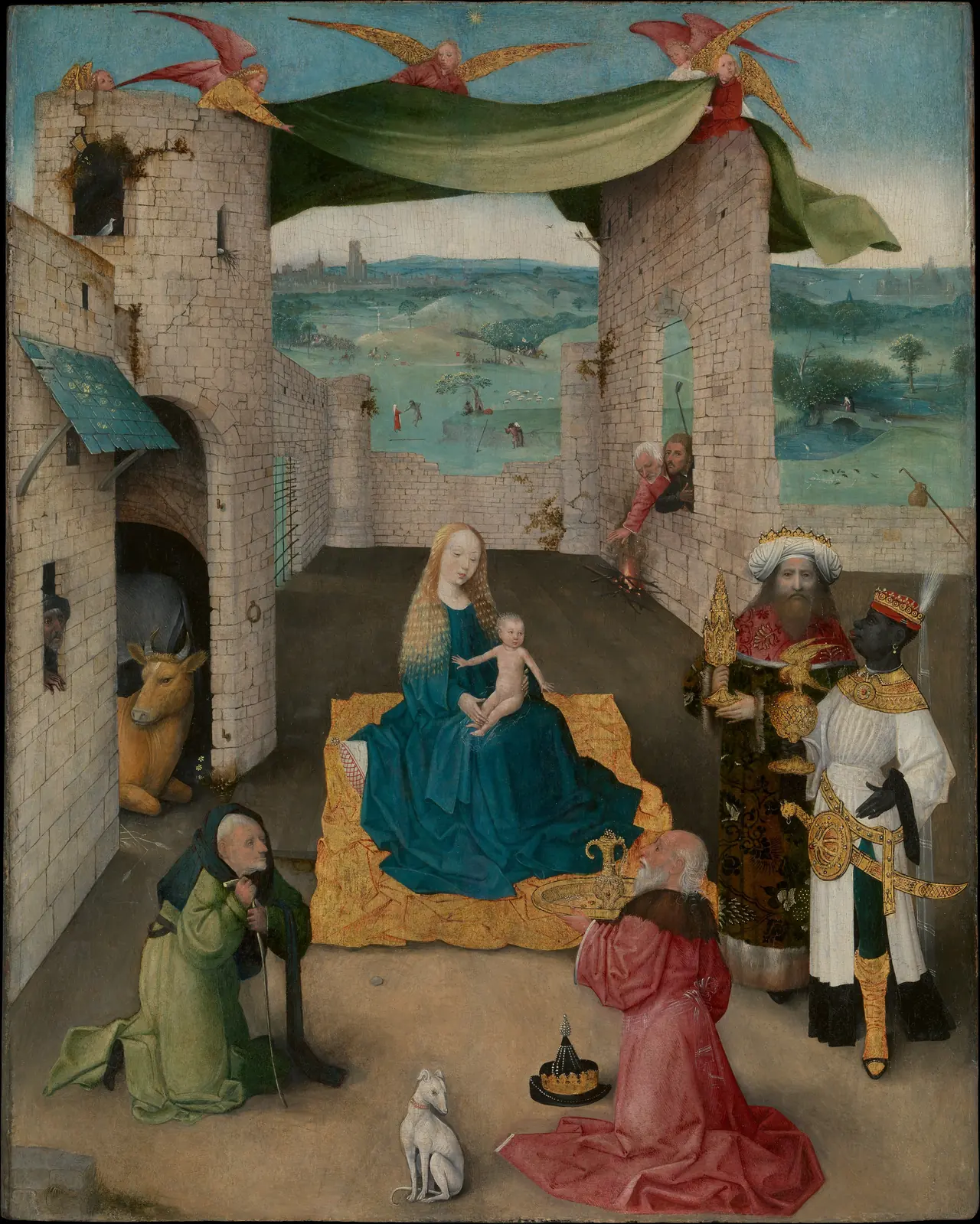
The green canopy, Mary’s blue clothing and the visitors’ red and gold details offer several colours to echo outside the frame. Choose one, rather than surrounding the reproduction with competing red, green and metallic objects. A plain frame can leave the elaborate clothing and architecture to supply the ornament.
This is a picture for looking closely. The small dog, the faces at the window and the landscape beyond the walls disappear if the reproduction is tiny or too high. A side wall beside a chair may serve it better than a narrow gap above a crowded mantel. Keep the full vertical arrangement; cutting off the angels to fit a squat frame changes the scene.
Bruegel offers a world beyond the tree
Pieter Bruegel the Elder’s 1565 Hunters in the Snow (Winter) belongs to a seasonal series. The Kunsthistorisches Museum’s account identifies the winter setting; the painting is not a Nativity scene or a Christmas card design.
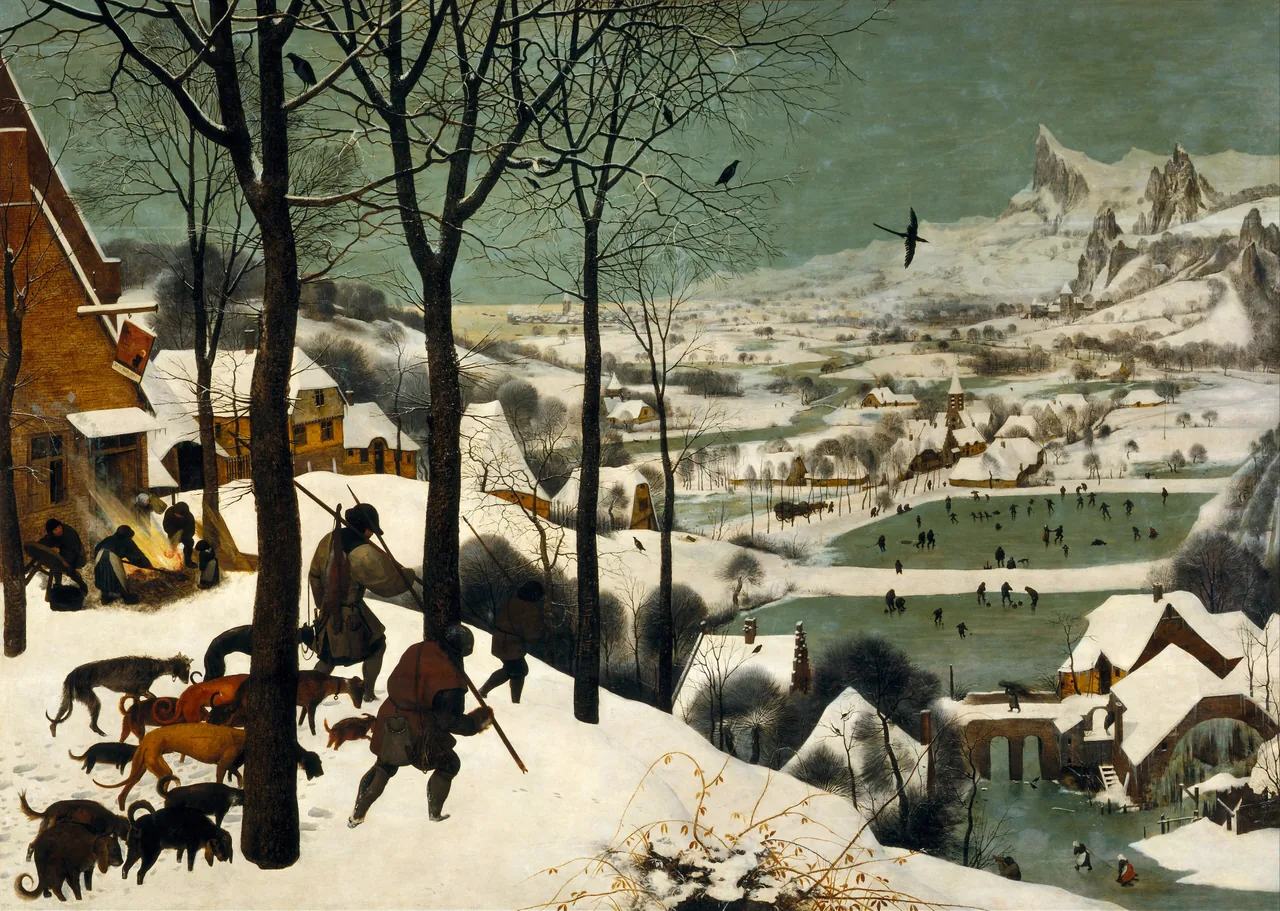

Its long view gives a busy holiday room somewhere else to look. Dark trunks establish the foreground; tiny people occupy the ice below. The landscape’s muted green and cream need not match a bright white artificial tree or red ornaments. Treat it as a separate picture, not a colour sample for the decorations.
The hunting subject is part of the choice. If you do not want hunters and dogs in the display, choose another winter scene rather than cropping them out. For a family room where people enjoy finding small details, a reproduction large enough to inspect can be more rewarding than several smaller snowy pictures.
Hiroshige keeps the decoration spare
Hiroshige’s Kanbara: Evening Snow, about 1833–34, is a Japanese colour woodblock print. The village, travellers and broad snow-covered shapes offer a winter subject without a Christian narrative. Choosing it for December is your decorating decision, not evidence that it was made for Christmas.
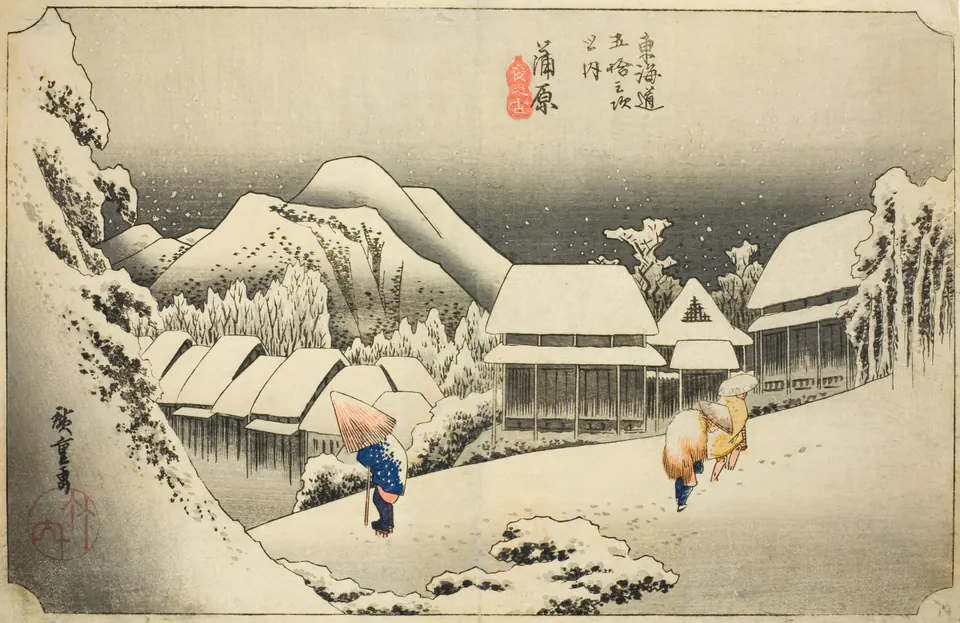
Look at the small blue and yellow areas in the travellers’ clothing. They stop the image being simply black and white. A cream mat and a restrained dark frame are possibilities, but compare them with the actual reproduction rather than assuming a standard “Japanese” framing style.
Keep the inscriptions and visible paper boundaries when assessing the image. A snow scene can already feel spacious without removing the marks that make it a particular print. If your room is full of patterned wrapping paper and cards, leaving clear wall around this one image may be enough.
Make space for the picture you chose
Plan the wall after allowing for the tree, opened doors and places where people gather. A print that looked clear in November may end up behind branches or reflected fairy lights. Check the view while seated as well as from the doorway; moving a decorative object can be easier than moving a frame.
Use a paper rectangle showing the outer frame size, not only the image size. For example, a proposed frame measuring 50 centimetres across on an 80-centimetre wall strip leaves 15 centimetres at each side when centred. That is a layout calculation, not a rule that the frame will suit the wall or its fixings.
Do not attach garlands to the frame as though it were a hook, or let ornaments rest against the glazing. Keep the display away from candles, heaters and places where water from greenery can reach it. Use fixings appropriate to the particular frame and wall, even for a display intended to last only a few weeks.
Check the image before printing
The age of a painting and the permission attached to a downloaded file are separate questions. Use an identified museum image or a file with a clear reuse statement, and retain the artist, title and source in your records. The captions here identify the files illustrated; an unrelated download carrying the same title is not automatically equivalent.
Inspect the whole file at the size you intend to reproduce. A good-looking thumbnail can hide missing margins, blurred faces or added text. Look especially at Bosch’s small figures and the lines in Hiroshige’s roofs. Do not stretch either image to fill a standard frame. A border or a correctly sized mat is preferable to silently changing its proportions.
If you are comparing print and frame measurements, our guide to art print sizes separates the image, sheet and frame. Those are different dimensions, and the difference matters when you already own the frame.
Plan what happens in January
Before changing the wall, decide where the displaced picture will go. Keep its title and framing details together so that reversing the change is straightforward. If the seasonal print is stored unframed, do not fold it into the decoration box or press it against glitter, adhesive tape and rough cardboard. Follow the material-specific advice in storing unframed prints.
A winter picture need not come down on the same day as the tree. Remove the surrounding holiday objects first and look at it on its own. You may find that Bruegel’s village or Hiroshige’s road belongs in the room for longer. A religious picture can equally remain because it matters to you, without needing a seasonal justification.
The strongest Christmas display is not necessarily the most elaborate. Choose a subject the household welcomes, show it clearly, and leave enough room for the picture to remain a picture.
Editorial record
About this article
- Author
- Publisher
- GeMarkt
- Published
- Reviewed
- Internal source & rights check. Conducted by GeMarkt Research Review. This is an internal editorial check—not independent peer review.
- Source standard
- Buying guide source standardSeparates measured or first-hand evidence from general guidance and keeps practical limits visible.
Found a claim that needs checking? Report a factual error.